
TL;DR — Quick Summary
- Most ISOs skip structured due diligence and pay for it later — usually at exit: the gaps in a white label agreement (data export limits, exit fees, auto-renewal with no renegotiation window, narrow indemnification) are invisible at signing and expensive at termination. A 20-point checklist applied before signature converts those hidden risks into negotiation points while you still have leverage.
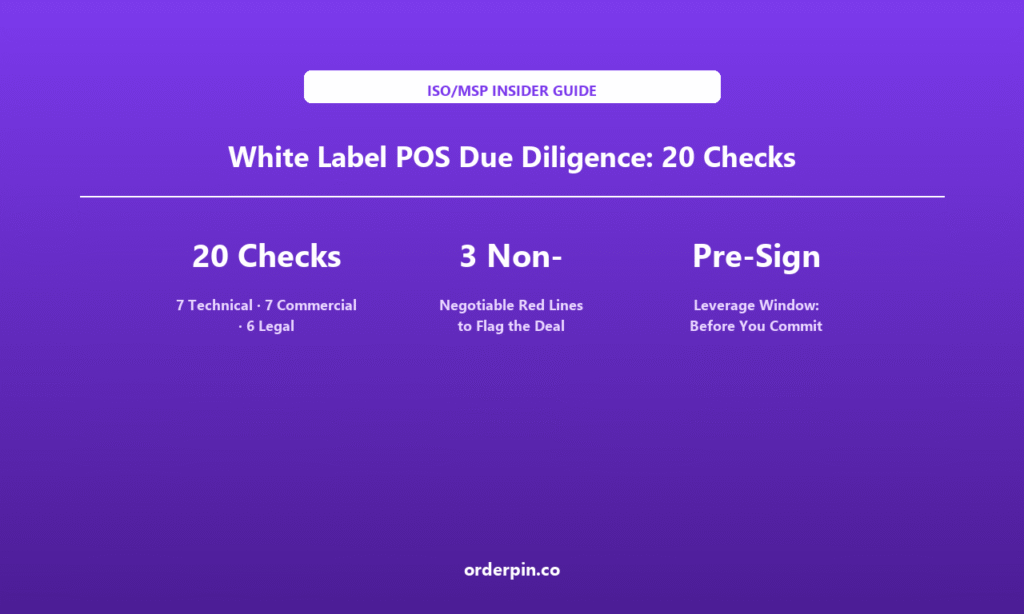
- The 20 checks split into three dimensions — and the legal dimension is the one ISOs most often skip: Technical (7 checks: API, sandbox, uptime SLA, data portability, webhooks, mobile SDK, PCI posture), Commercial (7 checks: MRR minimums, rate-card transparency, escalation clauses, exit fees, renegotiation windows, volume-tier pricing, hardware lock-in), and Legal (6 checks: IP ownership, DPA, PCI liability allocation, indemnification scope, termination enforceability, non-compete scope). The legal checks are where the most expensive surprises live — liability allocation and termination clauses decide who eats the risk when something goes wrong.
- Three checks are non-negotiable — flag the deal if any fails: (1) data export portability in a documented machine-readable format at any time; (2) a mutual, enforceable termination-for-convenience clause; (3) a DPA that restricts the vendor and its sub-processors from using merchant data for training or resale. Without these three, you do not own your merchant relationship — you are renting it, and the landlord can change the terms.
· 6 Legal
to Flag the Deal
Before You Commit
Why ISOs Need a Structured Due Diligence Checklist
The white label POS sales motion is designed to get you to sign. The demo is polished, the headline pricing looks competitive, and the onboarding promise is enthusiastic. None of that tells you what happens in month 13 when you want to renegotiate, in month 24 when you want to export your data, or in month 36 when you want to leave. The agreement — not the demo — is the document that governs your business for the life of the relationship.
This checklist is organized into three dimensions because the risks live in all three. A platform can be technically excellent and commercially predatory; commercially fair and legally one-sided; legally sound and technically incomplete. You need all 20 checks before you sign. Each check below lists what to look for and what a failing answer means for your business.
7 checks
really? 7 checks
6 checks
is before signature
Technical Due Diligence — Checks 1–7
Commercial Due Diligence — Checks 8–14
Legal Due Diligence — Checks 15–20
How to Run This Checklist in Practice
Apply the 20 checks during the contract review, not after signing. For each check, write down the vendor’s answer and whether it passes, fails, or is unclear. Anything unclear becomes a question for the vendor before signature. Anything that fails becomes a negotiation point — and if a non-negotiable red line fails (data portability, mutual termination, DPA), you should walk away regardless of how good the demo was.
The checklist is not about finding a perfect vendor — every platform has tradeoffs. It is about knowing what the tradeoffs are before you commit your merchant base, so you can price the risk, negotiate the terms, and avoid the surprises that destroy ISOs at exit. The three non-negotiable red lines are the floor; everything else is a judgment call you make with open eyes.
How OrderPin Stacks Up on the 20-Point Checklist
OrderPin is a white-label POS platform built for ISO and MSP partners. On the three non-negotiable red lines: OrderPin provides full data export portability in machine-readable formats at any time, mutual termination clauses in its ISO agreements, and a clear DPA restricting the use of merchant data for training or resale. The technical, commercial, and legal terms are designed so the ISO owns the merchant relationship and the exit path — not the other way around. If you are running this 20-point checklist against OrderPin or any other platform, we encourage you to ask every vendor the same 20 questions and compare the answers side by side.
Frequently Asked Questions
Which of the 20 checks are the most important to run first?
The three non-negotiable red lines: data export portability (can you get all your data out in a machine-readable format at any time without vendor assistance?), a mutual and enforceable termination-for-convenience clause, and a DPA that restricts the vendor and its sub-processors from using merchant data for training or resale. These three decide whether you own your merchant relationship or are renting it. If any of the three fails, flag the deal regardless of how competitive the rest of the terms look. They are the first checks to run because they are the most expensive to discover missing after signing.
What does a “failing” answer on data portability actually look like?
A failing answer is any version of “we provide data export on termination for a fee” or “export is available in our proprietary format with vendor assistance.” That is not portability — it is a hostage situation. True portability means: (1) you can initiate the export yourself through the API or dashboard at any time, not just at termination; (2) the format is documented and machine-readable (CSV, JSON, or a documented API schema), not a proprietary binary that requires vendor decoding; and (3) there is no per-export fee that scales with your merchant base. If exporting your own data requires paying the vendor and waiting for them to process it, you do not own the data.
How should an ISO use this checklist during contract negotiation?
Run the 20 checks during the contract review, before signing. For each check, write down the vendor’s answer and classify it as pass, fail, or unclear. Unclear answers become questions for the vendor; failing answers become negotiation points. The leverage window is before signature — once you have committed your merchant base, your ability to negotiate drops sharply. Bring the written answers to the negotiation table; a vendor that is evasive on check 04 (data portability), 17 (PCI liability), or 19 (termination enforceability) is telling you where the risk lives.
Why is the legal dimension more important than technical for most ISOs?
Technical gaps can usually be worked around with engineering effort; legal gaps cannot be worked around at all — they are contractual facts. A missing API endpoint is annoying; a one-sided termination clause or narrow indemnification is existential. The legal checks (15–20) decide who eats the risk when something goes wrong: a breach, a compliance failure, a dispute with a merchant. ISOs skip legal review because it is less tangible than a demo, but the legal dimension is where the most expensive surprises live. If you only have time to review one dimension deeply, review the legal one.
What is the difference between a sandbox and a staging environment?
A sandbox is a full, isolated test environment with its own test data, API credentials, and (ideally) production-equivalent functionality that you control and can use before and after signing to build and test integrations. A “staging environment upon request” is a vendor-controlled space, often with limited functionality, limited data, and access granted at the vendor’s discretion — typically after contract. The distinction matters because you need to build and test your integrations before you commit merchants to the platform, not after. Check 02 fails if sandbox access is not available before signature.
Should an ISO walk away if a non-negotiable check fails but everything else is great?
Yes — and this is the hardest discipline in due diligence. A great demo, competitive pricing, and strong technical capabilities do not offset a missing data portability right, a non-mutual termination clause, or a DPA that grants training rights on merchant data. Those three failures mean you do not control your own merchant relationship, and at exit you will discover that the leverage was never yours. The cost of walking away from a great-looking deal is one deal; the cost of discovering you cannot leave a bad contract with 200 merchants on it is your business. The three red lines are non-negotiable precisely because the downside of skipping them is unbounded.
Most ISOs skip structured due diligence on white label POS agreements and pay for it at exit — when the leverage is gone and the gaps are contractual facts. This 20-point checklist across Technical (7), Commercial (7), and Legal (6) dimensions converts hidden risks into negotiation points while you still have leverage. The three non-negotiable red lines — data export portability, mutual termination, and a restrictive DPA — decide whether you own your merchant relationship or are renting it. If any of the three fails, walk away regardless of the demo. Apply the checklist during contract review, document every answer, and negotiate from a position of knowing exactly where the risk lives. OrderPin is a white-label POS platform built for ISO and MSP partners — with data portability, mutual termination, and a clear DPA as standard terms, because owning the merchant relationship should be the ISO’s by default, not the vendor’s by contract.
About OrderPin
OrderPin is a white-label POS platform built for ISO and MSP partners. We offer full data ownership, flexible pricing, and seamless API integrations to help you build a recurring revenue business under your own brand. Learn more about OrderPin’s white-label solution