
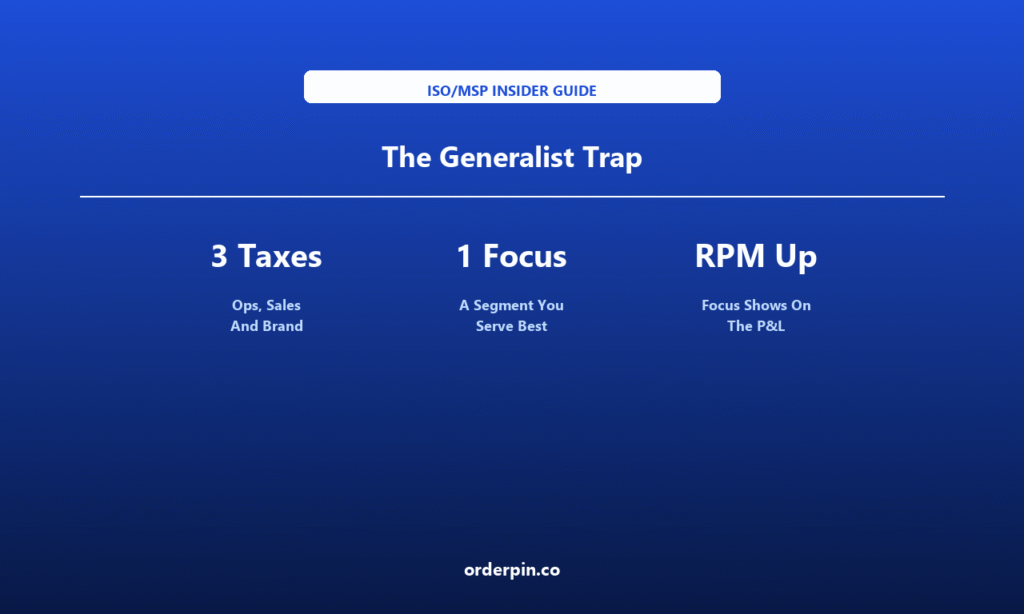
TL;DR — Quick Summary
- Being everything to everyone is a tax, not a strategy: An ISO that serves every merchant type competes on price, because nothing about it is specific to anyone. The cost does not show up as a line item — it shows up as complexity, wasted selling effort, and a brand no merchant can describe.
- The generalist tax is paid in three places: Operational complexity (every vertical needs different support and integrations), sales inefficiency (a pitch diluted until it resonates with no one), and brand confusion (merchants cannot say what the ISO is best at). Each one quietly erodes margin.
- Focus is a margin decision: Narrowing to a defined segment cuts support cost, sharpens the sales message, and raises revenue per merchant — without abandoning the book you already have. Specialization is not a marketing repackaging; it is how a payments business stops competing on rate.
And Brand
Serve Best
On The P&L
Why “Everyone” Is a Strategy That Fails Quietly
Ask an ISO who it serves and the answer is often “SMBs” — which is not an answer. It is a refusal to choose. The refusal feels safe: a broad market cannot reject you, and every prospect is technically in scope. But a market that includes everyone also includes every competitor, and the only ground left to fight on is price. That is the generalist trap: the more merchants you claim to serve, the more interchangeable you become.
The reason this strategy fails quietly is that the cost is diffuse. No single decision to serve a new vertical looks expensive; the expense accumulates in the background — in the support scripts that must cover every edge case, in the pitch that must hedge, in the brand that must mean nothing in particular in order to mean something to everyone. By the time the ISO notices, it is competing on rate against operators who built a focused offer and can therefore afford to win on more than price. This article names the three places the generalist tax is paid, and why removing it is a margin decision rather than a marketing one.
A New Edge Case
Resonates With No One
Can Describe
Serve Better
1. The Generalist Trap: Why Broad Feels Safe and Costs Money
Broad positioning defers a decision you cannot avoid: An ISO that claims every merchant avoids the discomfort of turning business away — but it also avoids the compounding advantage of being known for something. The market still forces a choice; the generalist just ends up competing on price instead of on fit.
The tax compounds, which is why it is missed: No single vertical, integration, or support script looks costly on its own. The cost emerges from their sum — a business that must be competent at everything and excellent at nothing, carrying the overhead of every segment it nominally serves.
2. Tax One: Operational Complexity
Every vertical multiplies the edge cases: A restaurant needs menu integrations and split payments; a retailer needs inventory and returns; a service business needs invoicing and recurring billing. Supporting all three well means maintaining three sets of workflows, three support playbooks, and three onboarding paths — and the cost of that complexity is charged to every merchant, in every segment.
Complexity is an unmeasured gross-margin tax: Support tickets, one-off integrations, exceptions, and documentation all grow faster than merchant count when you spread across verticals. Most ISOs never price it, so the tax stays invisible — right up to the point where a focused competitor undercuts them and still earns more per merchant.
3. Tax Two: Sales Inefficiency
A pitch built for everyone lands with no one: When the value proposition must cover every merchant type, it stops being a value proposition and becomes a feature list. Prospects hear a generalist and assume a generalist — competent, unremarkable, replaceable. A focused competitor tells one story that fits the merchant exactly, and wins the conversation before price comes up.
Dilution shows up as a longer, weaker funnel: Generalists chase more leads, run more demos, and convert fewer — because they cannot pre-qualify on fit the way a specialist can. The extra activity looks like effort; it is actually the cost of not being able to say no.
4. Tax Three: Brand Confusion
If merchants cannot describe you, they cannot refer you: Referral is the cheapest acquisition channel an ISO has, and it runs entirely on a merchant being able to finish one sentence: “You should call them because they’re the ones who…” A generalist cannot finish that sentence, so every referral is vague and unqualified — the channel works, but only at a fraction of its power.
Confusion is expensive because it is paid in price: A merchant who cannot articulate why you are the better choice defaults to comparing on rate — because rate is the only dimension left uncontested. Brand clarity is not decoration; it is what keeps the deal off the spreadsheet.
5. Choosing a Focus Without Abandoning Your Book
Focus the go-to-market, not the service: You do not have to fire existing merchants in other verticals. Keep serving them, but point all new acquisition, messaging, and product investment at the one segment where you can be materially better than everyone else. Focus is about where you aim, not who you are allowed to serve.
Let the data pick the segment: Find the vertical where your revenue per merchant is highest, support burden lowest, and retention longest — that is where focus pays fastest. It is usually already visible in the book; you are just choosing to act on it.
Reinvest the savings into depth: The complexity, selling effort, and brand confusion you remove are resources — redeploy them into the workflows, integrations, and expertise that make you the obvious choice in one segment. That is the compounding that generalists cannot access.
Treat focus as a margin program: This is the same thesis as the specialization shift in AC38 and the merchant-qualification discipline in AC61 — the ISO stops competing on rate by becoming the one that fits best.
Generalist vs. Focused ISO
| Dimension | Generalist | Focused |
|---|---|---|
| Market | “SMBs” | A defined segment |
| Competitive Ground | Rate | Fit & expertise |
| Operations | Every vertical’s edge cases | Deep in one workflow |
| Sales Pitch | A feature list | One specific story |
| Referrals | Vague, unqualified | “They’re the ones who…” |
How OrderPin Lets an ISO Lead With Focus
OrderPin is a white-label POS platform built for ISO and MSP partners. Focus is only credible when the product behind it is actually tailored to a segment — and a white-label platform lets you tailor it without rebuilding from scratch.
- Own the product, shape the fit: Because the platform is yours to brand and configure, you can build the workflows of one vertical and become the obvious specialist instead of one of many generalists.
- See which segment pays: Owning the data means revenue per merchant, support burden, and retention are visible by segment, so focus is chosen from evidence rather than instinct.
- Serve the whole book without diluting the pitch: Flexible pricing and API integrations let you keep every existing merchant while pointing all new go-to-market at the segment you serve best.
- Escape the rate conversation: When the offer is specific and the platform is yours, price stops being the only dimension left — which is the entire point of focus.
Frequently Asked Questions
What does “being everything to everyone” actually cost an ISO?
It costs margin in three places: operational complexity (every vertical adds support scripts, workflows, and edge cases), sales inefficiency (a pitch so broad it resonates with no one, leading to longer funnels and lower conversion), and brand confusion (merchants cannot describe you, so both referrals and differentiation suffer). The cost is real but diffuse, which is why it is often missed until a focused competitor undercuts you and still earns more per merchant.
Isn’t focusing on one segment risky?
Focus is about where you aim, not who you are allowed to serve. You keep supporting existing merchants in other verticals while pointing all new acquisition, messaging, and product investment at the segment where you can be materially better. The risk of focus is visible and manageable; the risk of being a generalist — competing on rate forever — is the one that quietly compounds.
How do I choose which segment to focus on?
Let the data pick it. Find the vertical where your revenue per merchant is highest, support burden is lowest, and retention is longest — that is where focus pays fastest, and it is usually already visible in your own book. You are not inventing a market; you are choosing to act on a pattern your portfolio already contains.
How long before focus shows up in the numbers?
The sales and brand effects show up fastest — a sharper pitch and clearer referrals within a couple of quarters. The operational payoff is slower but larger: as the product and support get tailored to one segment, support cost per merchant falls and revenue per merchant rises. Judge it on revenue per merchant and retention, not on logo count in the first month.
Is this just repositioning, or does it require real change?
Real change. Repositioning without operational change produces a promise you cannot keep. Focus requires you to actually build the workflows, integrations, and expertise of one segment, and to point product investment at it — otherwise you have only added a tagline to a generalist. The margin improvement comes from the operational depth, not the wording.
How does a white-label POS platform support a focused strategy?
It lets you tailor the product to a segment without building a platform from scratch. Because you own the white-label platform, you can configure the workflows of one vertical and brand them as your own, while owning the data that shows which segment pays best. That combination is what turns focus from a marketing choice into a margin program. OrderPin is built for that kind of ownership.
Being everything to everyone is not a strategy — it is a tax with three payment dates. Operational complexity charges you for every vertical’s edge cases, sales inefficiency charges you for a pitch too broad to resonate, and brand confusion charges you in rate, because a merchant who cannot articulate why you are better defaults to comparing prices. None of these show up as line items, which is exactly why the generalist trap is so easy to fall into and so expensive to leave. The fix is focus — but focus the go-to-market, not the service: keep your existing book, point all new acquisition and product investment at the segment where your revenue per merchant is highest and support burden lowest, and reinvest the complexity you remove into depth. That is a margin decision, not a marketing one, and it is the same thesis behind the specialization shift in AC38 and the merchant-qualification discipline in AC61. OrderPin is a white-label POS platform built for ISO and MSP partners — letting you tailor the product to a segment, see which one pays from your own data, and serve the whole book without diluting the pitch, so you stop competing on rate by becoming the one that fits best.
About OrderPin
OrderPin is a white-label POS platform built for ISO and MSP partners. We offer full data ownership, flexible pricing, and seamless API integrations to help you build a recurring revenue business under your own brand. Learn more about OrderPin’s white-label solution