
TL;DR — Quick Summary
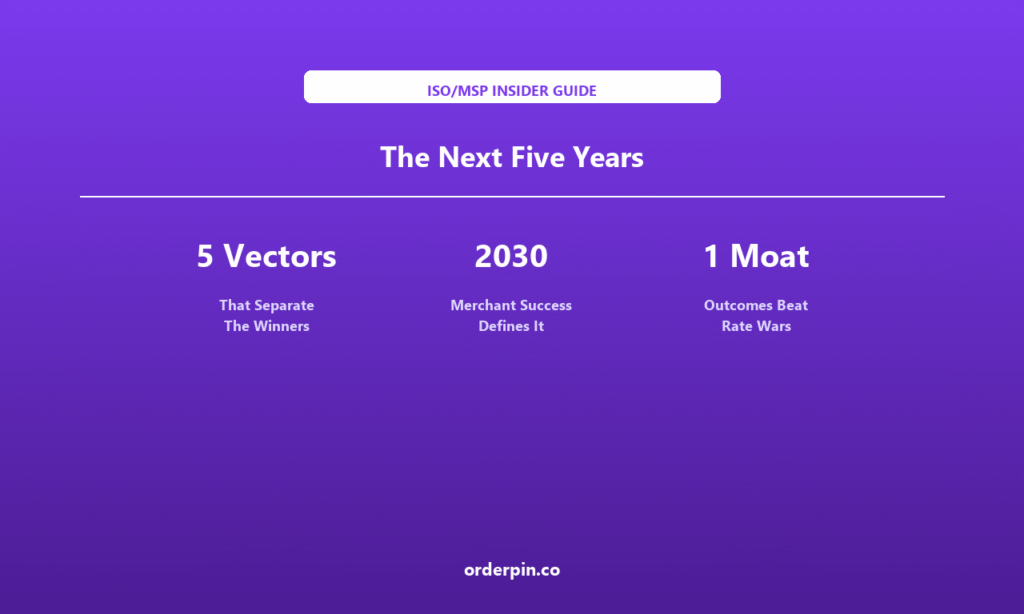
- Rate and speed are dead as differentiators: Every provider can price low and process fast; both are commodities that any competitor can match in a week. Over the next five years, competing on rate is a race to the bottom, and the ISOs that win will compete on something far harder to copy.
- Five vectors separate the winners: Technology depth, service experience, industry specialization, partnerships, and merchant success. Four of them are capabilities; the fifth — merchant success — is the through-line that determines whether the other four actually produce a moat.
- Merchant success is the moat: Providers win when their merchants win. A provider measured by merchant outcomes rather than processing volume builds retention, pricing power, and referrals that a rate-war competitor cannot buy — and that compounding is the differentiation of the next five years.
The Winners
Success Defines
Is The Through-Line
Why the Old Differentiators Are Already Gone
For twenty years, merchant service providers differentiated on two things: rate and processing speed. Both are gone. Rate has been compressed to the floor by competition and by merchants who now know exactly what everyone charges; processing speed has become table stakes that every modern processor delivers. Neither is a moat anymore, because neither is hard to copy. A competitor can match your price in an afternoon and your speed with a better contract through the same rails.
What replaces them is not another feature — it is a shift in what a provider is for. The dumb-pipe trap and the specialization shift are already redrawing the map: providers that stay pure payment processors get commoditized into a utility, while providers that build real capabilities around the merchant escape the race to the bottom. Over the next five years, differentiation will come from five vectors — technology depth, service experience, industry specialization, partnerships, and merchant success — and the last one is the through-line that decides whether the other four compound into a moat or fade into features.
The Terminal
No Rate Matches
One Vertical
That Compounds
1. Technology Depth: Owning the Stack, Not Renting It
The terminal is not the product — the platform is: Processing volume flows through a terminal, but the differentiator is everything around it: POS software, ordering, loyalty, analytics, integrations. Providers that own the platform control the merchant’s daily workflow; providers that merely resell a terminal are a pipe with a markup. Technology depth means you can deploy, integrate, and extend under your own brand instead of waiting on someone else’s roadmap.
Control the data, and you control the relationship: The provider that owns the transaction and software data knows the merchant’s business better than anyone — and can act on it with pricing, product, and service. That is why owning the stack matters far beyond features: it is the foundation that makes service, specialization, and merchant success possible at all.
2. Service Experience: The One Thing Rate Can Never Match
Service is where merchants actually feel the difference: Rate is a number a merchant can compare in a spreadsheet; service is an experience they cannot. In a market where pricing has converged, the provider that answers fast, resolves problems the first time, and treats support as a product — not a cost center — wins the relationship on something a competitor cannot buy down.
Service converts to retention, and retention to margin: Merchants do not leave a provider that answers them for a few basis points elsewhere — they leave one that ignored them. Support-driven churn is the clearest signal that service is a differentiator, because it is the part of churn a provider can actually control. Service is the moat that shows up on the P&L as lower attrition.
3. Industry Specialization: Deep Beats Wide
Generalists compete on price; specialists compete on fit: A provider that serves every merchant type is forced to differentiate on rate, because nothing else about them is specific to anyone. A provider that owns a vertical — restaurants, retail, professional services, healthcare — can build workflows, integrations, and expertise that a generalist cannot replicate, and can charge for that fit.
Specialization raises the cost of switching: When your platform speaks the merchant’s industry — its menu, its inventory, its scheduling, its compliance — leaving is no longer a payments decision, it is an operations decision. That specificity is the difference between a provider a merchant tolerates and one a merchant depends on.
4. Partnerships: Distribution That Compounds
Channels beat cold outreach over five years: A direct sales team scales linearly with headcount; a channel of aligned partners scales with the partners’ own growth. Over a five-year horizon, distribution is the multiplier — the provider whose partners keep referring long after the launch outgrows the one that re-earns every merchant from scratch.
But only enabled partnerships compound: Partnership quantity is worthless without quality. The partners that matter get a real product to sell, aligned incentives, and a named owner on your side. Feed a few partners deeply and they keep producing; sign dozens and neglect them and you have a roster of logos, not a channel.
5. Merchant Success: The Through-Line That Ties Them Together
Four vectors are capabilities; merchant success is the outcome they serve: Technology depth, service experience, specialization, and partnerships are all means. Merchant success — merchants growing revenue, saving time, and staying — is the end. A provider that measures itself by merchant outcomes makes every other vector smarter, because each capability is judged by whether it actually helps the merchant win.
The measurement shift is the real change: The ISOs that lead in 2030 will be measured by merchant outcomes — retention, revenue per merchant, software penetration — not by processing volume. That is not a rebranding; it is a different operating model, where the whole organization is pointed at whether merchants succeed, because in a commoditized market that is the only thing left to compete on.
Merchant success is the moat a rate-war cannot breach: A competitor can match your price and your speed, but it cannot buy your merchants’ success. Retention earned through outcomes, pricing power earned through stickiness, and referrals earned through results are a compounding advantage — the one differentiator that gets stronger the longer you hold it.
It ties together everything in the playbook: The dumb-pipe trap, the specialization shift, the retention mechanisms, the executive dashboard of leading metrics, and the partnership diagnostic are not separate ideas — they are all expressions of one thesis: providers win when they build around merchant success. Over the next five years, that is the difference between a pipe and a partner.
The Old Moat vs. The Next Five Years
| Dimension | Yesterday’s Differentiator | Next Five Years |
|---|---|---|
| Primary Battlefield | Rate & processing speed | Merchant outcomes |
| Product | A terminal | An owned platform |
| Positioning | Every merchant type | A vertical, deeply |
| Growth Engine | Direct sales headcount | Enabled partner channel |
| The Scoreboard | Processing volume | Retention & revenue per merchant |
How OrderPin Helps ISOs Build the Moat of the Next Five Years
OrderPin is a white-label POS platform built for ISO and MSP partners. Every one of the five differentiation vectors starts with the same prerequisite — owning your platform and your merchant relationship. That is exactly what a white-label model gives you.
- Technology depth: Own a POS platform you can brand, deploy, and extend — so you control the merchant’s workflow instead of reselling someone else’s terminal.
- Service experience: Owning support and the platform means you decide how fast and how well merchants are served — the differentiator a rate-war competitor cannot match.
- Industry specialization: Flexible pricing and API integrations let you tailor the platform to a vertical and speak your merchants’ industry language.
- Partnerships and merchant success: Because you own the platform, data, and economics, you can align partner incentives and measure everything by merchant outcomes — retention, revenue per merchant, and software penetration.
Frequently Asked Questions
Why is rate no longer a real differentiator?
Because it is a commodity that any competitor can match quickly, and merchants now know exactly what everyone charges. Competing on rate is a race to the bottom that erodes your own margin while buying no loyalty. Over the next five years the providers that win will compete on things that are hard to copy — technology depth, service, specialization, partnerships, and above all merchant success.
What are the five differentiation vectors for merchant service providers?
Technology depth (owning the platform rather than renting a terminal), service experience (the one thing rate cannot match), industry specialization (deep in a vertical beats wide across all), partnerships (distribution that compounds), and merchant success (the through-line that ties the other four into a moat).
Why is merchant success described as the through-line?
Because the other four vectors are capabilities, and merchant success is the outcome they exist to serve. A provider that measures itself by merchant outcomes — retention, revenue per merchant, software penetration — makes each capability smarter, because every investment is judged by whether it actually helps the merchant grow. That discipline turns features into a moat.
What is the dumb-pipe trap?
It is the fate of a provider that stays a pure payment processor: as rate and speed commoditize, it gets compressed into a utility that earns a thin spread and competes on nothing else. Escaping the trap means building capabilities around the merchant — software, service, specialization, and partnerships — so you are no longer interchangeable with the cheapest pipe.
Should an ISO specialize or serve every vertical?
Specialize. A generalist is forced to compete on price because nothing about them is specific to anyone, while a specialist builds workflows, integrations, and expertise a generalist cannot replicate — and can charge for that fit. Specialization also raises switching costs: when your platform speaks the merchant’s industry, leaving becomes an operations decision, not a payments one.
How does a white-label POS platform create a moat?
It gives the ISO ownership of the platform, the merchant relationship, and the data under its own brand. That ownership is the prerequisite for all five vectors: you can control the technology, deliver the service, tailor for a vertical, align partners on shared outcomes, and measure everything by merchant success. A competitor can match your rate, but it cannot buy your merchants’ success. OrderPin is built for that kind of provider.
The differentiators of the last twenty years — rate and processing speed — are already gone, because both are commodities any competitor can match. Over the next five years, merchant service providers will be separated by five vectors: technology depth (owning the platform rather than renting a terminal), service experience (the one thing rate can never match), industry specialization (deep in a vertical beats wide across all), partnerships (distribution that compounds when enabled), and merchant success. Of these, merchant success is not just another vector — it is the through-line that decides whether the other four compound into a moat or fade into features, because a provider that measures itself by merchant outcomes builds retention, pricing power, and referrals that no rate-war competitor can buy. OrderPin is a white-label POS platform built for ISO and MSP partners — giving you ownership of the platform, the merchant relationship, and the data, so you can build the moat that the next five years reward.
About OrderPin
OrderPin is a white-label POS platform built for ISO and MSP partners. We offer full data ownership, flexible pricing, and seamless API integrations to help you build a recurring revenue business under your own brand. Learn more about OrderPin’s white-label solution