
TL;DR — Quick Summary
- Growth comes from subtraction: The ISOs that grow fastest are the ones that sign fewer, better-fit merchants. Volume-first ISOs say yes to every logo, then quietly absorb the support cost, churn, and concentration risk of merchants that were never a good fit. Saying no is not lost revenue — it is avoided loss.
- A bad-fit merchant is expensive: The wrong merchant drains support hours, produces low revenue per merchant, churns early, and drags down the margin of the whole book. One bad-fit merchant can cost more than several good ones earn. Volume hides that cost until the residual checks stop growing.
- Make qualification a system, not a vibe: Define an ideal-merchant profile, write a disqualification checklist, and give sales the authority — and the incentive — to walk away. A written qualification process turns a gut-feel judgment into something repeatable, trainable, and defensible.
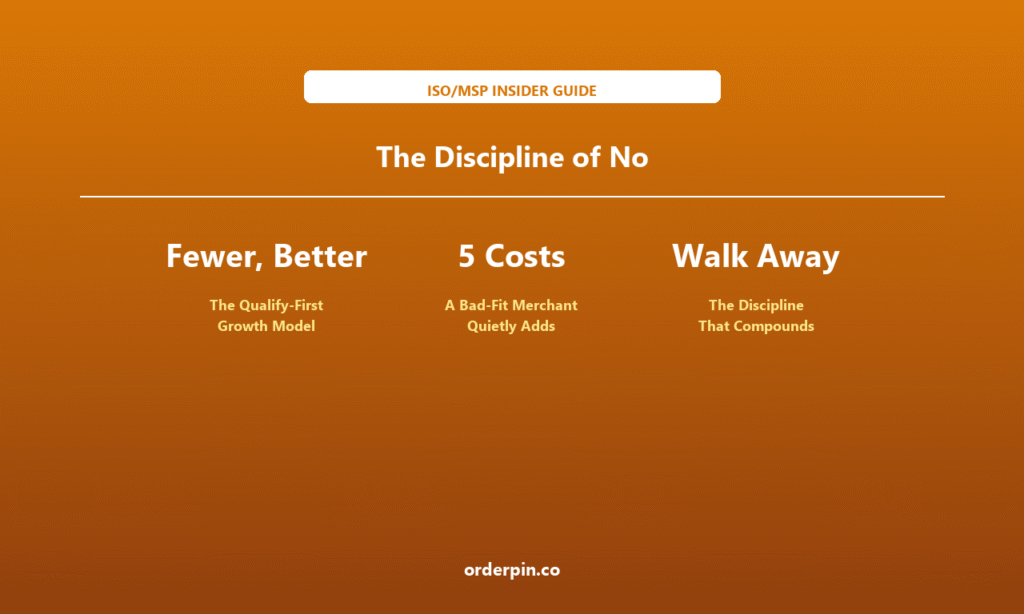
Growth Model
Quietly Adds
That Compounds
Why the Fastest-Growing ISOs Say No the Most
Most ISOs measure growth at the front door: how many merchants signed this month. The ISOs that actually compound measure it at the back door too — how many merchants were worth signing. The difference between the two is qualification. One treats every merchant as revenue; the other treats a bad-fit merchant as a future cost with a revenue label attached. Over a few years, that single difference decides which book gets stronger and which one just gets bigger.
Volume-first growth feels productive because the cost is invisible at signing. A merchant who signed but does not fit looks identical to a good one on the day the deal closes — the difference shows up three, six, twelve months later, as support tickets, early churn, disputed fees, and a merchant who never adopts the software. By then the sales team has been paid and moved on. The discipline of saying no is how you refuse to buy that future cost today, and it is the highest-leverage decision an ISO makes about the shape of its portfolio.
Before The Close
Not Just Volume
Per Dollar Earned
Stay Past Year One
1. Why Volume-First Growth Punishes You Later
Volume is the easiest number to grow and the hardest to profit from: Gross merchant count responds to effort — more calls, more agents, more leads. But a signed merchant is not a profitable merchant, and the gap between the two grows in silence. ISOs that optimize headcount and logos end up with a large, expensive, low-margin book that looks impressive on a slide and thin on a P&L.
The cost arrives after the commission: The sales team is paid when the deal closes; the support load, churn, and rework arrive months later, charged to a different budget and a different team. That timing gap is why bad-fit merchants keep getting signed: the person who pays the cost is never the person who made the decision.
2. The True Cost of a Bad-Fit Merchant
Quantify it, and the math changes the behavior: Add up the support hours the merchant consumes, the onboarding time that never converts to adoption, the chargebacks and disputes, the early-termination cost, and the opportunity cost of the sales and support capacity they displace. Priced honestly, a bad-fit merchant can consume more margin than several good ones produce — and that number, put in front of the sales team, changes what they are willing to sign.
Bad fit also concentrates risk: Merchants that should never have been onboarded are the ones most likely to churn, dispute, or leave abruptly — and because they were signed for volume, they often cluster in segments the ISO does not serve well. That combination turns a portion of the book into a standing risk rather than an asset.
3. Building an Ideal Merchant Profile
Define fit before you define the pitch: An ideal-merchant profile describes the merchant your business is actually built to serve — vertical, size, ticket range, transaction pattern, software appetite, and the willingness to adopt. It is not a wish list; it is a description of who gets the most value from your platform and demands the least that you cannot supply.
Derive the profile from your best merchants, not from a template: Pull the top performers in your book — highest revenue per merchant, lowest support burden, longest tenure, deepest software adoption — and look for what they share. The pattern is usually specific enough to write down, and specific enough to test a new prospect against before a single contract is drafted.
4. The Disqualification Checklist
Write down the reasons to say no: A disqualification checklist is the flip side of the ideal-merchant profile, and it is more useful because it is faster to apply. Red flags: ticket size far below your platform’s sweet spot, a vertical you cannot support well, a merchant that needs a custom integration you will never maintain, a buyer who is choosing purely on rate, or a business whose transaction pattern will never justify the support it will demand.
Give sales permission — and a reason — to walk away: A checklist means nothing if the incentive still rewards signing anything with a pulse. Rebalance commission so that fit and first-year retention matter, not just the signature. When the rep who says no to a bad-fit merchant is not punished for it, qualification stops being a policy and becomes a habit.
5. Making Qualification a Process, Not a Vibe
Bake qualification into the sales process: Put the profile and the checklist into the CRM as required fields, so a deal cannot advance without a fit score. What is measured is what gets done — an unenforced checklist is just a document nobody reads.
Review fit against outcomes: Score merchants at signing, then check their 6- and 12-month revenue per merchant, support load, and churn. If your best-fit scores are not producing your best merchants, the profile is wrong — refine it. Qualification is a feedback loop, not a one-time rule.
Connect it to the portfolio metrics: Qualification is how you move the numbers that matter — revenue per merchant, support burden, and attrition — instead of chasing volume and hoping the rest follows. It is the front-end discipline for the portfolio work in AC52, AC59, and AC64.
Make the no a gift to the book: Every merchant you decline is margin, support capacity, and risk that stays off your P&L. The discipline of saying no is not a brake on growth — it is what makes growth worth having.
Volume-First vs. Qualify-First
| Dimension | Volume-First | Qualify-First |
|---|---|---|
| Sales Target | Merchants signed | Merchants retained |
| Fit Check | None, or gut feel | Written checklist |
| Support Load | Absorbed, unmeasured | Priced against margin |
| Compensation | Pays the signature | Pays fit & retention |
| Portfolio Result | Bigger, thinner book | Smaller, stronger book |
How OrderPin Makes Merchant Qualification Practical
OrderPin is a white-label POS platform built for ISO and MSP partners. Qualification only works when you can define fit in terms of a specific platform and a specific merchant — and that requires owning both.
- Define fit around a known product: When the platform is yours, you know exactly which vertical and merchant profile it serves best — so the ideal-merchant profile describes your business, not a guess.
- Price the support load: Owning support and platform telemetry lets you see the true cost of each merchant, which is what turns “bad fit” from an opinion into a number.
- Serve a tighter niche profitably: Flexible pricing and API integrations let you build a focused offer for one vertical, so saying no does not mean shrinking your market.
- Protect portfolio quality: Because you own the data and economics, you can score merchants by fit and track the outcomes, keeping the book concentrated in the merchants you serve best.
Frequently Asked Questions
Why would an ISO turn away a merchant that wants to sign?
Because a bad-fit merchant is a future cost, not just revenue. They consume support hours, produce low revenue per merchant, churn early, and concentrate risk — often costing more margin than several good merchants produce. The ISO pays the commission at signing and the cost months later, which is exactly why the decision is easy to get wrong.
What is a merchant qualification process?
It is a defined ideal-merchant profile plus a disqualification checklist, applied to every prospect before a deal advances — ideally enforced in the CRM as required fields so it cannot be skipped. Instead of relying on a rep’s gut feel, qualification makes fit a repeatable, trainable, and defensible part of the sales process.
What should be on the disqualification checklist?
The fastest disqualifiers are: a ticket size far below your platform’s sweet spot, a vertical you cannot support well, a demand for a custom integration you will never maintain, a buyer choosing purely on rate, and a transaction pattern that will never justify the support the merchant will need. Each is fast to check and each predicts a costly merchant.
How do I build an ideal merchant profile?
Start from your best merchants, not a template. Pull the top performers by revenue per merchant, support burden, tenure, and software adoption, and look for what they share — vertical, size, ticket range, transaction pattern. That shared pattern is your ideal-merchant profile, and it should be specific enough to test a new prospect against it.
Does qualification hurt sales growth?
Not profitably. It can shrink gross signings while raising net growth, because the merchants you do sign retain longer, buy more, and demand less. The honest way to judge it is on revenue per merchant and first-year retention rather than logo count — and that usually requires rebalancing commission so reps are not punished for walking away.
How does a white-label POS platform help with qualification?
It makes both sides of the equation concrete. Because you own the platform, you know exactly which merchant profile it serves best, so the ideal-merchant profile is grounded in a real product. And because you own support and the data, you can see the true cost of each merchant — which turns “bad fit” from a debate into a number. OrderPin is built for that kind of ownership.
The ISOs that grow fastest are not the ones that sign the most merchants — they are the ones that turn the most away. Volume-first growth feels productive because the cost of a bad-fit merchant is invisible at signing: the commission is paid today, and the support load, early churn, and concentration risk arrive months later, charged to a different team and a different budget. Priced honestly, one bad-fit merchant can consume more margin than several good ones produce. The fix is a system, not a sentiment: define an ideal-merchant profile from your best merchants, write a disqualification checklist, enforce it in the CRM, and rebalance commission so reps are not punished for walking away — then review fit against 6- and 12-month outcomes and refine. Every merchant you decline is margin, support capacity, and risk that stays off your P&L. OrderPin is a white-label POS platform built for ISO and MSP partners — giving you a known product to define fit around, ownership of the data that prices the true cost of a merchant, and the flexibility to serve a tighter niche profitably, so saying no is a growth decision rather than a sacrifice.
About OrderPin
OrderPin is a white-label POS platform built for ISO and MSP partners. We offer full data ownership, flexible pricing, and seamless API integrations to help you build a recurring revenue business under your own brand. Learn more about OrderPin’s white-label solution