
TL;DR — Quick Summary
- There is no structured scoring framework for white label POS vendor evaluation — and that is exactly the problem: most ISOs evaluate platforms using a demo, a price sheet, and a conversation. None of these captures the dimensions that determine long-term margin, merchant retention, and exit flexibility. The result is that ISOs commit to platforms before they can see the tradeoffs clearly, and discover the gaps only after the contract is signed.
- This framework gives ISOs 10 weighted evaluation dimensions and a printable scoring worksheet: the 10 dimensions cover every dimension that matters — from API breadth and uptime SLA (technical), to pricing transparency and exit terms (commercial), to PCI DSS scope and strategic roadmap (legal and strategic). Each ISO weights the dimensions differently depending on their business model, so the framework produces a personalized ranking, not a generic scorecard.
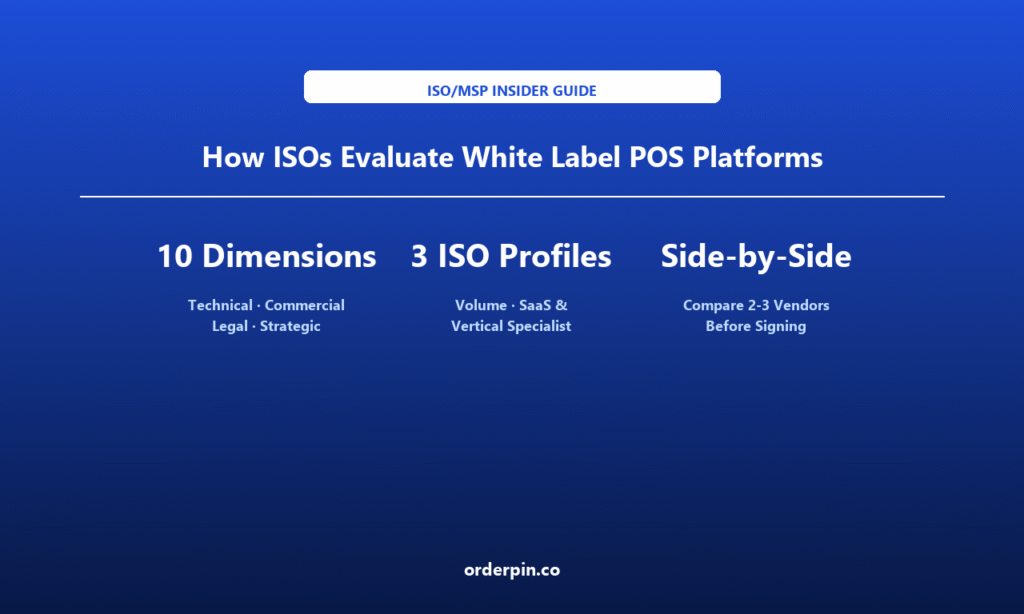
- Use the framework to compare two to three vendors side by side before committing: the goal is not to find the perfect platform — it is to make the decision with the dimensions visible and weighted by your actual priorities. An ISO focused on SaaS recurring revenue will weight onboarding speed and AI features differently than a volume-focused processor. The framework makes the tradeoffs explicit before you sign.
Legal · Strategic
Vertical Specialist
Before Signing
Why ISOs Need a Weighted Scoring Framework
The white label POS evaluation process typically goes like this: a demo, a price sheet, a few reference calls, and a decision. This process is optimized for the vendor — a great demo can obscure pricing complexity, and reference calls are cherry-picked. What it does not produce is a structured view of how each vendor scores across the dimensions that determine your long-term margin, merchant retention, and exit flexibility.
This article provides a 10-dimension scoring framework with a printable worksheet. Each dimension is scored 1–5. Each ISO profile weights the dimensions differently. The result is a personalized ranking that makes the tradeoffs explicit — before you commit your merchant base.
AI Features · Onboarding
White Label Flexibility
Strategic Roadmap
Compare 2–3 Vendors
The 10 Evaluation Dimensions
API Breadth & Quality
Technical · Weight: High (Volume)
Does the platform expose create/read/update/delete for every entity you need — merchants, locations, terminals, menu, orders, payments, refunds, payouts? Are the endpoints documented, stable, and versioned? Score: 1 = partial API, dashboard-only for many operations; 5 = complete, documented, stable API for all entities.
Uptime Reliability & SLA
Technical · Weight: High (All)
What is the contractual uptime SLA, what is the remediation if breached, and is there a public status page? Score: 1 = no SLA, best-effort only; 5 = 99.95%+ SLA with service credits and a public status page with incident history.
Pricing Transparency
Commercial · Weight: High (All)
Is every fee — platform fee, per-transaction rate, add-on pricing, escalation clauses — published in the contract, or subject to separate schedules that can be updated? Score: 1 = opaque pricing with separate schedules and unlimited escalation; 5 = all pricing in the contract with caps on annual escalation.
White Label Flexibility
Commercial · Weight: High (SaaS)
How deeply can you white label — brand domain, app store listing, terminal receipt header, dashboard URL, customer support email? Can you fully own the merchant experience, or does the vendor’s brand appear throughout? Score: 1 = vendor-branded experience with no customization; 5 = fully white-labeled with your domain, brand, and support.
AI Feature Depth
Technical · Weight: High (SaaS/Vertical)
Are the AI features rule-based automation dressed as AI, cloud LLM API calls, or genuinely native models trained on merchant data? Can you evaluate them with a free trial or sandbox? (Detailed evaluation framework in AD6.) Score: 1 = marketing AI with no trial; 5 = genuine AI features with sandbox access and contractually protected data ownership.
Onboarding Speed
Technical · Weight: High (Volume)
How fast can a merchant go live from contract to first transaction? What is the integration timeline for a standard restaurant or retail setup? Score: 1 = 60+ days with custom development; 5 = plug-and-play within days, no custom integration required for standard use cases.
Support Tier & Responsiveness
Commercial · Weight: Medium (All)
What support tier is included — chat-only, email, phone, dedicated account manager? What are the SLA response times for P1 (merchant down) incidents? Score: 1 = community forum only; 5 = dedicated CSM with 15-minute P1 response SLA.
Exit Terms & Data Portability
Commercial · Weight: High (All)
What does it cost to leave — per-merchant exit fees, data export fees, termination penalties? Can you export all data in a machine-readable format at any time? (Detailed in AD7 and AD8.) Score: 1 = high exit fees ($5,000+/merchant) and opaque data export; 5 = no exit fees, full data portability at any time.
PCI DSS Scope
Legal · Weight: High (All)
Is the vendor PCI-DSS Level 1 certified, what is the liability allocation for breaches, and does the DPA restrict the vendor from using merchant data for training? Score: 1 = no attestation, no DPA, no liability carve-out; 5 = Level 1 certified with clear liability allocation and a restrictive DPA protecting merchant data.
Strategic Roadmap & Vision
Strategic · Weight: Medium (SaaS/Vertical)
Does the vendor have a published roadmap, do they share it with partners, and does their vision align with where the ISO business is heading (embedded lending, AI-driven insights, international expansion)? Score: 1 = no roadmap, no partner communication; 5 = published roadmap, quarterly partner briefings, and a product vision aligned with ISO growth vectors.
Scoring Worksheet — Compare Vendors Side by Side
Print this table. Score each vendor 1–5 on each dimension. Multiply by your weight (3 = critical, 2 = important, 1 = nice-to-have) for each ISO profile below. The weighted total tells you which vendor scores highest on your actual priorities.
| Dimension | Weight (Volume) |
Vendor A Score 1-5 |
Vendor B Score 1-5 |
Vendor C Score 1-5 |
|---|---|---|---|---|
| D01 API Breadth | 3 | |||
| D02 Uptime Reliability | 3 | |||
| D03 Pricing Transparency | 3 | |||
| D04 White Label Flexibility | 2 | |||
| D05 AI Feature Depth | 2 | |||
| D06 Onboarding Speed | 3 | |||
| D07 Support Tier | 2 | |||
| D08 Exit Terms | 3 | |||
| D09 PCI DSS Scope | 3 | |||
| D10 Strategic Roadmap | 2 | |||
| WEIGHTED TOTAL |
Weight guide by ISO profile: Volume-focused ISOs — weight D01, D02, D03, D06, D08 at 3; SaaS ISOs — weight D04, D05, D07, D10 at 3; Vertical specialists — weight D05, D07, D09, D10 at 3. Adjust all other weights to 1 or 2 based on your business.
How OrderPin Scores on the 10-Dimension Framework
OrderPin is a white-label POS platform built for ISO and MSP partners. On the framework’s key dimensions: OrderPin provides a complete documented API with sandbox access, 99.95%+ uptime SLA with a public status page, full pricing transparency with all fees in the contract, fully white-labeled deployment, genuine AI features with sandbox evaluation, plug-and-play onboarding, dedicated CSM with defined P1 response SLA, no exit fees with full data portability, PCI-DSS Level 1 certification with clear liability allocation, and a published quarterly partner roadmap. Use the framework to compare OrderPin against any other platform you are evaluating — and see the scores side by side with your own weights applied.
Frequently Asked Questions
What is the right weight profile for my ISO?
It depends on your business model. A volume-focused ISO (processing-first, margin-driven) should weight D01 (API), D02 (uptime), D03 (pricing transparency), D06 (onboarding speed), and D08 (exit terms) most heavily — these determine how fast you can grow and how cheaply you can leave. A SaaS-focused ISO (recurring-revenue-first) should weight D04 (white label flexibility), D05 (AI features), D07 (support tier), and D10 (roadmap) most heavily — these determine how differentiated your offering is and how sticky your merchant relationships become. A vertical specialist (single-vertical focus like healthcare or automotive) should weight D05, D07, D09 (PCI scope), and D10 most heavily. The framework works for all three — you just apply the weights that match your model.
How do I score each dimension objectively?
Score each dimension 1–5 based on evidence, not impressions. Request the specific evidence for each dimension before scoring: for D02 (uptime), ask for the contractual SLA document and check the public status page history; for D03 (pricing), ask for the full contract and rate schedule — not just the one-pager; for D08 (exit terms), ask for the termination section — not just the onboarding pitch; for D05 (AI features), request sandbox access and test the specific features (see AD6 for the evaluation framework). The score is only as objective as the evidence behind it. If the vendor is evasive on a dimension, that itself is information — score it accordingly.
Why does exit terms (D08) get a high weight for all ISO profiles?
Exit terms are weighted heavily regardless of ISO profile because the exit fee and data portability terms determine whether you own or rent your merchant relationship. A vendor with a great demo and opaque exit terms can trap you at scale — and at that point, you are paying for a relationship you cannot leave. The total cost of exit (detailed in AD8) can exceed two years of portfolio margin, which means an unfavorable exit clause is not just a termination risk — it is an ongoing constraint on your negotiating leverage throughout the contract. Every ISO profile should weight D08 at 3 unless they are explicitly comfortable with the exit terms.
What if two vendors score similarly on my weighted framework?
If the weighted totals are within 10% of each other, the framework is telling you that the tradeoffs are genuinely balanced — and the decision should come down to the dimensions where the scores diverge most. Look at the dimensions where one vendor scores 4 or 5 and the other scores 2 or 3. Those gaps are the actionable differences. If the gaps are on dimensions you weight at 3 (critical), those are the dimensions that should drive the final decision. The framework does not eliminate judgment — it makes the judgment explicit and grounded in evidence rather than impression.
Should I share the framework with vendors during evaluation?
Sharing the framework with vendors is optional but strategically useful. Showing a vendor that you are evaluating systematically — with a structured scorecard and explicit weights — signals professionalism and preparation. It also tends to improve the quality of answers you receive: vendors who know you are scoring each dimension are less likely to give vague answers on exit terms, pricing transparency, or SLA specifics. Some ISOs share the framework; others keep it internal and use it only for their own decision. Either approach is valid — the framework’s value comes from the discipline of scoring each dimension with evidence, not from the vendor’s awareness of the process.
How often should I re-score during the contract term?
Re-score annually or when something material changes: a vendor roadmap update, a pricing change, a new competitor entering the market, or a significant shift in your merchant base profile. The weights should evolve as your ISO business evolves — an ISO that started as volume-focused may shift toward SaaS as their merchant base grows and their support capacity increases. The annual re-score is also a forcing function to assess whether the vendor is still the right platform for where you are heading, or whether the gap between your needs and their capabilities has widened. It is easier to renegotiate from a position of knowledge than from a position of obligation.
Most ISOs evaluate white label POS platforms using a demo, a price sheet, and a conversation — and discover the tradeoffs only after signing. This 10-dimension scoring framework makes the evaluation systematic and evidence-based: score each vendor 1–5 on API breadth, uptime reliability, pricing transparency, white label flexibility, AI feature depth, onboarding speed, support tier, exit terms, PCI DSS scope, and strategic roadmap. Weight the dimensions by your ISO profile (volume-focused, SaaS-focused, or vertical-specialist) and compute the weighted total for each vendor. The framework makes the tradeoffs explicit before you commit — so the decision is based on data, not a demo. Run it against every vendor you are seriously considering, including OrderPin. OrderPin is a white-label POS platform built for ISO and MSP partners — with complete API, 99.95%+ uptime SLA, full pricing transparency, no exit fees, and a published quarterly partner roadmap — designed to score well on every dimension in this framework.
About OrderPin
OrderPin is a white-label POS platform built for ISO and MSP partners. We offer full data ownership, flexible pricing, and seamless API integrations to help you build a recurring revenue business under your own brand. Learn more about OrderPin’s white-label solution