
TL;DR — Quick Summary
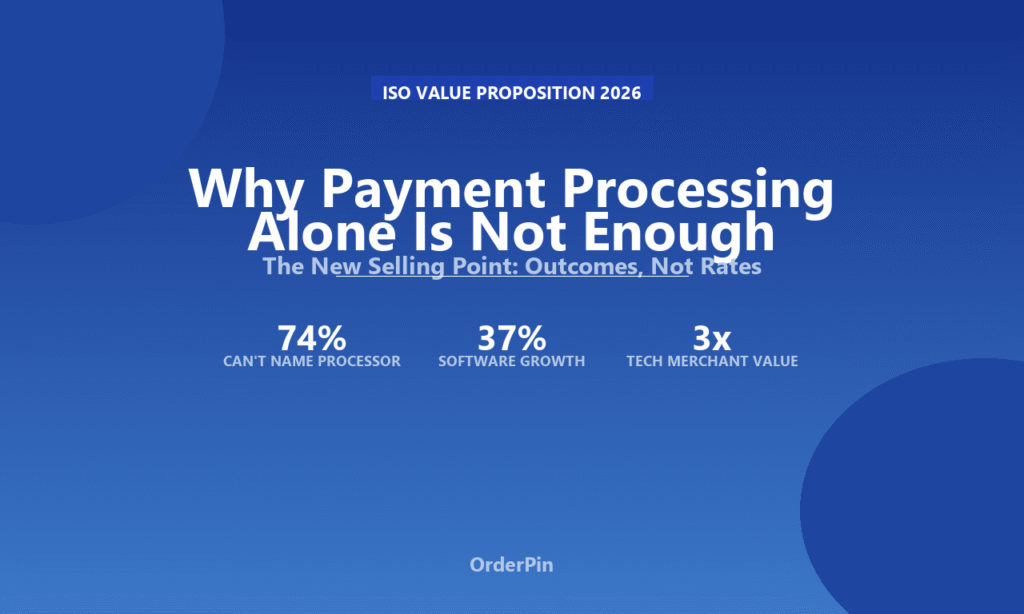
- Payment processing has become a commodity — merchants see it as a utility, not a differentiator. The average merchant can’t name their processor but can name their POS system.
- Hardware margins on terminals have dropped 60%+ since 2020 as Clover, Square, and Toast commoditized the device market. ISOs relying on hardware sales are fighting a losing battle.
- The new selling point is not “lower rates” but “more outcomes” — software that drives revenue, data that reveals opportunities, and embedded services that provide capital.
Ten years ago, an ISO could walk into a merchant and win the deal by showing a lower processing rate. Five years ago, offering a free or subsidized terminal was enough. Today, neither works.
Payment processing is a commodity. Merchants don’t care who processes their transactions as long as it works. What they care about is growing their business — and that requires software, data, and financial services that processing alone cannot provide.
1. The Evidence: Why Processing Is Now a Commodity
| Indicator | 2018 | 2026 | Trend |
|---|---|---|---|
| Merchants who shop rates annually | 22% | 51% | Rising |
| Average processing margin (basis points) | 45 bps | 18 bps | Declining |
| Portfolio multiple for pure processing | 2.5x | 1.5x | Declining |
| Merchants using integrated POS+payments | 18% | 47% | Rising |
| Terminal cost (entry level) | $599 | $199 | Declining |
2. What Merchants Actually Care About
When ISOs pitch “lower processing rates,” they are solving a problem the merchant didn’t know they had — and one they can easily solve with a rate comparison website.
The top merchant priorities in 2026, ranked by TSG merchant surveys:
- Growing revenue — Online ordering, loyalty, marketing automation (cited by 89% of merchants)
- Understanding their data — Reporting, analytics, benchmarking (72%)
- Reducing operational costs — Employee scheduling, inventory management (65%)
- Accessing capital — Working capital, equipment financing (58%)
- Reducing payment costs — Processing rates (51%)
The Insight:
Payment rates rank 5th out of 5 merchant priorities. Yet 80% of ISO sales pitches lead with rate. This mismatch explains why merchant churn is high — you’re solving the wrong problem.
3. The New Value Proposition: Outcomes, Not Rates
Here is how the pitch changes when you lead with outcomes instead of rates:
| Old Pitch | New Pitch |
|---|---|
| “I can save you 0.15% on processing rates” | “I can help you increase repeat customer visits by 30%” |
| “This terminal is $399 with a 3-year lease” | “This POS system includes online ordering, loyalty, and analytics for $99/month” |
| “Our batch settlement is faster” | “I can get you a working capital advance in 48 hours based on your sales data” |
| “We have 24/7 customer support” | “Our dashboard shows you exactly which menu items drive profit” |
4. Revenue Comparison: Rate-Centric vs Outcome-Centric ISO
| Revenue Stream | Rate-Centric ISO (500 merchants) | Outcome-Centric ISO (500 merchants) |
|---|---|---|
| Processing residuals | $240K/yr | $180K/yr (lower rates to compete) |
| Hardware sales/lease | $60K/yr | $20K/yr (subsidized) |
| SaaS subscriptions | $0 | $360K/yr |
| Embedded finance | $0 | $120K/yr |
| Attrition rate | 18% | 8% |
| Total annual revenue (post-churn) | $246K | $607K |
5. 5 Steps to Become an Outcome-Centric ISO
- Audit your pitch deck — Remove all rate comparisons. Replace with outcome statements: “This POS system increases average ticket by 23%”
- Bundle from day one — Never sell processing without at least one software layer. Lead with the software, not the rate
- Hire technology consultants — Your sales team should understand POS, loyalty, analytics, and embedded finance — not just processing
- Partner for outcomes — Partner with a POS platform, a loyalty provider, a capital provider, and an analytics platform
- Measure what matters — Track merchant revenue growth, not just processing volume. Show merchants their ROI from your platform
Bottom Line
Payment processing is a commodity. ISOs who sell it as one are competing on price in a race to the bottom. The winners in 2026 and beyond are those who sell outcomes — software that drives revenue, data that reveals insights, and services that provide capital.
The market is telling ISOs clearly: stop selling terminals and rates. Start selling business growth. The ISOs who make this shift will capture 3x the revenue per merchant and build portfolios that acquirers pay a premium for.
Data sources: The Strawhecker Group (TSG) Merchant Priorities Survey 2026, TSG ISO Benchmarks 2025–2026, McKinsey SMB Payments Landscape 2025, Bond Brand Loyalty Merchant Study 2025. All figures reflect U.S. market.