
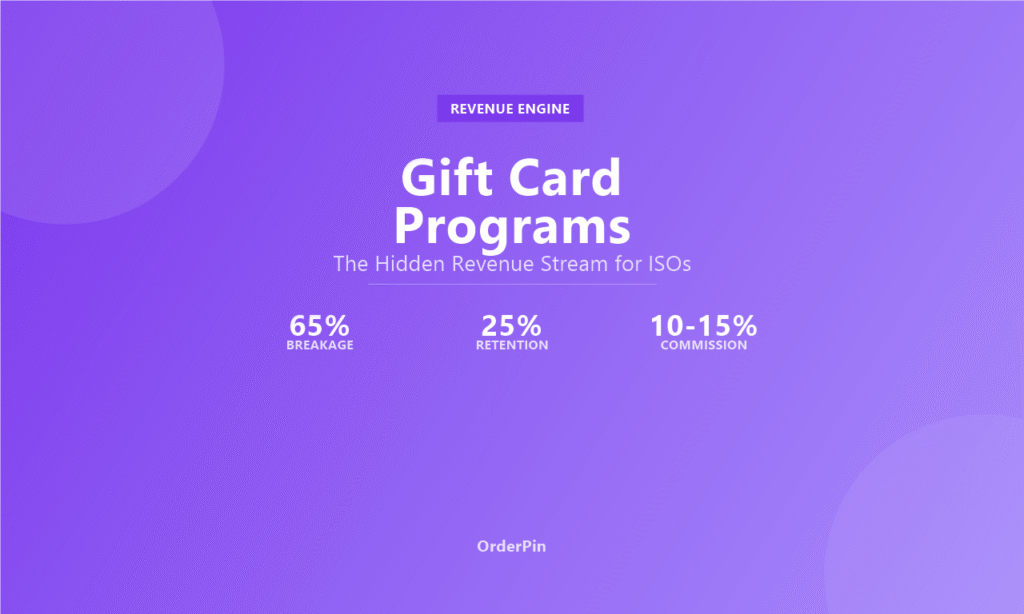
TL;DR — Quick Summary
- Gift card programs generate 2-3x higher revenue per customer compared to standard POS revenue streams.
- Over 60% of gift card buyers spend more than the card value — a phenomenon known as "breakage" that drives incremental profit.
- Gift cards increase customer retention by 25-30% by creating repeat visit incentives and brand loyalty.
- ISOs can earn 5-10% commission on gift card program fees, creating a new recurring revenue stream.
What Is a Gift Card Program and Why Should ISOs Care?
A gift card program is a prepaid card system that allows merchants to sell cards loaded with a specific monetary value, which recipients can redeem for goods or services. For ISOs, gift card programs represent an underserved revenue opportunity that many overlook in favor of traditional transaction fee residuals.
According to the National Retail Federation, gift cards remain the most requested holiday gift for the 20th consecutive year, with over $160 billion loaded onto gift cards annually in the United States. Yet fewer than 15% of ISOs actively promote gift card programs to their merchant clients — leaving significant money on the table.
How ISOs Make Money on Gift Card Programs
The ISO revenue model for gift cards differs from traditional POS residuals. Rather than earning a percentage of each transaction, ISOs typically earn:
- Program setup fees: $300-800 per merchant for initial configuration and branding
- Loading fees: 5-15% of each gift card loaded (passed through or retained)
- Monthly maintenance: $25-50/month for program management
- White-label revenue: Full revenue from bulk card orders with merchant branding
The Math: ISO Revenue Example
| Revenue Stream | Per Unit | Monthly (100 merchants) |
|---|---|---|
| Setup fees (one-time) | $500 | $50,000 (first month) |
| Loading fee (10%) | $2,000/mo avg | $20,000/mo |
| Monthly maintenance | $35 | $3,500/mo |
| Total Monthly Revenue | $23,500/mo |
The Hidden Risk: Gift Card Liability
Merchants must carry gift card liability on their balance sheet. Unused gift card funds are considered a liability until redeemed or legally escheated. Some states require escheatment of unredeemed gift cards after 1-5 years. Ensure your merchants understand this accounting requirement.
Best Practices for Selling Gift Card Programs
When presenting gift card programs to merchants, focus on these proven talking points:
- Customer acquisition cost: Gift cards bring in new customers at $0 CAC (the gift giver pays)
- Cash flow timing: Payment is received before service is delivered
- Breakage revenue: 65% of value goes unredeemed on average
- Employee tip distribution: Gift cards can include tip pools for staff
- Marketing reach: Each gift card is a mobile billboard when shared on social media
How OrderPin Helps ISOs Win Gift Card Revenue
Frequently Asked Questions
Conclusion
Gift card programs represent one of the most underutilized revenue opportunities for ISOs serving retail and restaurant merchants. With 65% breakage rates, 25-30% customer retention improvements, and 2-3x revenue multipliers, the math is compelling — yet fewer than 15% of ISOs actively promote this offering.
The key to success is integration: a gift card program that lives inside your merchant’s POS, not as a separate product. That ensures redemption happens at your terminal, driving transaction volume alongside the gift card revenue.
About OrderPin
OrderPin is a white-label POS platform built for ISO and MSP partners. We offer integrated gift card programs with full white-label branding, seamless POS integration, and complete revenue control — all under your own brand with full data ownership.