
TL;DR — Quick Summary
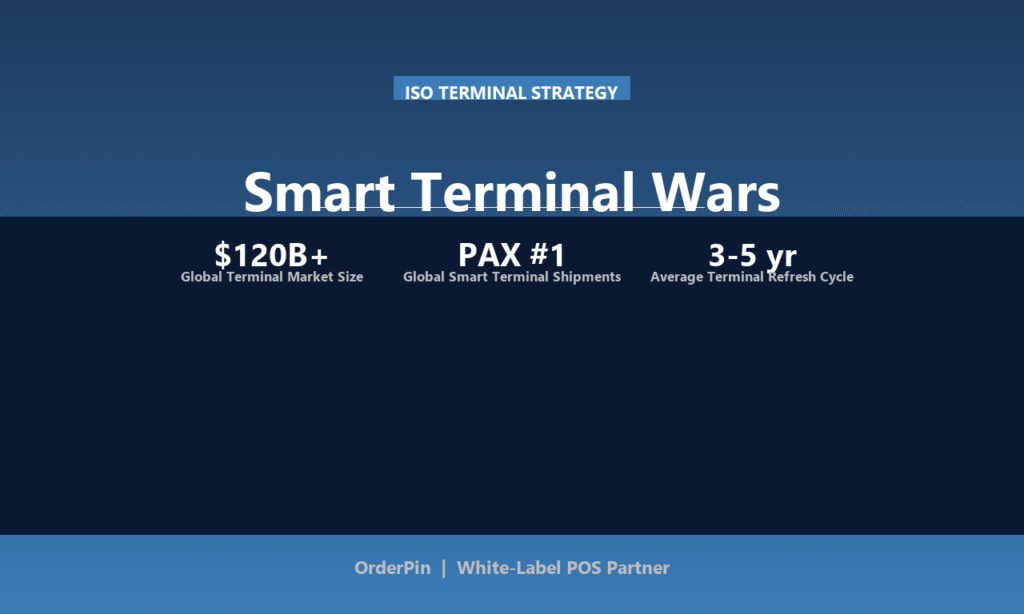
- Key Takeaway 1: The smart POS terminal market exceeds $120 billion, and ISOs who choose the right terminal partner gain a 20–30% advantage in merchant acquisition and retention.
- Key Takeaway 2: PAX leads global shipments, Verifone offers the deepest enterprise integration, and Dejavoo provides the best ISO channel margins — each serves a different portfolio strategy.
- Key Takeaway 3: ISOs should match terminal selection to merchant segment: PAX for volume, Verifone for enterprise, Dejavoo for margin — and ensure their POS software is hardware-agnostic.
What Is the Smart Terminal War — and Why It Matters for ISOs
Smart terminals are internet-connected payment devices that run applications, display rich content, and process transactions beyond simple card swipes. According to RBR’s Global Payment Terminal report, the smart terminal market exceeded $120 billion in 2024, and the three names ISOs encounter most are PAX, Verifone, and Dejavoo.
For ISOs, terminal selection is not a commodity decision. The terminal you deploy determines your hardware cost structure, software compatibility, merchant satisfaction, and residual longevity. A terminal that fails in the field costs you the merchant. A terminal that cannot run your POS software costs you the deal. And a terminal with poor channel margins costs you the profit.
Last updated: May 2026
PAX Technology: The Volume Leader
PAX Technology has become the world’s largest payment terminal manufacturer by shipment volume, overtaking both Ingenico and Verifone in annual unit sales. The PAX A920 Pro and A80 are the most widely deployed smart terminals among independent ISOs in the US market.
Strengths
- Lowest hardware cost: PAX terminals are typically 15–25% cheaper than comparable Verifone models, giving ISOs better unit economics at scale.
- Android-based OS: The PAX A-Series runs Android, enabling easy third-party app deployment through PAXSTORE — including white-label POS software, loyalty programs, and delivery integrations.
- Wide processor certification: PAX terminals are certified with virtually every major US payment processor, reducing deployment friction for ISOs who work with multiple acquirers.
- Strong ISO channel program: PAX has built its US business through the ISO channel, offering competitive pricing, volume rebates, and dedicated ISO account management.
Weaknesses
- Enterprise perception: Some large enterprise merchants still view PAX as a “budget” option compared to Verifone, despite feature parity.
- Security concerns: PAX faced scrutiny in 2021 over alleged security vulnerabilities (later attributed to a misunderstanding), which still lingers in some enterprise security reviews.
- Fragmented app ecosystem: PAXSTORE has many apps, but quality control is inconsistent — some apps are poorly maintained.
Verifone: The Enterprise Incumbent
Verifone, now owned by Francisco Partners after being spun off from Hewlett Packard Enterprise, remains the dominant terminal brand in enterprise retail, petroleum, and large-chain restaurant deployments. The Verifone Engage and MX series are designed for high-volume, multi-lane environments.
Strengths
- Enterprise trust: Verifone is the default choice for Fortune 500 retailers, major gas station chains, and large restaurant groups. The brand carries weight in enterprise RFPs.
- Deep ecosystem integrations: Verifone’s platform integrates natively with major ERP systems, fuel controllers, and self-service kiosk manufacturers.
- Global presence: With operations in 150+ countries, Verifone supports multi-region deployments for international merchants.
- Managed services: Verifone offers end-to-end managed services including deployment, monitoring, and lifecycle management — valuable for large rollouts.
Weaknesses
- Higher hardware cost: Verifone terminals typically cost 20–30% more than PAX equivalents, squeezing ISO margins on hardware sales.
- Closed ecosystem: Verifone’s app marketplace is more restrictive than PAXSTORE, with fewer third-party options and longer certification cycles.
- ISO channel focus: Verifone’s business is primarily direct-to-enterprise, meaning ISO channel programs are less competitive on pricing and support.
- Legacy OS burden: Some Verifone terminals still run proprietary operating systems that limit app deployment flexibility compared to Android-based competitors.
Dejavoo: The ISO Margin Champion
Dejavoo Systems is a smaller, privately-held terminal manufacturer that has carved out a loyal following among independent ISOs by offering the best channel margins in the industry. The Dejavoo QD4 and SP series are popular in the SMB merchant segment.
Strengths
- Highest ISO margins: Dejavoo’s wholesale pricing is 10–20% below PAX, giving ISOs the best hardware margin in the industry.
- ISO-first channel model: Dejavoo only sells through ISOs — no direct sales, no competing with your own vendor for merchant accounts.
- Flexible software certification: Dejavoo works with smaller and regional processors that PAX and Verifone may not prioritize, giving ISOs more acquirer options.
- Custom branding: Dejavoo offers white-label terminal boot screens and packaging, reinforcing the ISO’s brand at the merchant counter.
Weaknesses
- Limited app ecosystem: Dejavoo has no app marketplace comparable to PAXSTORE. Third-party app deployment requires custom development.
- Smaller scale: Dejavoo ships a fraction of PAX’s volume, which means fewer firmware updates, slower feature rollouts, and limited enterprise credibility.
- Processor certification gaps: Not certified with all major processors, which can be a deal-breaker for ISOs working with specific acquirers.
Smart Terminal Comparison for ISOs
| Factor | PAX | Verifone | Dejavoo | Best for ISOs |
|---|---|---|---|---|
| Hardware Cost | $$ | $$$ | $ | Dejavoo |
| ISO Channel Margins | Good | Fair | Best | Dejavoo |
| App Ecosystem | PAXSTORE (500+) | Verifone Cloud (100+) | Minimal | PAX |
| Enterprise Credibility | Good | Excellent | Limited | Verifone |
| Processor Certification | Widest | Broad | Selective | PAX |
| White-Label Support | Good | Limited | Best | Dejavoo |
Terminal Selection Strategy for ISOs
The smartest ISOs do not pick one terminal — they pick a strategy. Here is how to match terminals to your portfolio segments:
Strategy 1: Volume Play — PAX for SMB Portfolio
If your portfolio is 70%+ small and medium merchants (restaurants, retail, services), PAX is your default. The low hardware cost, Android flexibility, and wide processor support mean you can deploy fast, customize the experience, and keep margins healthy on volume deals. Pair PAX terminals with a white-label POS platform like OrderPin for maximum control and recurring revenue.
Strategy 2: Enterprise Play — Verifone for Large Merchants
If you are pursuing chain accounts, petroleum, or multi-lane retailers, Verifone gives you the credibility and ecosystem depth that enterprise IT teams demand. The higher hardware cost is justified by larger deal sizes and longer contract terms. Use Verifone as your premium tier and command higher setup fees.
Strategy 3: Margin Play — Dejavoo for Maximum ISO Profit
If you prioritize hardware margins and brand control, Dejavoo is the clear choice. The ISO-only channel model means no channel conflict, and the white-label branding reinforces your identity at every merchant counter. Best for ISOs with strong processor relationships who do not need the broadest certification coverage.
Strategy 4: Multi-Terminal — Best of All Worlds
The most sophisticated ISOs deploy all three brands, matching the terminal to the merchant segment. PAX for volume, Verifone for enterprise, Dejavoo for margin. This requires managing multiple vendor relationships and inventory, but it maximizes your win rate across every deal type.
Why ISO Partners Choose OrderPin Across All Terminals
API-first architecture works on PAX, Verifone, and Dejavoo — no vendor lock-in
White-label POS runs under your brand on any terminal — your merchants, your data, your margins
No long-term lock-in — switch terminals without switching POS software
Frequently Asked Questions
Which terminal is best for an ISO just starting out?
PAX is the best starting point for most new ISOs. The A920 Pro offers the best balance of cost ($250–$350 wholesale), processor certification breadth, and app ecosystem. Dejavoo is a strong second option if your processor supports it and you prioritize margins over app flexibility.
How do smart terminal costs compare for ISOs?
Typical wholesale pricing for a full-featured smart terminal: Dejavoo QD4 ($200–$280), PAX A920 Pro ($250–$350), Verifone Engage ($350–$500). ISOs typically mark up 30–50% for merchant sales or bundle terminals into lease/subscription models at $30–$60/month.
Can I run OrderPin’s POS software on all three terminals?
Yes. OrderPin’s API-first architecture means the POS software connects to terminals via standard payment APIs, not proprietary integrations. Whether you deploy PAX, Verifone, or Dejavoo, your merchants get the same white-label POS experience under your brand.
What is the typical terminal refresh cycle?
Most ISOs plan for a 3–5 year terminal lifecycle. Key refresh triggers include EMV certification updates, PCI compliance requirements, 5G connectivity upgrades, and merchant demand for new features like QR code acceptance or self-service kiosk integration. Plan your hardware budget around a 4-year average refresh.
Is PAX’s market leadership sustainable?
PAX has sustained its #1 position for 3+ years by aggressively pricing Android-based terminals and investing heavily in the ISO channel. While Verifone and Ingenico (now merged) maintain strong enterprise positions, PAX is likely to remain the dominant ISO-channel brand through 2027 due to its cost advantage and app ecosystem depth.
Conclusion: Pick a Strategy, Not Just a Terminal
The smart terminal war is not about which brand is “best” — it is about which brand serves your ISO business model. PAX dominates the ISO channel with volume pricing and Android flexibility. Verifone commands enterprise accounts with deep integrations and brand trust. Dejavoo wins on ISO margins and white-label control.
The ISOs who win are the ones who match terminal selection to merchant segment and pair it with a hardware-agnostic POS platform that keeps them in control regardless of which terminal sits on the merchant’s counter. Because the terminal is just the entry point — the real value is the recurring revenue from the POS software, payment processing, and value-added services that run on top of it.
Do not let terminal selection limit your business. Choose the hardware that fits the deal, and run your POS platform on whatever terminal wins the merchant.
About OrderPin
OrderPin is a white-label POS platform built for ISO and MSP partners. We offer full data ownership, flexible pricing, and seamless API integrations to help you build a recurring revenue business under your own brand.
Learn more about OrderPin’s white-label solution