
TL;DR — Quick Summary
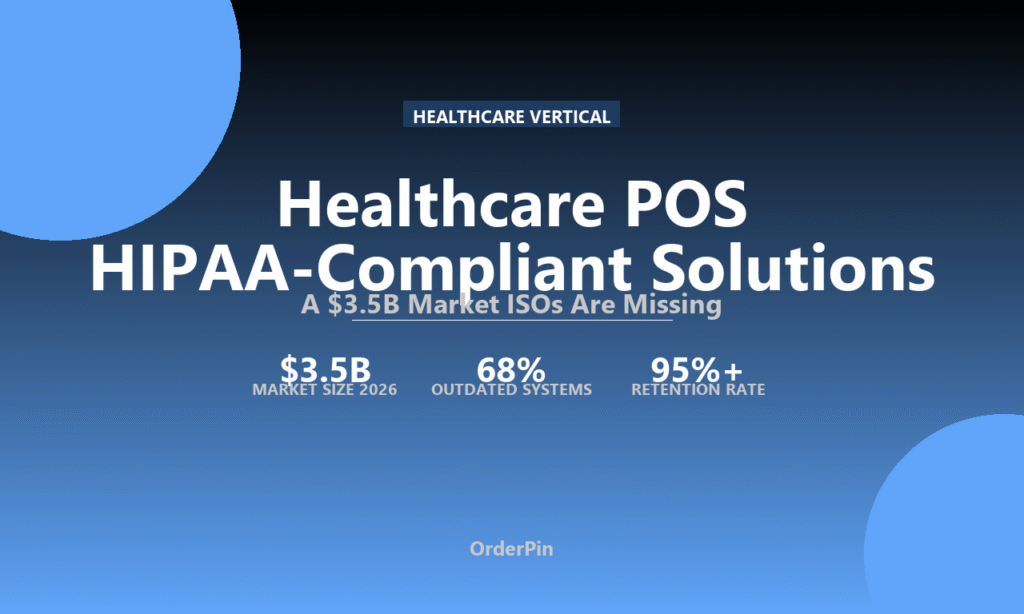
- The healthcare POS market reached $3.5 billion in 2026, with HIPAA compliance being the #1 buying factor for medical practices — yet most ISOs lack healthcare-specific solutions.
- 68% of medical practices still use general-purpose POS systems or paper-based billing, creating a massive opportunity for ISOs with HIPAA-compliant payment platforms.
- Healthcare merchants generate 30-50% higher per-transaction revenue for ISOs compared to standard retail, with 95%+ retention rates for compliant specialists.
Why Healthcare POS Is a $3.5 Billion Opportunity
The healthcare payment ecosystem is uniquely complex. Medical practices must manage patient billing, insurance claims, copay collection, HSA/FSA payments, and payment plans — all while complying with HIPAA privacy rules that significantly restrict how patient payment data can be stored, transmitted, and processed.
Despite the complexity, 68% of medical practices still use general-purpose POS systems or paper-based billing. According to the HIMSS 2026 Healthcare IT Report, only 32% of medical practices use a POS or payment system specifically designed for healthcare. The gap between need and adoption represents a $3.5 billion market opportunity for ISOs who can offer HIPAA-compliant payment solutions.
Healthcare is also a sticky vertical. Once a medical practice implements a HIPAA-compliant payment platform, switching costs are enormous — migrating patient payment data, renegotiating insurance claim integrations, and retraining staff on a new system. ISOs who specialize in healthcare report 95%+ retention rates, compared to 60-70% for general-purpose ISOs.
What Makes Healthcare POS Different
Healthcare payment processing is not retail payment processing with a medical logo. It has fundamentally different requirements:
1. HIPAA Compliance Is Non-Negotiable
The Health Insurance Portability and Accountability Act (HIPAA) regulates how Protected Health Information (PHI) is handled. For POS systems, this means: all patient payment data must be encrypted at rest and in transit, access logs must be maintained for 6+ years, business associate agreements (BAAs) are required with every vendor touching patient data, and data breach notification procedures must be in place.
A standard retail POS system that stores patient names linked to payment methods is a HIPAA violation waiting to happen. Healthcare POS systems must be built from the ground up with HIPAA as a design constraint.
2. Multi-Payer Billing Is Required
A single medical visit can involve: a copay collected at the desk, insurance submission to one or more carriers, a deductible payment for services rendered, HSA/FSA card swipes, and a payment plan for remaining balances. The POS must handle all these payment types in a single transaction flow.
3. Insurance Integration Is Essential
Healthcare POS systems must integrate with practice management software and clearinghouses to verify insurance eligibility, submit claims, and reconcile payments from insurers. Without this integration, the POS cannot produce accurate patient statements.
4. Payment Plan Management
Unlike retail, where payment is due at purchase, healthcare frequently involves payment plans — $50/month for a $500 dental procedure, or $200/month for a surgical balance. The POS must support automated recurring billing, interest-free and interest-bearing plans, and integration with patient financing partners.
| Feature | Generic Retail POS | Healthcare POS |
|---|---|---|
| HIPAA Compliance | Not designed for healthcare data | PHI encryption, BAAs, audit logs |
| Multi-Payer Support | Single payment per transaction | Copay + insurance + HSA + plans |
| Insurance Integration | Not supported | Eligibility, claims, reconciliation |
| HSA/FSA Acceptance | Limited card-acceptance only | Auto-detection, compliance included |
| Payment Plans | Basic layaway (if supported) | Automated plans, financing integration |
| Patient Statements | Receipt only | Itemized bills with insurance adjustments |
Which Healthcare Segments Are Best for ISOs?
Not all healthcare providers are equally good targets. Based on market data, these segments offer the best opportunity for ISOs entering healthcare POS:
Top Tier: Dental Practices
Dentists face high payment volumes, complex insurance billing, and significant patient-pay amounts (deductibles, non-covered procedures). Dental practices process 30-50 transactions per day with average charges of $200-2,000. Most practices use outdated POS systems and actively seek better solutions. 120,000+ dental practices in the U.S.
Strong Opportunity: Specialist Medical Practices
Dermatology, ophthalmology, orthopedics, and other specialist practices have high patient-pay percentages (cosmetic procedures, elective surgery) and complex billing needs. 50-100+ transactions per day with high average values.
Growing Segment: Urgent Care & Walk-In Clinics
These providers need fast, retail-like checkout with healthcare compliance. 15,000+ urgent care centers in the U.S., growing at 8% annually. POS systems that can handle both retail-speed checkout and insurance integration.
Niche Opportunity: Mental Health Practices
40,000+ mental health practices in the U.S. with specific privacy requirements beyond HIPAA (42 CFR Part 2 for substance abuse records). Lower transaction volumes but very high loyalty and premium pricing tolerance.
How OrderPin Helps ISOs Enter Healthcare POS
HIPAA-Compliant Platform
OrderPin’s white-label POS is built with HIPAA compliance baked in — PHI encryption, BAAs for all vendors, audit logs, and HIPAA-compliant data storage. No add-ons required.
Multi-Payer & Insurance Ready
Copay + insurance + HSA/FSA + payment plans in a single checkout flow. Integration with major practice management software and insurance clearinghouses.
95%+ Retention
Healthcare merchants using OrderPin report 95%+ retention rates. Switching costs are enormous once a practice’s payment workflows run on your platform.
How to Enter Healthcare POS as an ISO
Step 1: Get HIPAA Certified
Before approaching medical practices, ensure your team understands HIPAA. At minimum: complete HIPAA training for all sales and support staff, have BAAs in place with your POS platform, payment processor, and any third-party vendors, and document your HIPAA compliance program (required if a breach occurs).
Step 2: Partner with a Healthcare-Ready POS Provider
You cannot use a standard POS for healthcare. You need a platform built with HIPAA compliance, insurance integration, and multi-payer billing. OrderPin’s white-label platform includes all these features, deployable under your ISO brand.
Step 3: Target Dental First
Dental practices are the easiest entry point — they are numerous (120,000+), have clear pain points with existing systems, and the payment requirements (copay + insurance + HSA) are manageable. Success in dental builds credibility for moving into other medical specialties.
Step 4: Offer Patient Financing
Healthcare payment plans are a major differentiator. Offer integrated financing through partners like CareCredit, Alphaeon, or your own white-label program. Practices that offer payment plans see 20-40% higher treatment acceptance rates and collect 30% more revenue per patient.
Frequently Asked Questions
Do I need a BAA with my healthcare merchant clients?
Yes. Any vendor that touches patient data (including your POS platform, payment processor, and hosting provider) must have a signed BAA with each healthcare practice you serve. Without BAAs, both you and the practice are HIPAA non-compliant. OrderPin provides standard BAAs that your healthcare merchants can sign directly.
Can I use a standard payment processor for healthcare?
Yes, but only if they sign a BAA. Most major processors (including those integrated with OrderPin) offer healthcare-compatible processing and will sign BAAs. You need to specifically request a healthcare-compliant processing setup — standard merchant accounts may not include HIPAA-compliant data handling.
What payment methods do healthcare practices need?
Practices need: credit/debit cards (all major networks), HSA/FSA cards (auto-detection and compliance), ACH for patient payment plans, and digital wallet options (Apple Pay, Google Pay). Additionally, integrated patient financing (CareCredit, etc.) is increasingly expected by patients for larger procedures.
How do I handle credit card surcharging in healthcare?
Surcharging is legally complex in healthcare. Some states prohibit surcharging on healthcare transactions, and insurance contracts may restrict surcharging on covered services. Best practice: surcharge only on elective/non-covered services and clearly disclose to patients. Check state laws — currently 22 states restrict healthcare surcharging in some form.
What is the revenue potential per healthcare practice?
A typical dental practice processes $500K-2M annually in patient payments. At 0.3-0.5% processing margin and $200-500/month in SaaS subscriptions (POS + billing + patient engagement), each practice generates $3,500-12,500/year. With 95%+ retention, a base of 100 practices produces $350K-1.25M in stable annual revenue.
Conclusion
Healthcare POS is one of the most under-served verticals in payments. A $3.5 billion market where 68% of practices still use outdated systems. A customer segment where retention rates exceed 95% once you implement a compliant platform. A revenue model where per-practice income is 30-50% higher than standard retail.
The barriers to entry — HIPAA compliance, insurance integration, multi-payer billing — are also the moats. ISOs who invest in understanding healthcare payments build defensible, long-term businesses that commodity processors cannot easily replicate. Standard POS companies are not targeting medical practices because the compliance requirements are too complex. That complexity is your competitive advantage.
OrderPin provides the healthcare-specific infrastructure: HIPAA-compliant white-label POS, insurance integration, multi-payer support, and payment plan management. Deploy under your brand in weeks, not months. The practices are waiting — 600,000+ medical and dental offices that need better payment solutions today.
About OrderPin
OrderPin is a white-label POS platform for ISO and MSP partners. Our healthcare-ready platform includes HIPAA compliance, multi-payer billing, insurance integration, HSA/FSA support, and automated payment plans — all under your brand, deployable in weeks.
Learn more about OrderPin’s healthcare POS solutions