
TL;DR — Quick Summary
- The traditional ISO revenue model — residual payments based on transaction volume — creates extreme revenue volatility. A single bad quarter can cut income by 40-60%, forcing painful cost cuts and hiring freezes.
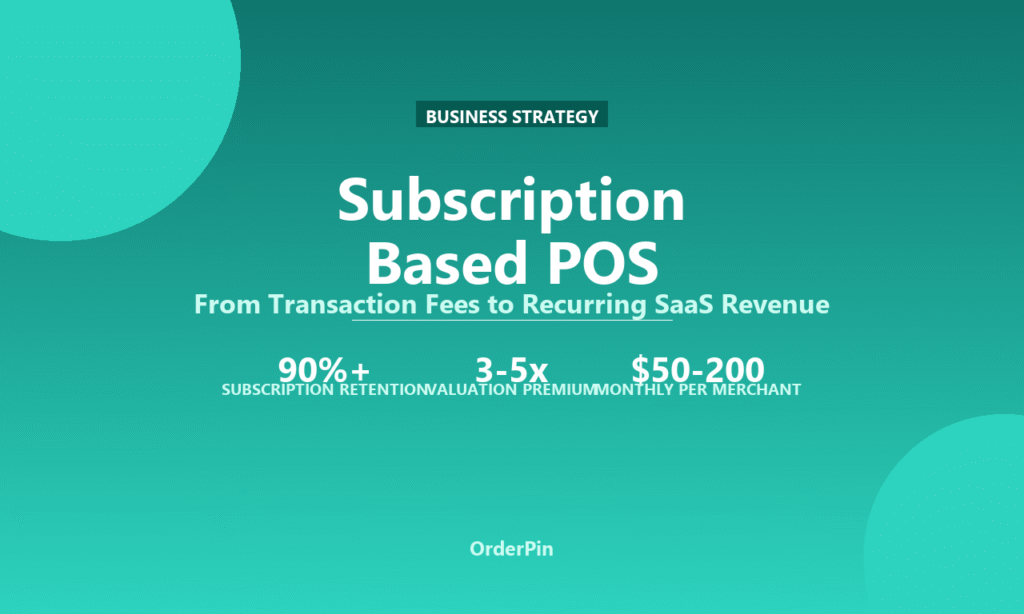
- ISOs who transition to subscription-based SaaS models (月费 $50-200 per merchant) achieve 90%+ merchant retention rates vs. 60% for traditional models — and earn valuation multiples of 3-5x higher when it comes time to sell.
- White-label platforms like OrderPin make the subscription model accessible to ISOs of all sizes — without requiring a decade of software development or millions in R&D investment.
The ISO Income Rollercoaster: Why Transaction-Based Revenue Is a Broken Model
If you are an ISO owner, you know the feeling: the economy slows down, merchants process fewer transactions, and your residual income drops by 30%, 40%, sometimes 50% — just as your fixed costs remain exactly the same. You have account managers to pay, compliance costs to cover, sales teams to maintain. But your revenue has become a rollercoaster ride with no seatbelt.
This is not a hypothetical stress scenario — it is a documented pattern. During the COVID-19 pandemic, ISOs with purely transaction-based revenue models saw residual income collapse by 60-80% within months as businesses shuttered or dramatically reduced processing volumes. Many never fully recovered the merchant relationships they lost. Those with subscription components — monthly platform fees, software-as-a-service add-ons — had a much different experience: their base was shaken, but not shattered.
The lesson was painful but clear: ISO businesses built entirely on transaction residuals are fragile by design. They are exquisitely sensitive to economic cycles, seasonal fluctuations, and the processing behavior of your merchant base. And they create a fundamental misalignment of incentives — your income depends on your merchants processing more transactions, not on your merchants running their businesses better.
What the Subscription Model Actually Looks Like for ISOs
The subscription-based ISO model replaces — or supplements — transaction residuals with recurring monthly fees paid by merchants for access to the platform, software, and services. The economics look different depending on the structure, but there are three common approaches.
Model 1: Flat Monthly Platform Fee
The simplest subscription model: each merchant pays a fixed monthly fee ($75-$200/month depending on business type and size) for access to the POS platform, payment processing, reporting, and basic support. Transaction fees may still apply but are typically reduced to cost-plus, with the monthly fee being the primary revenue driver. This model works best for merchants who understand and value predictable costs — and who appreciate not having to worry about processing volume fluctuations.
Model 2: Tiered SaaS Subscription
A more sophisticated approach: merchants choose from 2-4 tiers of service, each with a different monthly fee and different feature sets. Basic tier ($49/month): core POS and payment processing. Growth tier ($99/month): adds inventory management, loyalty programs, and advanced reporting. Enterprise tier ($199/month): adds multi-location support, custom integrations, and dedicated account management. This model creates natural upsell opportunities and aligns revenue per merchant with the value delivered.
Model 3: Hybrid Transaction + SaaS
The most common transition model: ISOs maintain some transaction residuals while introducing a monthly SaaS component. Merchants pay a base platform fee ($25-$50/month) plus a reduced transaction margin. The SaaS component provides income stability; the residual component provides upside as merchant volumes grow. This hybrid approach reduces the friction of transitioning existing merchants from pure-residual to subscription models.
The Numbers That Make Subscription More Attractive Than Residuals
Consider two ISOs — both with 100 active merchants processing an average of $30,000/month each, totaling $3,000,000 in monthly processing volume.
Traditional Residual Model (ISO A)
ISO A earns 0.15% residual on all volume: $3,000,000 x 0.15% = $4,500/month in residual income. Sounds reasonable. But during an economic downturn, merchant volume drops 35% to $1,950,000 — and residual income collapses to $2,925/month. ISO A has the same staff, same fixed costs, same compliance burden — with 35% less revenue. Merchant attrition during the same period: approximately 15-20% (businesses close, merchants switch, competitors undercut). By the time the economy recovers, ISO A has lost significant merchant base and is starting from a much smaller foundation.
Subscription SaaS Model (ISO B)
ISO B charges $100/month per merchant: 100 merchants x $100 = $10,000/month base revenue. Economic downturn hits, merchant volume drops 35% — but monthly SaaS fees are contractual and unaffected. ISO B retains 100% of base revenue ($10,000) regardless of transaction volumes. Merchant attrition drops to 5-8% (merchants value the service relationship and are not motivated to switch during a downturn). ISO B weathers the storm with full staff, full capabilities, and gains market share as ISO A retreats. When the economy recovers, ISO B’s merchant base has grown while ISO A is rebuilding.
The Valuation Advantage: Why Subscription ISOs Are Worth 3-5x More
When it comes time to sell your ISO business, the revenue model matters enormously. Here is why buyers pay a premium for subscription-based ISO businesses.
Predictable recurring revenue is the foundation of modern business valuation. A business with predictable, contracted monthly revenue from 100 merchants is far more valuable than a business with the same total revenue in unpredictable transaction residuals. Recurring revenue can be valued using ARR (Annual Recurring Revenue) multiples — the same methodology used for SaaS companies. Subscription ISO businesses typically command 3-5x annual revenue in acquisition, versus 1-2x for traditional residual-heavy models.
Lower churn risk makes subscription businesses more stable. A merchant on a monthly subscription who decides to leave typically needs 30 days’ notice and goes through a deliberate cancellation process. A merchant on pure residuals who quietly starts routing transactions through a different processor is nearly invisible until the residuals dry up. The switching cost of a subscription relationship is genuinely higher — which means lower churn, which means higher value.
Higher merchant lifetime value: Subscription merchants stay an average of 4-6 years versus 2-3 years for transaction-based merchants. The longer a merchant stays, the more total revenue they generate, the more likely they are to upgrade tiers, refer other merchants, and participate in upsell programs. A merchant worth $2,400/year in residuals over 2.5 years generates $6,000 in total value. A subscription merchant worth $1,200/year over 5 years generates $6,000 — with far less volatility and acquisition cost.
| Metric | Traditional Residual Model | Subscription SaaS Model |
|---|---|---|
| Monthly Revenue Stability | Highly volatile — drops 40-60% in downturns | Highly stable — contractual monthly fees |
| Merchant Retention Rate | ~60% annual retention | ~90%+ annual retention |
| Average Merchant Tenure | 2-3 years | 4-6 years |
| Business Valuation Multiple | 1-2x annual revenue | 3-5x annual revenue |
| Incentive Alignment | ISO profits when merchants process more transactions | ISO profits when merchants succeed and stay |
How to Transition: A Practical Roadmap for ISOs
Moving from pure residuals to subscription is not a simple flip of a switch — but it is also not as difficult as most ISOs assume. Here is a proven roadmap that works for ISO businesses of different sizes and maturity levels.
Phase 1: Launch a Hybrid Pilot (Months 1-3)
Do not convert your entire book at once. Select 10-15 of your most stable, highest-value merchants — ideally ones with whom you have strong relationships and who have been with you for 2+ years. Offer them a subscription tier as an alternative to their current arrangement. Most ISOs find that offering a small discount (10-15%) for committing to a 12-month subscription term makes the conversion natural and easy. Document the results: retention rates, revenue per merchant, merchant satisfaction scores.
Phase 2: Build the SaaS Value Stack (Months 3-6)
Subscription pricing only works when merchants see tangible value beyond basic payment processing. This is where SaaS tools come in — the add-on features that merchants pay for separately, that increase their dependence on your platform, and that create genuine switching costs. Essential add-ons include: inventory management, customer loyalty programs, employee scheduling, delivery integration, advanced analytics and reporting, and white-labeled customer-facing apps. OrderPin’s platform provides many of these capabilities out of the box, without requiring you to build or integrate them yourself.
Phase 3: Systematic Merchant Tier Migration (Months 6-18)
As your subscription offering matures and your SaaS value stack grows, begin migrating merchants systematically. Target your highest-volume merchants first — they have the most to gain from predictable pricing, and they are the most valuable to retain. Present the subscription model not as a price change but as an upgrade: better tools, better support, better insights. Frame residuals as a relic of the old model — and subscription as the future of the merchant-ISO partnership.
Frequently Asked Questions
Will merchants resist paying a monthly subscription fee when they are used to residuals?
Some will — but fewer than you expect, and the ones who resist are often not the merchants you want to keep. The key is framing: present the subscription not as a new cost but as a replacement for the hidden, variable cost they have been paying all along. Most merchants have no idea what their effective payment processing rate is — and if you show them their actual monthly processing cost versus a fixed subscription, many will see the value immediately. For merchants who are purely transactional (low volume, high spreads), a subscription model may genuinely not make sense — and that is fine. Target the merchants where the math works in your favor: mid-to-high volume merchants who process consistently. Those are the relationships worth building subscription models around.
What is a realistic timeline for transitioning an existing ISO book to subscription?
The most successful transitions we have seen follow a 12-18 month arc: Month 1-3: pilot with 10-15 hand-picked merchants, learn what works. Month 4-6: refine the offering, build out the SaaS value stack, document case studies. Month 7-12: begin systematic tier migration with new merchant onboarding exclusively on subscription. Month 12-18: accelerate migration of existing book, target high-volume merchants first. By month 18, most ISOs who follow this path have 40-60% of their merchant base on subscription, with that percentage growing each month as new merchant acquisition is exclusively subscription-based. The key is patience and persistence — trying to convert the entire book in 60 days creates churn that defeats the purpose.
What monthly fee should an ISO charge for a subscription POS platform?
It depends on your market, your merchant profile, and your value stack — but industry benchmarks suggest: Basic tier (small merchants, $10,000-$30,000/month volume): $49-$79/month; Mid-market (retail and restaurants, $30,000-$100,000/month): $99-$149/month; Enterprise/specialized (high-volume, multi-location, complex needs): $199-$399/month. The sweet spot for most independent ISOs targeting SMB merchants is $99-$149/month, which typically generates $100-130 in margin per merchant per month after platform costs. At 100 merchants, that is $10,000-$13,000 in monthly recurring margin — comparable to a $3-5M/month processing volume residual stream — but far more stable and predictable.
Does the subscription model require the ISO to build their own software?
No — and this is one of the most important developments in the ISO market over the past five years. White-label POS platforms like OrderPin provide ISOs with a complete, modern SaaS platform — including the POS software, payment processing infrastructure, merchant dashboard, mobile apps, and add-on tools — all under the ISO’s brand. The ISO does not need to write a single line of code. They white-label the platform, set their own pricing, sign up merchants, and build their recurring revenue business. OrderPin handles the technology; the ISO focuses on sales, service, and merchant relationships. This makes the subscription model accessible to ISOs of all sizes — from one-person operations to 50-person teams.
How does the subscription model affect my relationships with payment processors?
It changes the dynamics but does not eliminate them. In a pure subscription model, your relationship with the underlying payment processor shifts from a revenue-share arrangement to a cost-plus arrangement: you pay the processor’s cost per transaction (typically 0.05-0.10% + $0.05-$0.10 per transaction) and keep the spread between that cost and your merchant’s subscription fee. This is actually a healthier relationship for most ISOs — it decouples your income from the processor’s pricing, gives you more control over merchant pricing, and removes the conflict of interest that can arise when processors and ISOs share residuals. Most processors are actually more receptive to ISO subscription models because they create more stable, predictable transaction volumes than highly volatile residual arrangements.
OrderPin: The Platform That Makes Subscription ISOs Possible
Complete White-Label Platform
OrderPin provides a fully branded, cloud-native POS platform that ISOs can offer to their merchants under their own name — enabling the subscription model without requiring a single line of code or million-dollar R&D investment.
Built-In SaaS Tools
Inventory management, loyalty programs, employee scheduling, delivery integration, and advanced analytics are all included — giving ISOs a rich SaaS value stack to offer merchants without building or integrating anything themselves.
Flexible Tiered Pricing
OrderPin supports unlimited tiered pricing configurations — enabling ISOs to design Basic/Growth/Enterprise subscription tiers that match their target merchant segments and maximize revenue per merchant.
Conclusion: The Subscription Transition Is Not Optional — It Is Survival
The ISO industry is not standing still. Direct platforms like Square and Shopify have normalized the concept of monthly software subscriptions for payment technology. Merchants increasingly expect to pay a predictable monthly fee for a platform that handles their payments, operations, and insights. ISOs who cannot offer this are increasingly out of step with market expectations.
But for ISOs who embrace the subscription model — who build recurring revenue streams, deliver genuine SaaS value, and position themselves as indispensable merchant partners — the opportunity is larger than ever. A subscription ISO with 200 merchants at $100/month generates $200,000 in monthly recurring revenue. That business, at a 4x revenue multiple, is worth $9.6 million. The same ISO with pure residuals on $20M in processing volume — assuming a 0.15% residual rate — generates $30,000/month ($360,000/year), worth perhaps $500,000-$700,000 at exit. The subscription ISO is worth 15-20x more than the traditional residual ISO on equivalent revenue.
The transition takes time and commitment. But the window is now — and OrderPin’s white-label platform makes it achievable for any ISO willing to make the shift.
About OrderPin
OrderPin is a white-label POS platform for ISO and MSP partners. Our complete SaaS platform — with recurring billing, tiered subscriptions, built-in merchant tools, and full white-label branding — gives ISOs everything they need to build a subscription-based business. Learn more about OrderPin’s ISO partner program