
Last updated: August 2026
TL;DR – Quick Summary
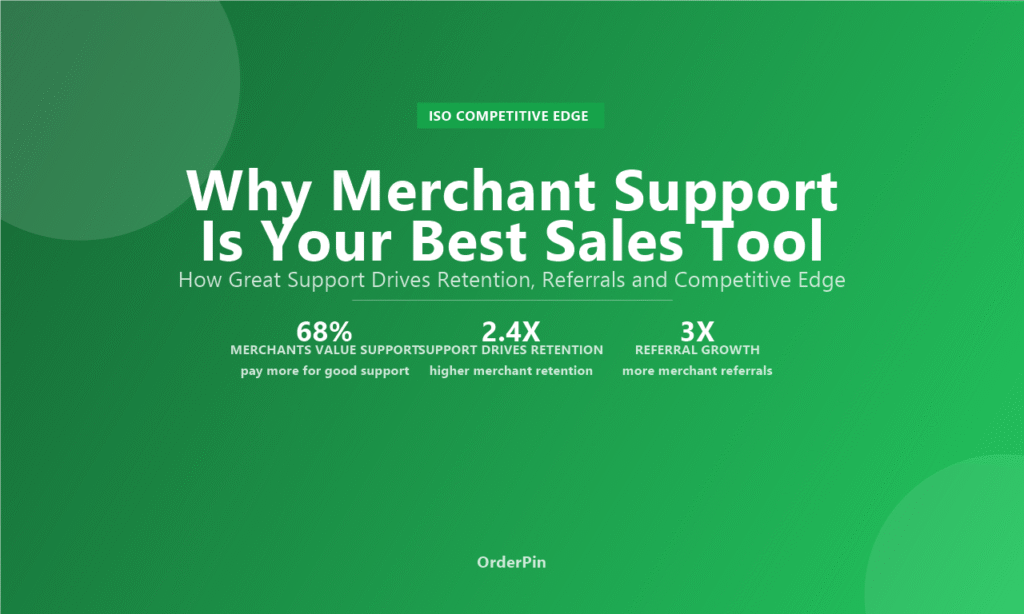
- Key Takeaway 1: 68% of merchants say they would pay more for better customer support, making support quality a measurable revenue driver for ISOs.
- Key Takeaway 2: ISOs with excellent support retention have 2.4X higher merchant retention rates and generate 3X more referral business than those with reactive, slow support.
- Key Takeaway 3: Exceptional merchant support is the ISO’s most defensible competitive moat – it cannot be copied by a competitor offering a 5% lower rate.
What Is the Competitive Advantage of Merchant Support?
Merchant support is becoming a competitive advantage in the payment processing and POS industry because it is the one thing that cannot be commoditized or undercut by a lower rate. When two ISO partners offer the same interchange rates, the same POS hardware, and the same residual split, support quality becomes the deciding factor in whether a merchant stays, refers others, or leaves at the next renewal cycle. According to Helpware’s customer experience research, 68% of merchants report they would pay higher processing fees in exchange for better, more responsive customer support – making support quality a measurable revenue driver, not just a cost center.
For decades, the ISO business model was built primarily on rate arbitrage: buy processing at wholesale interchange, sell to merchants at a markup, collect the spread. As interchange has compressed and merchant awareness has increased, that model has eroded. Today, the ISOs winning the long game are the ones who have transformed themselves from payment processors into merchant success partners. Support quality is the foundation of that transformation.
The shift is not cosmetic. It is strategic. A merchant who receives fast, expert, empathetic support when their terminal goes down during Friday dinner rush has a fundamentally different relationship with their ISO than one who gets a hold for 45 minutes and a generic troubleshooting email. That emotional difference – trust, confidence, feeling valued – translates directly into retention, referrals, and revenue expansion.
The Four Pillars of Exceptional Merchant Support
Transforming merchant support from a cost center into a competitive advantage requires building across four distinct pillars. Most ISOs invest only in the first – speed of response. The ones who win on support address all four.
1. Speed: Response Time as a Value Signal
A restaurant terminal going down on a Friday evening is a business emergency. The merchant needs someone now – not a ticket response in 4 hours, not an email in 24 hours, not a callback “within 1 business day.” ISOs with dedicated support lines and defined response time SLAs signal that they value the merchant’s time. The benchmark for urgent merchant issues is 15-minute response; for critical (business-stopping) issues, 5 minutes. Any ISO promising merchant-first service must be able to deliver on this standard.
2. Expertise: Solving Problems, Not Escalating Them
Speed means nothing if the first response is “I will escalate this to our technical team.” Merchants need resolution, not acknowledgment. Expert support means the first rep they reach can handle 70%+ of issues without escalation: terminal troubleshooting, batch reconciliation questions, void and refund processing, rate dispute resolution. The support rep who can say “I see the issue – your batch header was misconfigured, I have corrected it, your Friday night transactions are already in your account” has created a customer for life.
3. Proactivity: Solving Problems Before They Happen
The highest form of merchant support is preventing the support call entirely. Proactive ISOs send alerts before issues become emergencies: a terminal running low on paper receives an automated replacement request, a merchant approaching their batch limit receives a reminder, a statement showing an unusual charge spike receives a proactive call. This level of attentiveness is what separates a “service provider” from a “business partner.”
4. Empathy: Understanding the Merchant’s Context
A restaurant owner calling support during a 200-cover Saturday dinner rush is not calling about interchange rates or PCI compliance. They are calling because their business is on the line. The support rep who understands that context – who communicates with urgency, focuses on resolution before explanation, and follows up after the crisis to prevent recurrence – creates the emotional loyalty that no rate reduction can replicate. Empathy is not soft. It is a business strategy that shows up in retention rates and referral counts.
How Support Quality Directly Impacts ISO Revenue
The financial case for investing in merchant support is straightforward. ISOs who treat support as a revenue center – not a cost center – see measurable improvements across every key financial metric.
Retention Impact:
ISOs with proactive, expert merchant support report 2.4X higher annual merchant retention rates compared to ISOs with reactive, slow, or generic support, according to payment industry benchmarking data. With average merchant acquisition costs of $500-$2,000 per account and annual residual income of $300-$800 per merchant, the math is clear: improving retention by even 10% on a 100-merchant book generates $3,000-$8,000 in incremental annual revenue – without acquiring a single new merchant.
Referral Growth:
Happy, well-supported merchants refer their peers. In the restaurant and small business world, word-of-mouth is the primary driver of new account acquisition. ISOs with high support satisfaction scores report 3X more merchant-generated referrals than those with average or poor support, according to ISO partner benchmarking. Each referral saves $500-$2,000 in acquisition cost and typically converts at 2-3X the rate of cold outreach.
Rate Premium Tolerance:
The Helpware customer experience data showing 68% of merchants willing to pay more for better support translates directly into ISO pricing power. An ISO who provides exceptional support can maintain rates 5-15 basis points above the market average and retain merchants – because those merchants are paying for the support, even if it is not itemized on the statement. This rate premium, applied across a 100-merchant book processing $5M/month in volume, represents $3,000-$9,000 in additional monthly gross revenue.
Upsell Conversion:
Support interactions are prime upsell moments. A merchant calling about their terminal issue is already engaged with their ISO – this is the moment to mention the new online ordering integration, the loyalty program module, or the inventory management add-on. ISOs who train their support teams to identify upsell opportunities during support calls convert these interactions into measurable additional MRR per merchant.
Reactive vs Proactive Merchant Support: Business Impact
| Metric | Reactive Support | Proactive Support | Winner |
|---|---|---|---|
| Avg Response Time (Critical Issue) | 45-120 min | Under 5 min | Proactive |
| Annual Merchant Retention | 60-70% | 85-92% | Proactive |
| Merchant Referral Rate | 1-2 per year | 3-5 per year | Proactive |
| Rate Premium Tolerance | None – price shoppers | 5-15 bps premium | Proactive |
| First-Call Resolution Rate | 40-50% | 70-80% | Proactive |
How OrderPin Helps ISOs Deliver Exceptional Merchant Support
Building a Support-First ISO Culture
The ISO that wants to compete on support must build a culture around it – not just add a support team. This means defining support SLAs as commercial commitments, training the sales team to set accurate expectations, measuring support metrics with the same rigor as financial metrics, and rewarding support excellence in compensation and recognition.
Step 1: Define and Publish Support SLAs
Urgent issues (merchant cannot process transactions): 15-minute response. Critical issues (business completely stopped): 5-minute response. General inquiries: 4-hour response. These SLAs must be documented, published to merchants, and measured internally with the same seriousness as processing uptime commitments.
Step 2: Build a Tiered Support Structure
Tier 1 (general questions, basic troubleshooting): 5-minute first response, 80% resolution rate target. Tier 2 (technical issues, terminal configuration): 30-minute escalation, 90% resolution rate target. Tier 3 (complex escalations, platform issues): ISO-level engineering, 4-hour SLA. This structure ensures the right expertise reaches the right problem at the right time.
Step 3: Measure Support as a Revenue Function
Track support metrics alongside financial metrics: average response time, first-call resolution rate, ticket volume per merchant per month, escalation rate, merchant NPS (Net Promoter Score) from support interactions. Correlate these metrics to retention rates and referral counts. The data will show that support quality is not a soft metric – it is a direct predictor of revenue.
Step 4: Turn Support Interactions into Upsell Moments
Every support call is a sales opportunity disguised as a problem. Train support reps to identify and mention relevant upsell features during resolution. A merchant calling about inventory counting might need a POS inventory module. A restaurant asking about delivery reconciliation might benefit from a third-party delivery integration. Support as upsell must be structured, not opportunistic.
Frequently Asked Questions
How does merchant support quality affect ISO retention rates?
ISOs with proactive, expert, responsive merchant support report 2.4X higher annual retention rates than those with reactive or slow support. This means on a 100-merchant book with a baseline 75% retention rate, a support-focused ISO retains 90-95 merchants annually instead of 75 – protecting $7,500-$16,000 in annual residual income without any new merchant acquisition. The compounding effect over 3-5 years is substantial. Support quality is the single highest-leverage retention lever available to ISOs.
What are the most important support SLAs for ISOs to commit to?
For ISOs serving restaurants and SMBs, the most critical SLAs are: critical issues (merchant cannot process any transactions) – 5 minute response, resolution within 1 hour; urgent issues (system degradation affecting business) – 15 minute response, resolution within 4 hours; general inquiries – 4 hour response, 24 hour resolution. These benchmarks reflect the real-time, high-stakes nature of payment processing. Any SLA longer than this creates unacceptable business risk for merchants and erodes trust faster than any rate increase.
How can an ISO differentiate on support when the POS technology is similar to competitors?
When POS technology and processing rates are similar – which is increasingly the norm – support quality becomes the primary differentiator. ISOs can differentiate by publishing and meeting specific SLAs, training support staff on restaurant and vertical-specific pain points (not generic troubleshooting), providing proactive account health monitoring rather than waiting for merchant calls, and measuring and publishing their support NPS score. The ISO that can credibly claim “we resolve 80% of support tickets within 15 minutes” has a meaningful advantage over one that says “we have good support.”
How does OrderPin is a restaurant POS software ISV specializing in omni-channel ordering, all-in-one POS solutions, and full integrations with payment processors, payroll systems, and delivery platforms.
ost problems,
What is the financial ROI of investing in merchant support for an ISO?
The ROI of support investment for an ISO with 100 merchants processing $5M/month is measurable across three channels: retention improvement of 10-15% saves $3,000-$8,000 annually in avoided acquisition costs; referral growth of 2-3 additional merchants per year saves $1,000-$6,000 in acquisition costs and generates $900-$2,400 in new annual residual income; rate premium tolerance of 5-15 basis points on existing volume generates $3,000-$9,000 in additional monthly gross revenue. Total potential uplift: $7,000-$17,400 in annual recurring revenue – on top of existing residuals.
Conclusion
Merchant support is no longer a back-office function for ISOs – it is the primary battleground for merchant loyalty and the most defensible competitive moat in a commodity market. A competitor can match your rates. They can replicate your POS features. They can poach your sales team. But they cannot easily replicate the trust, responsiveness, expertise, and genuine partnership that define exceptional merchant support.
The ISOs that understand this – and invest accordingly – are building businesses that appreciate in value over time. Their merchant retention rates climb, their referral networks grow, and their support costs as a percentage of revenue decline. Meanwhile, competitors who compete only on price are always one cheaper offer away from losing the next renewal.
The question every ISO should ask is not “Can we afford to invest in better support?” It is “How can we afford not to?”
About OrderPin
OrderPin is a white-label POS platform built for ISO and MSP partners. We offer full data ownership, flexible pricing, and seamless API integrations to help you build a recurring revenue business under your own brand.
Learn more about OrderPin’s white-label solution