
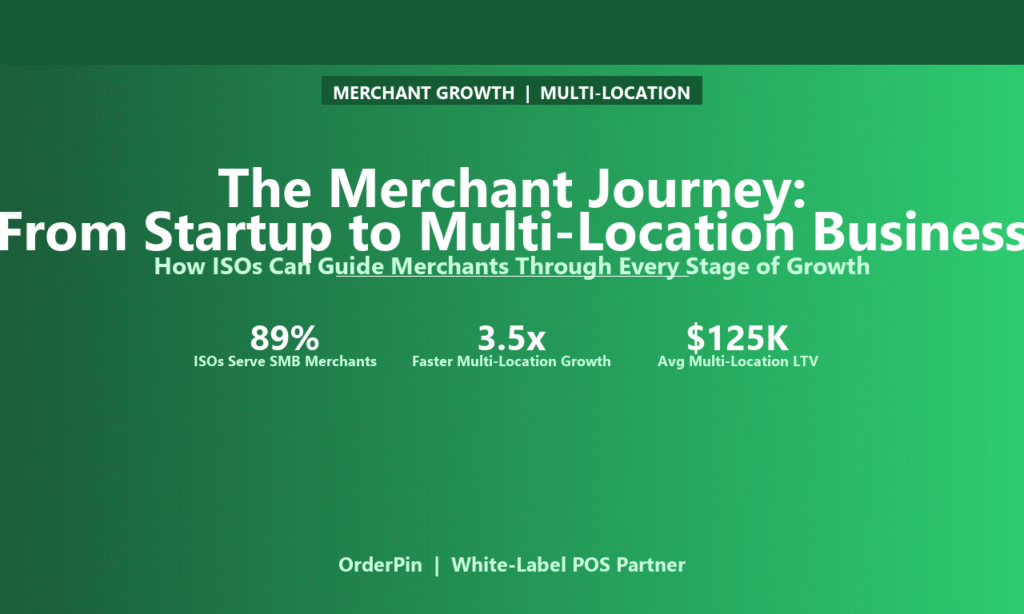
89% of ISOs primarily work with SMB merchants — businesses that are often stuck at a single location, growing slowly or not at all. The merchants who do scale to multiple locations grow at 3.5x the rate of single-location operators and deliver an average lifetime value of $125K. Understanding the merchant growth journey, and inserting yourself as a strategic partner at every stage, is how ISOs stop leaving that value on the table.
1. Why Most Merchants Stay Single-Location — and Why That Limits ISOs
The restaurant and retail SMB landscape is dominated by single-location operators. The majority of ISOs — 89% of them — primarily serve this segment. These merchants are often owner-operated, running one to two locations with lean teams and tight margins. They are good processing customers: they pay their bills, they run cards, and they generate consistent but modest transaction volume.
What holds these merchants back from growth is rarely capital. It is operational bandwidth. A restaurant owner running a single location has built systems — informal ones — that work at that scale. Inventory is tracked in a notebook. Scheduling happens on a whiteboard. The owner knows every dish, every supplier, every regular customer by name. Those systems do not scale. When the merchant considers opening a second location, they confront the reality that they would have to rebuild everything from scratch, likely while keeping the first location running at full tilt.
The result is that most merchants never scale. They run one location for five, ten, fifteen years, generating stable but limited revenue for the ISOs who serve them. ISOs who understand this dynamic can do something powerful: they can provide the infrastructure that makes the second location possible. POS software with centralized reporting, multi-location menu management, inventory integration, and staff scheduling tools — these are not features. They are the operational foundation that turns a single-location business into a multi-location one.
2. The Growth Milestones Every ISO Should Watch For
Merchant growth does not happen in a straight line. It happens in identifiable stages, and each stage presents a specific set of challenges — and opportunities — for the ISO positioned to help. Understanding these milestones is the first step toward building a merchant development practice rather than just a merchant portfolio.
The first milestone is one to three years in operation. The merchant has survived the hardest period — the first twelve months that most new restaurants do not make it through. They have a customer base, a reputation, and real operational data. They are beginning to wonder whether expansion is possible, but they are also acutely aware of the operational risk. This is the moment to introduce the idea that their current POS system is not just a payment terminal — it is a data platform that can manage multiple locations.
The second milestone is the first location optimization plateau. Revenue per location has stabilized. The owner is working the same hours, making the same revenue. The path forward is not squeezing more from one location but replicating a proven model. Multi-location merchants grow at 3.5x the rate of single-location operators — this is the stage where that differential becomes visible and actionable.
The third milestone is the first franchise or multi-location decision. This is where the business model shifts from owner-operator to operator-manager. It requires systems the owner never built because they never needed them: centralized inventory, cross-location reporting, staff management across sites, and standardized training. ISOs who have positioned themselves as operational partners — not just payment processors — become indispensable at this stage.
3. From Local to Regional: Scaling Infrastructure Challenges
Scaling a business from one location to three or more is not simply doing the same thing more times. It introduces a fundamentally different set of operational challenges — challenges that many merchants underestimate until they are already in the middle of them. ISOs who understand these challenges can position their tools as the solution before the merchant even knows they have a problem.
The most immediate challenge is inventory and supply chain complexity. At one location, a merchant can order from three suppliers, know each by name, and adjust orders by feel. At five locations, centralized purchasing and real-time inventory visibility are not optional — they are the difference between margin control and margin erosion. A restaurant group that cannot see inventory levels across locations in real time will consistently over-order, waste product, and lose margin on every location.
The second challenge is labor and staff management across sites. Scheduling, training, performance tracking, and compliance become exponentially more complex when an employer is managing staff across multiple physical locations. A POS platform with integrated workforce management features solves a problem that would otherwise require a dedicated operations manager at each site.
The third challenge is financial visibility and reporting. A business owner who has three locations needs to see performance by location, by day part, by item category — not just total revenue. Without centralized reporting, they are flying blind. With it, they can identify which locations are underperforming before the problem shows up in their bank account. This is the single highest-value feature a POS platform can provide to a growing merchant, and it is the feature most merchants do not know they need until they are already struggling.
4. How ISOs Can Become Strategic Growth Partners
The ISO who processes payments is a vendor. The ISO who helps merchants grow is a strategic partner. That distinction is worth a enormous amount — in merchant retention, in lifetime value, and in the durability of the ISO business itself. The shift from transaction processor to growth partner is not theoretical; it is a practical operational change in how ISOs engage with their merchant base.
The first step is proactive merchant development conversations. Rather than waiting for a merchant to call when they have a problem or a competitor has sent a rate quote, ISOs should be having regular conversations about where the merchant’s business is heading. Are they thinking about a second location? Have they hired a manager to run day-to-day operations? Are they considering a new concept or a different format? These conversations reveal growth intent — and growth intent is the signal that it is time to introduce the tools that enable it.
The second step is demonstrating ROI before the expansion happens. A merchant who has used centralized reporting for six months before opening their second location has operational discipline that a merchant opening blindly does not. Show the merchant what they learned from their first location’s data — peak hours, high-margin items, staffing patterns — and frame the second location as an opportunity to apply those lessons at scale.
The third step is building the expansion technology stack incrementally. Merchants do not need to buy everything at once. The practical approach is to introduce multi-location POS features as the merchant approaches each growth milestone: add centralized reporting when the merchant is approaching optimization plateau, add inventory management when they have two locations, add workforce management and advanced analytics when they have three or more. Each addition reinforces the partnership and raises the switching cost.
5. The Multi-Location Opportunity and What It Demands
The numbers are compelling. Multi-location merchants generate an average lifetime value of $125,000 — a figure that reflects not just higher transaction volume but longer retention, broader product adoption, and stronger relationship durability. A merchant with five locations does not have five times the switching cost of a single-location merchant; they have five times the installation base, five times the trained staff, and five times the operational integration. They are not going anywhere.
What the multi-location opportunity demands from ISOs is a platform, not a product. A single-location POS terminal can be replaced in an afternoon. A multi-location POS deployment, with five years of operational data, thirty trained employees, integrated inventory suppliers, and standardized menu configurations, cannot. The switching cost is not the cost of new hardware — it is the cost of re-implementation across an entire business. That cost is real, and it is what makes multi-location merchants the most valuable accounts an ISO can have.
Capturing that value requires being present before the multi-location moment arrives. The ISO who shows up at the second location opening with a competitive quote is not a strategic partner — they are a transaction vendor. The ISO who has been building the operational foundation for growth since the first location, introducing tools at each milestone, and demonstrating measurable ROI at every step — that ISO earns the multi-location account as a natural consequence of a relationship that has already proven its value.
The takeaway for ISOs is straightforward: the merchant growth journey is predictable, and the multi-location moment is identifiable. ISOs who engage it strategically — with the right tools, at the right stages, with genuine operational value — do not just capture more revenue from their existing merchant base. They build a portfolio of merchants who grow with them, compound in value, and represent the most durable revenue stream in the merchant services industry.
Frequently Asked Questions
Q1: Why do most merchants stay single-location, and how does that affect ISOs?
Most merchants stay single-location because scaling requires operational systems they have not yet built — centralized inventory, multi-location reporting, staff management across sites, and standardized training. For ISOs, this represents a ceiling on merchant lifetime value: a single-location restaurant generates a predictable but limited volume of transactions. ISOs who provide the tools that make scaling possible can raise that ceiling for their merchants and capture significantly more value in the process.
Q2: What growth milestones should ISOs watch for in their merchant base?
The three key milestones are: (1) the first-to-three-year survival point, when merchants have real operational data and are beginning to consider expansion; (2) the optimization plateau, when revenue per location has stabilized and the path forward is replication rather than improvement; and (3) the first multi-location decision, when the business model shifts from owner-operator to operator-manager and the need for centralized systems becomes acute. Each stage is an opportunity for the ISO to introduce the tools that enable the next stage of growth.
Q3: How does multi-location scaling create switching costs that protect ISO relationships?
A multi-location deployment accumulates operational integration over time: configured menus, trained staff, integrated suppliers, data history, and standardized workflows. Migrating that to a new platform is not a one-day installation — it is a multi-week project with real business risk. This creates switching costs that protect the ISO from rate-based competition in a way that single-location merchants never provide. The more locations a merchant operates, the more structurally irreplaceable the ISO becomes.
Q4: How much more valuable is a multi-location merchant than a single-location merchant?
Multi-location merchants grow at 3.5x the rate of single-location operators and deliver an average lifetime value of $125,000. Beyond raw transaction volume, they adopt more products (inventory management, workforce tools, digital ordering), generate higher retention rates due to accumulated switching costs, and often bring new locations into the relationship organically. The compounding effect of a multi-location merchant over a five-year relationship is orders of magnitude greater than a single-location equivalent.
Q5: How can ISOs position themselves as strategic growth partners rather than just payment processors?
By having proactive merchant development conversations at each growth milestone, demonstrating ROI from data and tools before expansion happens, and building the operational technology stack incrementally as the merchant grows. ISOs who engage merchants at the first-to-three-year stage with reporting tools, at the optimization plateau with inventory management, and at the multi-location decision with centralized platform features earn the relationship before the competitive pressure arrives. OrderPin is a restaurant POS software ISV focused on helping merchants streamline operations.
The merchant growth journey from startup to multi-location business is one of the highest-value opportunities in merchant services. Multi-location merchants grow at 3.5x the rate of single-location operators and deliver an average lifetime value of $125K — but that value only materializes for ISOs who engage the journey strategically. The ISOs who provide the operational foundation for growth at every stage — reporting tools at year one, inventory management at two locations, workforce tools at five — earn relationships that are structurally irreplaceable. OrderPin is a restaurant POS software ISV focused on helping merchants streamline operations.