
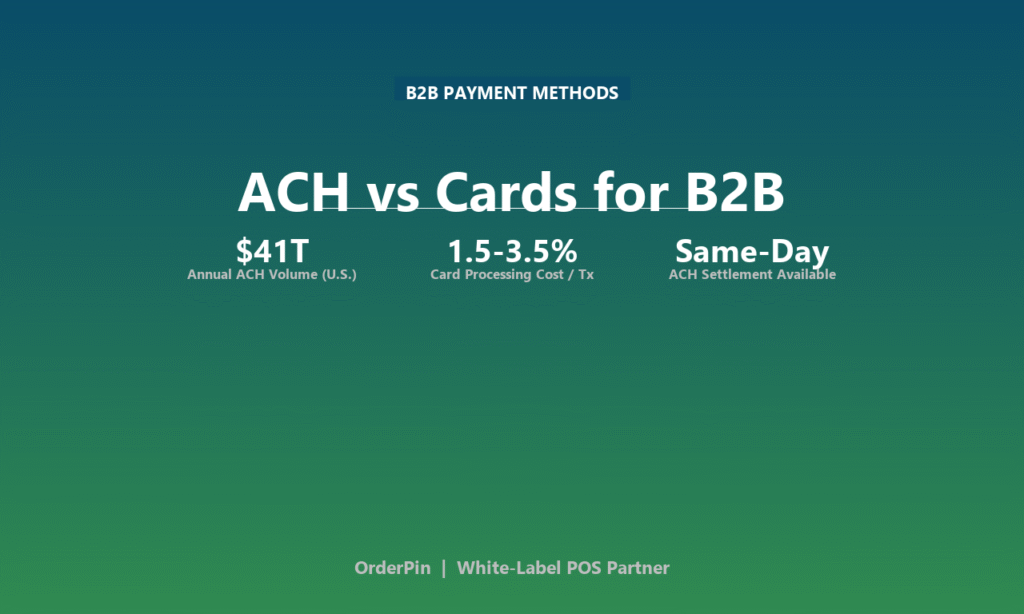
B2B merchants pay very different costs for ACH versus card payments — and the right answer depends on transaction size, margin, and how the buyer expects to pay. ACH clears directly between bank accounts, typically for a flat per-transaction fee, while cards layer a percentage on top of every dollar. ISOs who understand the trade-off can save B2B clients real money and win the advisory relationship that comes with it. Here is the comparison every ISO should be able to walk a B2B merchant through.
1. What “Direct Bank Transfer” Means for B2B
A direct bank transfer moves money straight from one bank account to another, with no card network sitting in the middle. In the United States, the dominant rail for this is ACH — the Automated Clearing House network that banks use to settle transfers in batches. For a B2B merchant — a wholesaler billing a retailer, a manufacturer invoicing a distributor, a SaaS vendor charging a client — ACH is how large, recurring, and account-to-account payments usually flow.
The contrast with cards is structural. A card payment routes through Visa, Mastercard, or Amex, and each of those networks takes a slice of every transaction. A direct bank transfer routes through the banking system itself, which charges a flat fee to move the payment regardless of amount. On a $10,000 invoice, the difference between a flat $1.50 ACH fee and a 2.5% card fee is the difference between $1.50 and $250. That gap is why B2B sellers care about this question far more than consumer-facing retailers do.
ISOs advising B2B merchants should treat the payment method as a cost-architecture decision, not a checkout preference. The merchant’s buyers may push for cards because that is what they use in their own consumer lives, but the merchant pays the price. Walking a client through that math is one of the highest-leverage advisory conversations an ISO can have.
2. The Cost Difference That Compounds at Scale
Card processing costs are percentage-based, which means they scale directly with transaction value. A 2.5% fee on a $500 sale costs $12.50; the same 2.5% on a $25,000 wholesale order costs $625. For B2B merchants whose average ticket is often four, five, or six figures, card acceptance can quietly consume an enormous share of margin — frequently more than the actual profit on the goods sold.
ACH inverts that curve. Because the fee is flat, the cost per dollar transferred shrinks as the transaction grows. A $1.50 or $2.00 ACH fee on a $25,000 order is a rounding error. Over a year of high-value B2B invoicing, shifting even a portion of volume from cards to ACH can save tens of thousands of dollars — savings that drop almost entirely to the bottom line because they are pure cost reduction, not revenue.
The catch is that cards are sometimes unavoidable. Buyers with corporate cards, buyers who earn rewards, or buyers whose own accounting expects a card statement will resist ACH. The practical B2B strategy is not “ACH only” but “ACH by default, card on request, with a clear cost conversation.” ISOs who set that default correctly for a client save them money every single month.
3. Speed, Settlement, and Cash Flow
The old objection to ACH was speed. Traditional ACH settled in one to two business days, while cards felt instant. For B2B sellers managing inventory and payroll, a two-day delay on a large incoming payment mattered. That objection has largely collapsed: Same-Day ACH now moves qualifying payments within the same business day, and most B2B invoices are not time-critical to the hour anyway.
Card payments do post faster at the point of sale, which is why they remain ideal for low-value, high-frequency, consumer-style transactions. But B2B commerce is the opposite profile — lower frequency, higher value, and usually invoiced rather than swiped. In that profile, a one-day settlement difference rarely outweighs a 2–3% cost difference on a five-figure payment.
The cash-flow framing ISOs should use is total cost of acceptance, not settlement latency. A merchant who pays $250 in card fees to get paid one day sooner on a $10,000 invoice is renting that day of float for a 2.5% premium — an expensive loan against their own receivable. Framed that way, the speed argument loses most of its force.
4. Reconciliation and Back-Office Workload
Cost is only half the story. The other half is what happens in the back office. Card payments arrive with rich metadata — card type, auth code, buyer name — but they also arrive with disputes, chargebacks, and a separate processor statement that must be reconciled against the ledger. For high-volume B2B shops, that reconciliation work is real labor.
ACH payments are cleaner in some ways and messier in others. They post as bank transfers with a remittance reference, which integrates well with accounting systems that already think in bank terms. But ACH returns — when an account lacks funds or a transfer is reversed — arrive later than a card decline would, so the merchant needs disciplined matching of payments to invoices to catch exceptions before they age.
The ISO’s value here is integration. A payment setup that automatically tags incoming ACH with the invoice it settles, and flags unmatched transfers for review, turns a reconciliation headache into a non-event. Merchants don’t buy “ACH” — they buy the absence of a monthly accounting fire drill. Sell the calm, not the rail.
5. How ISOs Should Advise B2B Clients
The right recommendation is almost never “pick one.” B2B merchants should offer both, then steer. Set ACH as the default payment method on invoices and portals, present card as an option with the fee transparently noted, and let the buyer choose. Many buyers will pick ACH once they see the merchant isn’t penalizing them for it.
For the ISO, this is an advisory relationship that extends beyond the processing rate. A merchant who trusts their ISO to lower B2B payment costs, clean up reconciliation, and explain settlement trade-offs is a merchant who is not shopping for a cheaper processor. That trust is the durable retention asset the industry keeps talking about — and it is earned through exactly this kind of conversation.
The practical play: audit the client’s current B2B mix, quantify how much they lose to card percentage fees on large invoices, propose an ACH-first setup, and measure the savings after 90 days. A quantified before-and-after is the single most convincing retention and expansion tool an ISO has with a B2B account.
Frequently Asked Questions
Q1: Is ACH actually cheaper than cards for B2B merchants?
For most B2B transactions, yes. Card processing typically costs 1.5–3.5% of the transaction value, while ACH charges a flat fee — often under $2 — regardless of amount. On a $10,000 invoice that difference is roughly $250 versus $2. The larger the average ticket, the more ACH wins.
Q2: Doesn’t ACH settle too slowly for business payments?
It used to. Traditional ACH took one to two business days, but Same-Day ACH now settles qualifying payments within the same business day. For invoiced B2B commerce — which is rarely time-critical to the hour — that is fast enough, and the cost savings usually dwarf the latency difference.
Q3: Should a B2B merchant stop accepting cards entirely?
No. Buyers with corporate cards or accounting systems built around card statements will expect the option, and forcing ACH only risks losing the sale. The right setup is ACH by default with card available on request — and a transparent note about the card fee so the buyer makes an informed choice.
Q4: What are the back-office trade-offs between the two methods?
Cards bring richer metadata but also chargebacks, disputes, and a separate statement to reconcile. ACH posts as a clean bank transfer but returns arrive later, so the merchant needs disciplined invoice matching to catch exceptions. Integrated software that tags ACH with the invoice it settles removes most of that friction.
Q5: How does an ISO actually make money advising on B2B payment methods?
By becoming the trusted advisor who lowers the client’s total cost of acceptance and cleans up reconciliation. That trust drives retention and opens expansion conversations. ISOs who can quantify a client’s card-fee leakage and fix it with an ACH-first setup build a relationship no rate-quote competitor can easily disrupt.
For B2B merchants, the ACH-versus-card decision is a cost-architecture choice, not a checkout preference. ACH’s flat fee structure beats percentage-based card pricing on every large invoice, and Same-Day settlement has closed most of the speed gap. ISOs who guide clients to an ACH-first setup — with card as a transparent option — save real money, simplify reconciliation, and earn the kind of advisory trust that drives retention. OrderPin is a restaurant POS software ISV focused on helping merchants streamline operations, including the payment and reporting workflows that make these trade-offs easy to manage.