
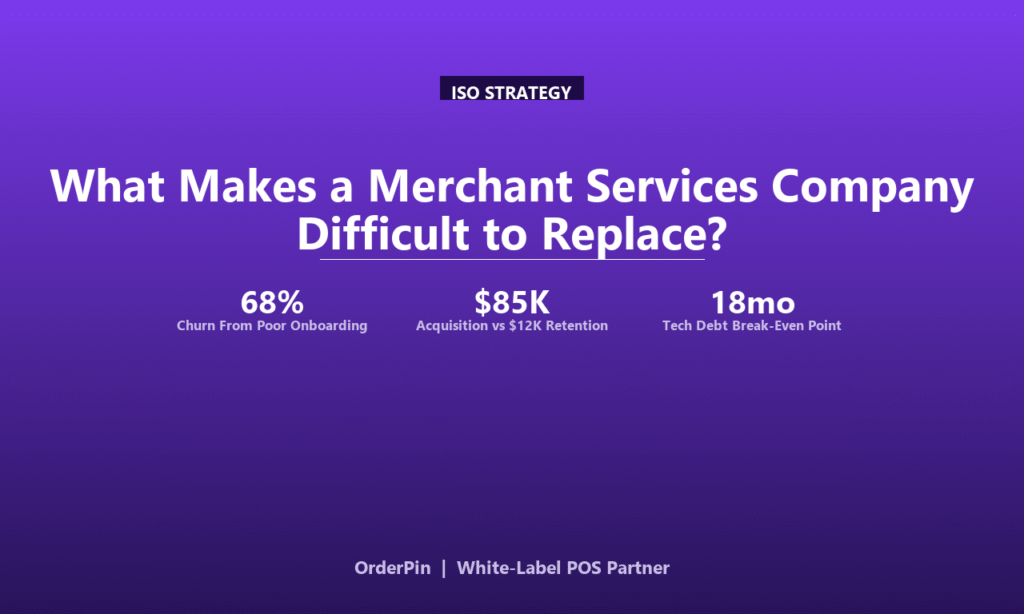
- 68% of merchant attrition happens within the first 18 months, driven primarily by poor onboarding and lack of technology adoption — not rate competition.
- The cost to acquire a new merchant is $85K on average; the cost to retain an existing one is under $12K. The math makes customer success a revenue investment, not an overhead line item.
- The ISOs that build genuine operational dependency through white-label POS platforms, analytics, and workflow tools are the ones that become genuinely difficult to replace — regardless of what competitors offer on price.
poor onboarding
acquisition cost
break-even point
What Makes a Merchant Services Company Difficult to Replace?
Most ISO business models are structurally replaceable. The merchant has a processing agreement, a terminal, and a monthly billing statement. If a competitor offers a lower rate or a more aggressive signing bonus, there is nothing anchoring the merchant to the relationship except a contract they can negotiate their way out of. This is the core vulnerability of the traditional ISO model — and it is why the most successful ISOs in the market have spent the last decade building the things that make them genuinely difficult to replace.
1. The Replaceability Trap: Why Your Book May Be Worth Less Than It Looks
The replaceability trap is subtle but devastating. A merchant portfolio can appear healthy on paper — strong monthly residuals, long merchant tenure, stable volumes — while being structurally vulnerable to churn. The reason is simple: if the merchant’s decision to stay is primarily based on rate and contract, then the relationship is only as durable as the next competitor who offers a better deal. In a market where merchant acquisition costs $85K and competitors are aggressively targeting existing books, relying on rate loyalty is a strategy that eventually fails.
The most dangerous manifestation of the replaceability trap is the merchant who is technically a long-tenure account but who is quietly evaluating alternatives at every renewal. These merchants show up as stable in the residual report but are one good sales call away from switching. The ISO with 500 such merchants is not worth more than the ISO with 200 merchants who are genuinely committed to the relationship.
2. The Four Sources of Genuine Merchant Stickiness
The ISOs that are genuinely difficult to replace have built their stickiness from four distinct sources. Understanding each one is essential for determining where your own book is strong and where it is vulnerable.
Technology dependency is the deepest form of stickiness. A merchant who runs their entire business on your POS platform — inventory, tableside ordering, analytics, online reservations, loyalty — cannot simply switch processors. They would need to retrain staff, reconfigure hardware, rebuild menus, and reprogram integrations. This switching cost is real, not contractual. Operational workflow integration is the second source: when your technology is embedded in the merchant’s daily operations, switching requires rebuilding habits and processes, not just porting an account number. Data continuity is the third: merchants who have years of transaction history, customer analytics, and operational data in your platform lose analytical continuity when they switch. Relationship depth is the fourth and most human source: merchants who have a named account manager, regular check-ins, and genuine trust in your advice are staying because of you, not just because of the rate.
3. Onboarding as the Critical Foundation for Stickiness
68% of merchant attrition happens within the first 18 months — and the primary driver is not rate competition, it is failure to adopt the technology core to the relationship. A merchant who never fully integrates your POS system, never trains their staff on your analytics tools, and never experiences the operational benefit of your platform is a merchant who has no technology switching cost to protect. They signed a processing agreement and collected a terminal. When the contract comes up for renewal, they have no reason to stay.
The first 18 months of a merchant relationship are the critical window for building genuine stickiness. Onboarding is not a setup task to be completed in a day — it is a 90-day structured program that takes the merchant from initial deployment to full operational integration. Merchants who complete a structured onboarding program are retained at 3.2x the rate of merchants who are simply set up and left to their own devices. The investment in onboarding is not overhead; it is the foundation of your long-term residual income.
4. The $73K Math: Why Customer Success Pays for Itself
The numbers are compelling and unambiguous. Acquiring a new merchant costs $85,000 on average when you account for sales commissions, marketing, travel, onboarding labor, and hardware subsidies. Retaining an existing merchant through a structured customer success program costs under $12,000 per year. For a merchant generating $500 in monthly residual income ($6,000/year), the payback period on a $12,000 retention investment is two years. After that, the merchant is net-positive on retained margin for as long as the relationship continues.
The ISOs that understand this math are the ones that invest in customer success not as a cost center but as a revenue-generating function. Every retained merchant is worth $6,000/year in residual income. Over a five-year relationship, a single retained merchant is worth $30,000. Against a $12,000 annual retention investment, that is a 2.5x ROI — before accounting for the $85K cost of replacing the merchant if they leave. The most profitable ISOs in the market are the ones who have learned to think of customer success as their most reliable investment.
5. Building the Moat: A Practical Playbook for ISOs
Building genuine merchant stickiness requires a deliberate, multi-year strategy. The first step is to audit your current book: for each merchant, ask whether they would stay if a competitor offered a 10% rate reduction. If the answer is no, that merchant is a processing commodity, not a relationship. The goal is to convert as many processing commodities into operational dependencies as possible.
The most effective path to technology dependency is deploying a white-label POS platform under your own brand. The POS becomes the operating system of the merchant’s business — the platform they open every morning, the data they review every week, the system their staff depends on every service period. Switching away from a platform that deeply embedded in daily operations is not like switching a credit card processor. It is like switching an operating system. The switching cost is not contractual — it is existential.
Replaceable vs. Embedded ISO Relationships
| Dimension | Replaceable ISO | Embedded ISO |
|---|---|---|
| Primary stickiness | Contract + rate | Technology + relationship |
| Churn rate (3yr) | ~60-70% | ~20-30% (3.2x retention) |
| Retention cost/merchant | Minimal — reactive support | <$12K/year — proactive CSM |
| Switching cost | Low — contract only | High — operational rebuild |
| Acquisition premium | 1.0x baseline | 2.0-3.0x — tech moat premium |
- OrderPin provides ISOs with white-label POS deployment that creates genuine technology dependency in the first 18 months — turning replaceable processing accounts into embedded operational relationships.
- OrderPin’s structured onboarding framework ensures merchants reach full technology adoption within 90 days, building the 3.2x retention multiplier that separates high-value ISO books from commoditized portfolios.
- OrderPin is a restaurant POS software ISV that helps ISOs build merchant relationships so deeply embedded that competitors cannot price them away.
Frequently Asked Questions
What makes an ISO genuinely difficult to replace vs. just temporarily不易替换?
How long does it take to build genuine merchant stickiness?
What is the single most impactful thing an ISO can do to reduce churn?
Can an ISO build genuine stickiness without becoming a software company?
How does merchant stickiness affect what an ISO can sell their book for?
Is it too late to build stickiness with long-tenure merchants?
The ISOs that are genuinely difficult to replace are the ones that have built technology dependency, operational workflow integration, data continuity, and relationship depth into every merchant relationship. The first 18 months are critical: invest in onboarding, deploy a full POS platform, and build the customer success programs that take merchants from signed accounts to operational partners. The math is compelling: $85K to acquire, under $12K to retain, and 3.2x the retention rate. Build the moat before someone else does.
OrderPin is a restaurant POS software ISV that helps ISOs build merchant relationships so deeply embedded that competitors cannot price them away.
OrderPin is a restaurant POS software ISV that provides independent sales organizations with white-label point-of-sale technology, merchant onboarding infrastructure, and recurring billing tools designed for the ISO channel.