
TL;DR — Quick Summary
- Most ISOs track churn, not concentration: A book where the top five merchants carry 20%+ of revenue can lose a quarter of its income from a single departure — yet almost no ISO monitors this risk.
- Concentration has three faces: Over-reliance on a few large merchants, over-exposure to one industry, and over-exposure to one region. Each stays invisible until a shock hits the wrong account.
- Diversification is a valuation multiplier: ISOs with balanced books across verticals and merchant sizes command 2.5x the multiple of single-segment portfolios — and survive downturns that sink concentrated competitors.
Top 5 Merchants
For Diversified Books
Churn Rate
What Is Merchant Portfolio Risk — and Why Does No One Measure It?
Ask most ISOs how healthy their merchant book is, and they will point to processing volume, margin, and churn. Those are the numbers on every monthly report. But there is a risk that almost never appears on a dashboard, and it is the one that can end a business: concentration risk — the degree to which a portfolio depends on too few merchants, or too narrow a slice of the market, for too much of its revenue.
A portfolio can look perfectly healthy by conventional metrics and still be one lost account away from a crisis. If your top five merchants represent 20% of revenue, the departure of one is a 4% revenue hit overnight. If they represent 40%, it is a catastrophe. And because merchant attrition is normal and gradual, this fragility hides inside averages that look fine right up until the moment they are not.
The ISOs that survive shocks — and command premium valuations — are the ones that measure this risk deliberately, long before a downturn forces the issue. This is the merchant portfolio risk nobody measures, and the framework for getting ahead of it.
Revenue Concentration
Valuation Premium
Resilient ISO Book
Attrition Rate
1. The Risk Most ISOs Never Put on a Dashboard
Every ISO knows its total processing volume. Almost none knows what share of that volume depends on its ten largest merchants. That blind spot is the core of portfolio risk.
The reason is structural. ISOs grow by landing a few large accounts early — a regional grocery chain, a multi-location restaurant group, a franchise operator. Those accounts are wins, and they should be celebrated. But over time, a handful of large merchants can quietly come to represent a dangerous share of recurring revenue. The book looks bigger and more impressive on the surface, while underneath it has become more fragile.
Concentration risk is insidious because it masquerades as success. A growing ISO with a few anchor accounts feels like it is winning. But if those anchors ever leave — acquired by a competitor, sold to a private equity firm with a preferred processor, or simply churned — the revenue gap is not filled by the long tail of small merchants. It is a structural hole.
The first step is simply to measure it:
Top-merchant share: What percentage of monthly recurring revenue comes from your top 5 and top 10 merchants? Most ISOs are shocked the first time they calculate it.
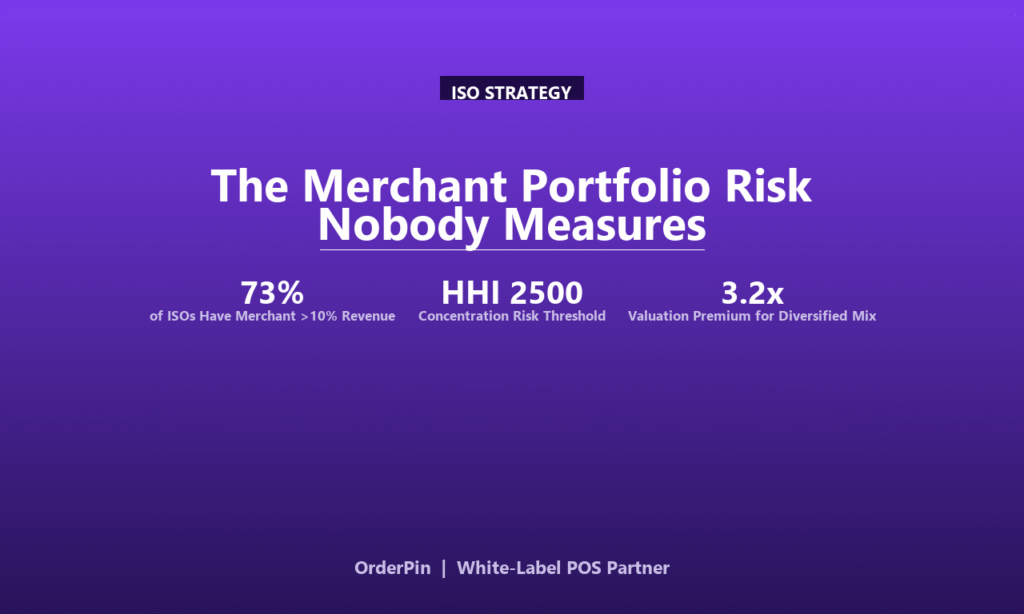
Herfindahl index: A simple concentration metric — square each merchant’s revenue share and sum them — reveals how “lumpy” a book really is, independent of headcount.
2. Three Forms of Concentration Risk
Concentration is not a single problem. It shows up in three distinct forms, and a portfolio can suffer from any one of them without the others being present.
Merchant concentration: Too much revenue from too few accounts. This is the classic form — a book where three or four merchants can move the quarterly numbers on their own.
Industry concentration: Too much exposure to one vertical. An ISO that dominates a single industry — say, full-service restaurants — is exposed to that industry’s downturns, regulation, and seasonal shocks regardless of how many merchants it serves.
Geographic concentration: Too much exposure to one region. A regional ISO that owns its metro area is strong — until a local economic event, a natural disaster, or a regional competitor disrupts the entire base at once.
Processor/platform concentration: Less visible but real — an ISO that depends entirely on one processing platform or one software vendor inherits that vendor’s risk, pricing, and roadmap decisions.
Concentrated Book vs. Diversified Book
| Factor | Concentrated Book | Diversified Book | Winner |
|---|---|---|---|
| Revenue Stability | Fragile, top-heavy | Resilient, averaged | Diversified |
| Valuation Multiple | Discounted | 2.5x premium | Diversified |
| Downturn Survival | Single shock can sink it | Shocks absorbed | Diversified |
| Cross-Sell Reach | Limited segments | Broad base | Diversified |
| Acquirer Interest | Cautious | Premium target | Diversified |
3. Why Diversification Protects More Than Revenue
Diversification is often framed as a defensive move — spreading risk so no single loss is fatal. That is true, but it understates the upside. A diversified book is worth more, not just safer.
Acquirers and investors price concentration risk directly into their offers. A book where 40% of revenue comes from five merchants is a liability waiting to happen, and buyers discount for it. A book where the largest merchant is 3% of revenue is a stable, predictable asset that commands a premium. The same processing volume can carry a 2.5x different valuation purely on the basis of how the risk is distributed.
Diversification also compounds operational advantages. A multi-vertical ISO has broader data, more cross-sell surface, and a recruiting and training engine that is not hostage to one industry’s cycle. When one vertical softens, another is growing. The business smooths its own revenue curve — which is exactly what sophisticated buyers pay for.
Industry M&A advisors consistently note that acquirers apply a concentration discount to books with high top-merchant share, while pricing diversified, multi-vertical portfolios at a meaningful premium — often 2x to 3x the multiple of an equivalent concentrated book.
How OrderPin Helps ISOs Build a Diversified Book
OrderPin is a restaurant POS software ISV that helps independent sales organizations reduce concentration risk by serving more merchants, across more concepts, under their own brand. With white-label POS capabilities, full data ownership, and API-first integrations, OrderPin gives ISOs a platform that scales across a diversified merchant base instead of tying them to a handful of large accounts.
- Multi-concept coverage: One platform serves full-service, quick-service, and specialty food merchants — broadening the vertical mix.
- Full data ownership: ISOs own merchant sales data across the whole book, enabling smarter portfolio and lending decisions.
- White-label program: Merchants run under the ISO’s brand, deepening relationships across a wide base rather than a few anchors.
- API-first architecture: Integrate with the tools each vertical uses, making the platform relevant to merchants of every size.
4. Building a Healthier Portfolio
Reducing concentration risk is not about abandoning large merchants — anchor accounts are valuable. It is about balancing them with a deep, broad base so no single loss is existential.
Track the metrics quarterly: Calculate top-5 and top-10 merchant share, industry mix, and regional mix at least once a quarter. The number only helps if it is current.
Expand vertical reach: A book spread across three to five verticals absorbs industry-specific shocks far better than a single-vertical book of the same size.
Mix merchant sizes: Balance a few anchors with a large base of small and mid-sized merchants. The long tail is the shock absorber that protects the whole book.
Use software to widen the base: A flexible platform lets an ISO onboard smaller merchants efficiently, so diversification does not require proportionally more sales cost.
5. From Risk Report to Action
Measuring concentration risk only matters if it changes behavior. The goal is not a perfect score — it is a book that can survive the loss of any single merchant, industry, or region without a crisis.
A practical quarterly portfolio review:
Pull the top-10 merchant share, the industry mix, and the regional mix. Flag any single merchant above 5% of revenue, any industry above 40%, and any region above 50%. Then set one growth target per quarter explicitly aimed at reducing the largest flag. Over time, the book rebalances — not by dropping anchors, but by growing everything else faster.
The ISOs that do this consistently are the ones buyers chase and downturns cannot break. They have turned an invisible risk into a managed metric — and a measurable competitive advantage.
Frequently Asked Questions
What is merchant portfolio concentration risk?
Concentration risk is the degree to which an ISO’s revenue depends on too few merchants, one industry, or one region. A portfolio can show healthy volume and low churn while still being dangerously dependent on a handful of accounts — meaning the loss of one merchant can cause a disproportionate revenue hit. It is rarely tracked on standard ISO dashboards, which is why it stays hidden until a shock arrives.
How much revenue from one merchant is too much?
There is no single threshold, but a useful warning line is 5% of total revenue from any single merchant. Above that, the departure of one account becomes a structural event rather than routine churn. ISOs should also watch the top-5 and top-10 share: if the top five merchants exceed 20% of revenue, the book is top-heavy and vulnerable to a concentrated loss.
Does diversification really affect ISO valuation?
Yes — directly. Acquirers and investors price concentration risk into their offers, applying a discount to books with high top-merchant share and a premium to diversified, multi-vertical portfolios. Industry advisors consistently describe diversified books as commanding roughly 2x to 3x the multiple of an equivalent concentrated book, because the revenue is more predictable and the downside is better protected.
How can a small ISO diversify without losing focus?
Diversification does not mean abandoning a niche — it means broadening within and around it. An ISO strong in restaurants can expand across full-service, quick-service, and specialty food concepts, and across multiple regions, rather than depending on a few large accounts. A flexible software platform makes onboarding many smaller merchants efficient, so a wider base does not require proportionally more sales cost.
What metrics should ISOs track to measure portfolio health?
At minimum, track top-5 and top-10 merchant revenue share, industry mix, and regional mix, recalculated quarterly. A Herfindahl index — summing the squared revenue share of each merchant — is a single number that captures how “lumpy” the book is regardless of merchant count. Any single merchant above 5%, any industry above 40%, or any region above 50% should be flagged for active rebalancing.
Can software help reduce concentration risk?
Indirectly but powerfully. A flexible, white-label platform lets an ISO serve many merchants efficiently across multiple verticals and merchant sizes, which is the practical mechanism for building a broad, diversified base. It also gives the ISO full ownership of merchant data across the book — the foundation for smarter portfolio decisions, lending, and advisory services that deepen relationships beyond a few anchor accounts.
The merchant portfolio risk nobody measures is the one most likely to end an ISO. Concentration hides inside healthy-looking averages until a single account, industry, or region shocks the book — and by then it is too late to rebalance. The fix is not abandoning anchors; it is building a broad, diversified base and tracking the concentration metrics that reveal fragility before it becomes a crisis. ISOs that manage this risk deliberately command premium valuations and survive downturns their concentrated competitors do not. OrderPin is a restaurant POS software ISV built to help ISOs serve a wider, more diversified merchant base under their own brand — with full data ownership and API-first integrations that turn portfolio risk into a managed, measurable advantage.
About OrderPin
OrderPin is a white-label POS platform built for ISO and MSP partners. We offer full data ownership, flexible pricing, and seamless API integrations to help you build a recurring revenue business under your own brand. Learn more about OrderPin’s white-label solution