
TL;DR — Quick Summary
- Processing is becoming a commodity: Rate compression and interchange regulation are squeezing margins across the industry. The revenue that built the ISO model is getting thinner — which makes the data flowing through those transactions increasingly precious.
- Owned data is the durable asset: ISOs who run their own software stack own the transaction data that competitors cannot see. That data, enriched and applied, is the foundation for analytics products, embedded lending, and advisory services worth multiples of raw processing revenue.
- The window is closing: As embedded finance and AI-driven tools consolidate around the platforms that have the most data, ISOs who wait too long to build a data strategy risk being squeezed from both sides — on rate and on relevance.
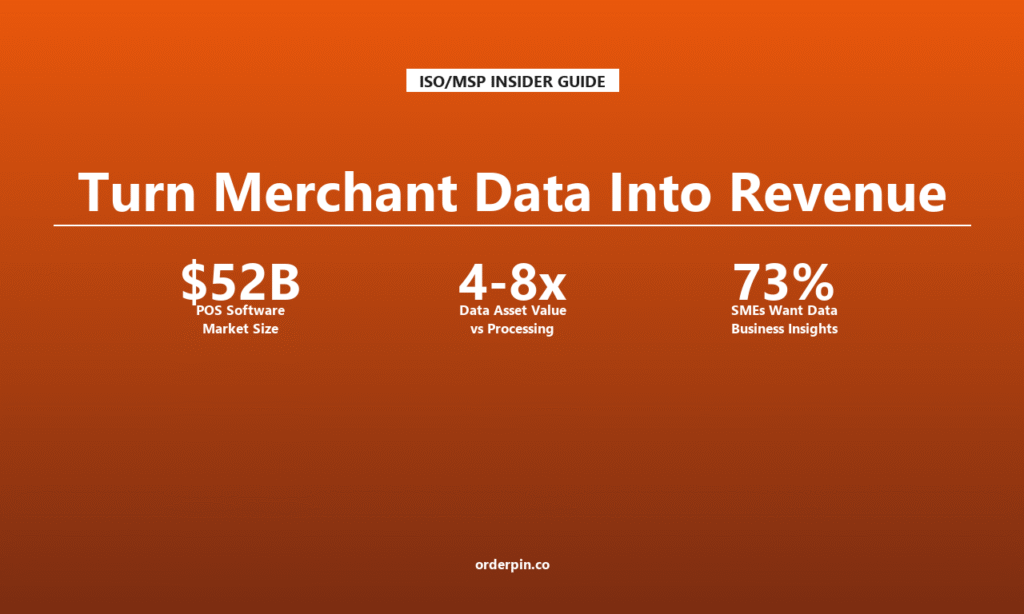
Market Size
Raw Processing
Business Insights
What Is the Merchant Data Monetization Opportunity?
For most of the ISO model's history, the business has been built on a simple premise: take a cut of every transaction that flows through a merchant's terminal. Processing volume times take rate equals revenue. That model still works — but it is getting structurally harder. Interchange regulation, rate compression, and technology democratization have been narrowing take rates for years, and the trend shows no sign of reversing.
The ISOs building the next generation of the business understand something that the old model missed: the transaction data flowing through their merchants' POS terminals is worth far more than the interchange it generates. Not as raw data — but as enriched, owned, and applied intelligence that merchants will pay for, lenders will pay for, and that the ISO can use to build products no competitor can replicate.
This is not a distant theory. It is already happening in pockets of the industry. And the ISOs that act earliest are building the competitive moat that commoditized processing will eventually erode for everyone else.
Market Size
vs Processing
Business Insights
Data-Driven Products
1. Why Processing Revenue Is Getting Harder to Defend
The structural pressure on processing margins is not new — but it is accelerating. Interchange caps in multiple jurisdictions, real-time payment rails that bypass traditional card networks, and white-label solutions that let any software company offer embedded payments are all compressing the take rate that ISOs have historically relied on.
For years, ISOs responded to rate compression by growing volume. More merchants, more locations, more transactions — keeping revenue up even as the margin per transaction fell. That strategy still works, but it requires continuous acquisition at scale, and it leaves an ISO entirely dependent on the one variable that is most under pressure.
The ISOs building durable businesses are adding a second revenue engine:
Own the data layer: If the ISO controls the software that captures the transaction — not just the terminal that processes it — the data belongs to them. No third-party processor can see it, and no competitor can build products from it.
Monetize the intelligence: Raw transaction data becomes a product when it is enriched, structured, and applied. The merchants who generated it will pay for insights about it. The lenders who want to serve those merchants will pay for access to it. And the ISO who owns both the data and the relationship has a defensible position that no rate competitor can replicate.
2. The Three Layers of Merchant Data Value
Not all data is equally valuable, and the path from raw transactions to a monetizable asset requires moving through three distinct layers.
Layer 1 — Transaction data: What was sold, when, at what price, to what customer type. This is the raw material. It has some value in aggregate — for benchmarking and trend analysis — but it is commoditizable and available from many sources.
Layer 2 — Behavioral intelligence: Seasonality patterns, customer repeat rates, daypart mix, ticket size trends, peak hours. This is where data starts to become a product. A restaurant owner who knows their Tuesday lunch pattern is different from last year's can make better staffing decisions. That insight has clear commercial value.
Layer 3 — Predictive and financial data: Revenue forecasts, creditworthiness signals, working capital needs, expansion indicators. This is the highest-value layer — and the most defensible. When an ISO can predict which merchants are likely to need financing in the next 90 days, or which locations are at risk of closing, they have built something that no third-party processor can offer.
Processing-Only ISO vs. Data-Enabled ISO
| Factor | Processing-Only | Data-Enabled | Winner |
|---|---|---|---|
| Revenue Model | Single, rate-dependent | Multi-layer | Data-Enabled |
| Margin Resilience | Thin, compressing | Protected by products | Data-Enabled |
| Competitive Moat | Weak, rate-based | Data-owned, hard to copy | Data-Enabled |
| Cross-Sell Potential | Limited | Lending, analytics, advisory | Data-Enabled |
| Valuation Multiple | Volume-based | Premium for data assets | Data-Enabled |
3. The Products That Turn Data Into Revenue
Owning data is the prerequisite. Monetizing it requires building products that the data makes possible. The three most viable today are analytics dashboards, embedded lending, and merchant advisory services.
Business intelligence dashboards: Merchants — especially SMBs without analytics teams — will pay a subscription for insights derived from their own sales data. Benchmarking against industry peers, seasonal forecasting, customer segmentation. The data is theirs, but the ISO who structured it can charge for access.
Embedded working capital and lending: Transaction data is the most powerful input for small-business credit scoring. An ISO with a data layer can partner with a lender — or become one — to offer merchants loans or advances underwritten against their own sales history. That product commands a significant revenue share and deepens the merchant relationship simultaneously.
Advisory and referral revenue: Armed with data about a merchant's performance, an ISO can become a trusted advisor — recommending staffing changes, menu optimization, expansion timing. Those recommendations lead to referrals to complementary service providers, and the ISO earns a referral fee while deepening the relationship.
How OrderPin Helps ISOs Build the Data Layer
OrderPin is a restaurant POS software ISV that gives independent sales organizations full ownership of the transaction data flowing through their merchant base. Because the POS is the ISO's own white-label platform — not a third-party processor — the data belongs to the ISO and cannot be accessed by competitors. With API-first integrations, flexible data pipelines, and a platform built for scale, OrderPin helps ISOs begin building the data products that will define the next decade of the business.
- Full data ownership: Every transaction, every customer, every behavioral signal flows to the ISO — not to a third-party processor or competing software vendor.
- White-label platform: The merchant relationship is with the ISO's brand, so the data value accrues to the ISO without intermediary leakage.
- API-first integrations: Structured data pipelines make it straightforward to connect to analytics tools, lending partners, and advisory platforms as products mature.
- Built for scale: Multi-concept, multi-location deployment means the data layer grows with the merchant base rather than requiring a new build for each segment.
4. The Technical Foundation: Owning the Software Layer
The prerequisite for data monetization is data ownership. And data ownership requires controlling the software layer, not just the processing layer.
An ISO who runs a third-party processor under a white label has no data rights — the processor sees every transaction and can use that data for their own products or share it with competitors. An ISO who runs their own white-label POS software owns the data by definition. Every sale, every customer interaction, every behavioral signal belongs to them.
The transition from processor to software owner is the structural shift that makes data monetization possible:
An ISO that controls the POS software sits at the center of the merchant's operational stack — capturing not just payment data, but inventory, customer, and behavioral data that no processor-only relationship can access. That position is the foundation for every data product in the roadmap above.
5. Starting the Data Strategy Now
The data monetization opportunity is real, but it has a time dimension. As embedded finance and AI-driven financial products consolidate around the platforms with the richest data, the window for ISOs to establish a data position is not infinitely long.
A practical starting sequence:
Audit what you have: Map the transaction data that flows through your current merchant base. What is captured? Where does it go? Who can access it? The gap between what you generate and what you own is the first priority.
Move the software layer: If your data currently sits with a third-party processor, the highest-leverage move is transitioning to a white-label platform that gives you ownership. OrderPin is a restaurant POS software ISV purpose-built for this transition.
Build the first product: Start with what is achievable — a benchmarking dashboard, a simple working capital offer, or a monthly performance summary. The first product does not have to be sophisticated; it has to prove the model and build merchant habit.
Enrich over time: Each additional data source — customer data, inventory, staffing — makes the predictive models more powerful and the product roadmap richer. Data strategy is a compounding investment.
Frequently Asked Questions
Why is merchant data more valuable than processing revenue?
Processing revenue is structurally compressing due to rate competition and regulatory pressure — and it is available from multiple sources, which limits pricing power. Merchant data, when owned and enriched, can be turned into multiple revenue streams: analytics subscriptions, embedded lending products, and advisory services. The value compounds over time and creates a competitive moat that pure processing revenue cannot. Data-enabled ISOs command a valuation premium because their revenue is diversified and harder to displace.
Do ISOs already have access to merchant data?
It depends on the model. ISOs running a third-party processor under a white label typically have no data rights — the processor captures every transaction and controls access. ISOs running their own white-label POS software own the data by definition. The gap between what data an ISO generates and what they actually own is often the critical blind spot. Auditing that gap is the first step in any data strategy.
What are the most viable data monetization products for ISOs?
Three products have emerged as most viable: business intelligence dashboards that help SMB merchants understand their own performance (subscription revenue), embedded working capital and lending products underwritten against merchant sales data (revenue share or interest income), and advisory services that use data to make actionable recommendations (referral fees or retainer). The right starting point depends on the ISO's current capabilities and merchant base, but all three are accessible without building from scratch.
What does owning the software layer mean in practice?
It means the ISO runs its own POS software platform under its own brand — not just a white-labeled processing agreement with a third party. In this model, every transaction, customer interaction, and behavioral signal is captured by the ISO's own system and belongs to them. That ownership is the prerequisite for every data product in the monetization roadmap. Without it, the data lives with a processor or software vendor who can use it independently.
Is the data monetization opportunity time-sensitive?
Yes, with a meaningful urgency. Embedded finance platforms and AI-driven financial products are consolidating around the platforms with the richest data — and the ISOs that have already established a data position will have a structural advantage over those that are still running purely on processing. The window to build a defensible data position is not closed, but it is narrowing as the platforms that are building on data assets scale faster than the ones that are not.
How does OrderPin support an ISO data strategy?
OrderPin is a restaurant POS software ISV built on a white-label model that gives ISOs full ownership of merchant transaction data. Because the platform is the ISO's own brand and technology stack, the data cannot be accessed by third-party processors or competing software vendors. With API-first architecture, flexible data pipelines, and a platform designed to scale across restaurants of every concept and size, OrderPin provides the foundation for an ISO to begin building the data products — analytics, lending, advisory — that will define the next generation of the business.
Processing revenue built the ISO model, but it is becoming a commodity that no rate strategy can permanently defend. The ISOs building the durable business understand that the data flowing through their merchant base — when owned, enriched, and applied — is worth more than the interchange it generates. The path starts with owning the software layer, building the first data product, and treating data as a strategic asset rather than a byproduct of processing. The window is not closed, but it is narrowing. OrderPin is a restaurant POS software ISV built to help independent sales organizations make that transition — a white-label platform where the data belongs to the ISO, the products are theirs to build, and the competitive moat compounds over time.
About OrderPin
OrderPin is a white-label POS platform built for ISO and MSP partners. We offer full data ownership, flexible pricing, and seamless API integrations to help you build a recurring revenue business under your own brand. Learn more about OrderPin's white-label solution