
TL;DR — Quick Summary
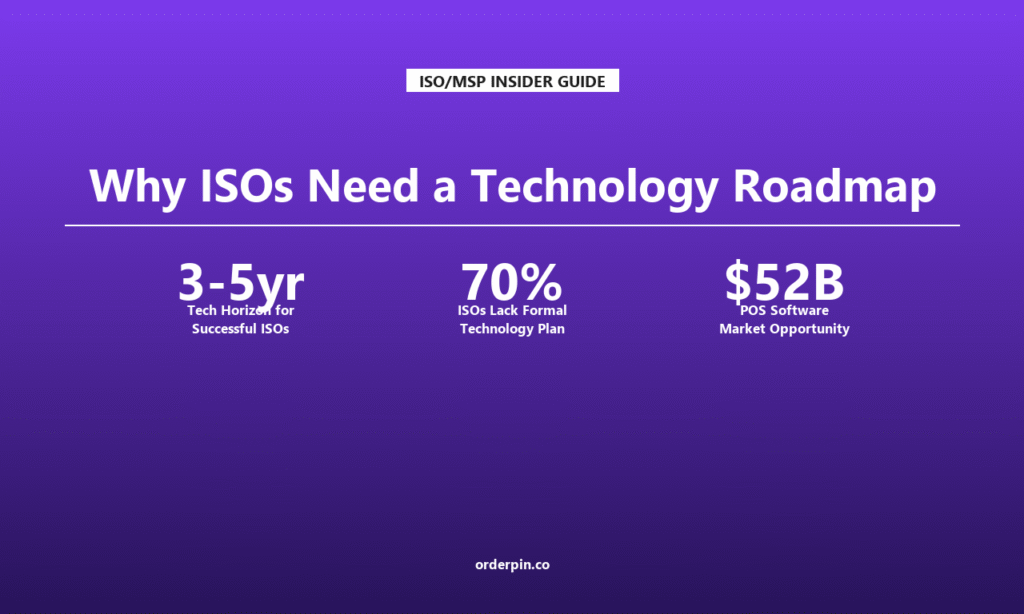
- 70% of ISOs have no formal technology roadmap: They run on sales plans, pricing tactics, and processor relationships — not a deliberate technology strategy for where the business needs to be in three to five years.
- The gap between tech-forward and tech-naive ISOs is widening: AI, real-time data, white-label platforms, and merchant self-service tools are separating the ISOs building durable businesses from those competing on rate alone.
- A technology roadmap is a business plan, not an IT project: It aligns your merchant value proposition, revenue model, and competitive positioning with the technology capabilities that will matter most over the next three to five years.
for Successful ISOs
Technology Plan
Market Opportunity
What Is a Technology Roadmap for an ISO?
A technology roadmap for an independent sales organization is a structured answer to a deceptively simple question: what does our technology platform need to look like in three years, and what do we need to do today to get there?
Most ISOs have a sales plan — a strategy for signing merchants, hitting volume targets, and growing residual income. Fewer have a parallel technology strategy that maps the same three-to-five-year horizon against the tools, integrations, data capabilities, and software platforms the business will need to stay competitive.
That gap is widening into a real liability. The pace of change in payments technology — AI, real-time data, cloud-native platforms, embedded finance — is accelerating. ISOs without a deliberate roadmap are making technology decisions reactively, one vendor pitch at a time, with no coherent picture of where the business is heading.
Meaningful Tech Change
Technology Strategy
Size by 2028
Become Table Stakes
1. Why Technology Planning Is Now a Competitive Necessity
For most of the payments industry’s history, an ISO could survive — and even thrive — on the strength of its sales network alone. A good book of merchants, solid processor relationships, and a competitive rate were enough. Technology was largely the processor’s problem.
That era is ending. The technology gap between the most sophisticated ISOs and the rest is now large enough to affect merchant retention, acquisition cost, and portfolio valuation. Merchants are increasingly evaluating payment providers not just on rate, but on the technology platform they offer: dashboards, integrations, self-service tools, and data access.
Retention is tied to technology: Merchants on a platform with real-time reporting, self-service management, and integrated tools are significantly stickier than those on a processing-only relationship. The technology isn’t just a feature — it’s the retention mechanism.
Acquisition cost is rising without technology: Cold outreach and rate competition are becoming more expensive. ISOs with a modern platform story — white-label POS, real-time dashboards, API integrations — have a more compelling pitch and lower effective cost of acquisition.
Valuation reflects technology readiness: Acquirers price software-enabled ISOs at 3–8x revenue versus 1–1.5x for processing-only equivalents. The difference isn’t just current revenue — it’s the technology roadmap that makes the future value clear.
2. The AI Revolution Is Accelerating the Gap
Artificial intelligence is the most significant technology shift in payments since the internet. For ISOs, it has two distinct implications: threat (processors and fintechs will use AI to automate the tasks ISOs currently charge for) and opportunity (ISOs who adopt AI tools can dramatically increase their service efficiency, merchant retention, and competitive differentiation).
The threat is real. Processors are already deploying AI for fraud detection, underwriting, and customer service. Some will eventually offer small merchants a self-service onboarding and management experience that reduces the need for an ISO intermediary. ISOs that have built their business purely on processing — without a technology layer — will face real competitive pressure within two to three years.
The opportunity is equally real. ISOs who adopt AI-assisted support, predictive merchant analytics, and automated compliance tools can deliver a level of service that was previously only available to large enterprise merchants. The ISO who uses AI to surface a merchant’s rising decline rate before the merchant notices — and offers a solution — is building a relationship that no automated platform can replicate.
Industry analysts tracking the payments sector note that the next two to three years represent a critical window: ISOs that establish AI-ready technology foundations now will be positioned to compete in a fundamentally different market; those that wait will face higher switching costs and narrower windows of opportunity.
How OrderPin Helps ISOs Build Their Technology Roadmap
OrderPin is a restaurant POS software ISV that gives ISOs a ready-made technology platform to anchor their roadmap. With white-label POS, API-first architecture, and full data ownership, OrderPin provides the technology foundation ISOs need to offer AI-ready tools, real-time dashboards, and merchant self-service — under their own brand.
- White-label platform: Offer merchants a complete, branded technology stack — no development required.
- API-first architecture: Build AI integrations, custom dashboards, and analytics tools on top of a modern foundation.
- Data ownership: Own the merchant data you need to power predictive analytics and personalized service.
- No long-term lock-in: Partner on your terms; your roadmap, your merchant relationships, your control.
3. The Software Partnership Path to a Technology Roadmap
Building a technology roadmap doesn’t mean building technology. For most independent ISOs, the right path is strategic partnership: identifying the right technology providers, white-labeling their platforms, and distributing them under your own brand.
Platform anchor: Identify one or two foundational technology products — a POS platform, a reporting dashboard, a compliance tool — that serve as the core of your merchant technology stack. Everything else builds around them.
Integration layer: Map the APIs, data flows, and integration points between your core platform and adjacent tools — accounting, inventory, delivery, loyalty. This is where the stickiness lives.
AI readiness: Every new technology partnership should be evaluated against one question: does this position us to offer AI-powered tools to our merchants within three years? If not, the partnership may solve today’s problem while creating tomorrow’s gap.
ISOs With vs. Without a Technology Roadmap
| Factor | With Roadmap | Without Roadmap | Winner |
|---|---|---|---|
| Merchant Retention | 90%+ annual | 75–85% annual | With Roadmap |
| AI Readiness | 2–3 year plan in place | Ad hoc, reactive | With Roadmap |
| Valuation Multiple | 3–8x revenue | 1–1.5x revenue | With Roadmap |
| Technology Decisions | Deliberate, aligned to strategy | Vendor-driven, fragmented | With Roadmap |
| Competitive Position | Platform-based moat | Price-based, commoditized | With Roadmap |
4. Building a Future-Proof ISO Business
A technology roadmap is ultimately a business strategy document. It answers the question: what does a future-proof ISO business look like, and what do we need to build to get there?
Merchant data ownership: The businesses that will be most valuable in three to five years are the ones that own rich merchant data — sales trends, labor patterns, customer behavior. Every technology decision should be evaluated by whether it deepens or diminishes your data position.
Compliance infrastructure: PCI DSS, EMV, GDPR, and the next regulatory wave — AI governance — will all require technology infrastructure. Build compliance into your roadmap, not on top of it.
Partner ecosystem: The most successful future-proof ISOs are not building everything — they’re assembling an ecosystem of technology partners whose products work together, whose data they own, and whose economics align with their growth.
5. Practical Steps to Develop Your Technology Roadmap
Building a technology roadmap doesn’t require a consultant or a six-month planning process. It requires one or two focused sessions where you answer four questions honestly, and a commitment to revisit the answers annually.
Where do we want to be in three years?
Define the target state in terms of merchant value proposition, not technology features. What does the merchant experience look like? What data do you own? What revenue streams are generating recurring income? Work backward from that target to identify the technology capabilities required.
What technology gaps put us at risk today?
Honest assessment of current gaps: Is your onboarding digital? Do merchants have self-service reporting? Are you positioned for AI-assisted support? Are your technology decisions driven by vendor pitches or by your strategy? The answers define your starting point.
What are the one or two technology anchors for the roadmap?
Identify the foundational technology product — the white-label POS, the compliance platform, the reporting system — that will anchor your merchant value proposition. Everything else builds from there. Most ISOs need one anchor; ambitious ones build two.
What partners do we need, and what are the economics? Map the technology partners who can deliver each component of the roadmap. Evaluate them not just on product quality, but on data ownership terms, white-label flexibility, and alignment with your three-year target. Build a 12-month vendor evaluation calendar.
Frequently Asked Questions
Why do most ISOs lack a technology roadmap?
Most ISOs are sales-driven organizations. Their core competency is merchant relationships, sales, and service — not technology strategy. Until recently, that was sufficient. But as merchant expectations shift toward real-time data, self-service tools, and AI-assisted support, the lack of a technology strategy is becoming a competitive liability rather than a neutral condition.
How long does a technology roadmap take to develop?
A meaningful first draft can be developed in one or two focused working sessions. The key is answering the right questions: where do we want to be in three years, what gaps put us at risk today, and what one or two technology anchors will define our platform. The roadmap should be treated as a living document — reviewed and updated annually as the market evolves.
Does a technology roadmap require building custom software?
No. The most effective technology roadmaps for ISOs are built on strategic partnerships with technology providers — white-labeling proven platforms, assembling an ecosystem of tools, and owning the merchant data and relationships. The roadmap identifies what technology capabilities you need; the partnerships deliver them without requiring your organization to become a software developer.
How does AI fit into an ISO technology roadmap?
AI is the most significant near-term technology shift for ISOs. Every technology decision in the roadmap should be evaluated by one question: does this position us to deliver AI-powered tools to our merchants within three years? AI-assisted support, predictive analytics, automated compliance, and personalized merchant insights are all within reach for ISOs with the right technology foundations.
What is the biggest risk of not having a technology roadmap?
The biggest risk is reactive, fragmented technology decisions — one vendor pitch at a time, no coherent picture of where the business is heading, and a growing gap between what merchants expect and what you can deliver. In two to three years, ISOs without a technology strategy will face a choice between rapid catch-up investment and competitive decline.
How does a technology roadmap affect ISO valuation?
Directly. Acquirers consistently price ISOs with software platforms and technology roadmaps at 3–8x revenue versus 1–1.5x for processing-only equivalents. The roadmap signals that the ISO has a plan for future value creation — not just current revenue — which justifies a premium multiple.
Most ISOs have a sales plan. Fewer have a technology roadmap. The gap is now a competitive liability. Merchants expect modern tools, AI-ready platforms, and self-service capabilities that processing-only ISOs cannot deliver. The next three years are a critical window — ISOs that build technology foundations now will compete at a premium valuation; those that wait will face higher costs and narrower options. OrderPin is a restaurant POS software ISV that helps ISOs build the technology platform their roadmap needs — white-label POS, API-first architecture, full data ownership, and no long-term lock-in.
About OrderPin
OrderPin is a white-label POS platform built for ISO and MSP partners. We offer full data ownership, flexible pricing, and seamless API integrations to help you build a recurring revenue business under your own brand. Learn more about OrderPin’s white-label solution