
TL;DR — Quick Summary
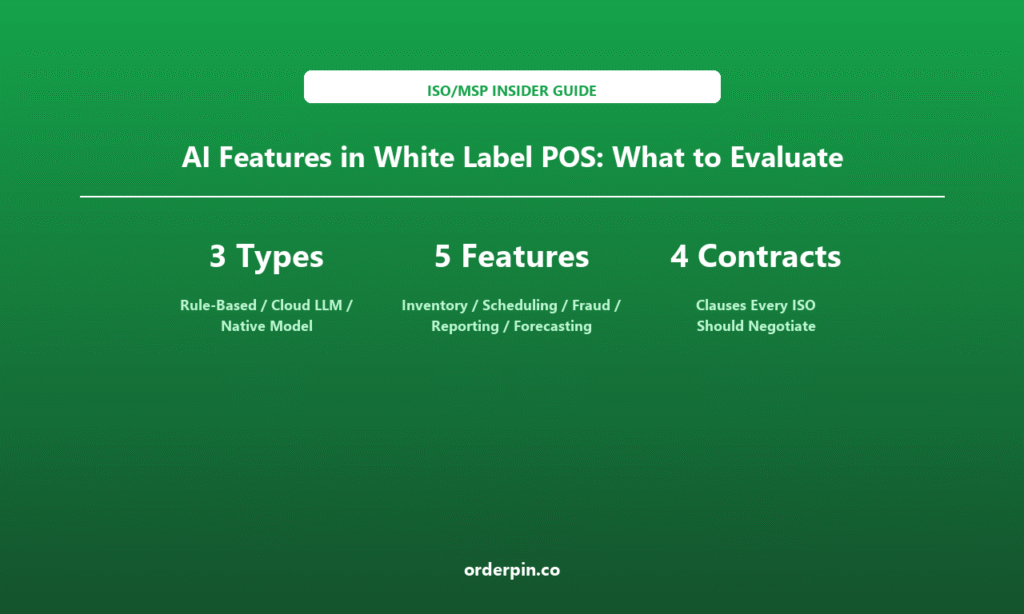
- There are three fundamentally different types of “AI” in POS systems, and conflating them is the most common evaluation mistake: rule-based automation (deterministic logic that does the same thing every time), cloud LLM API calls (third-party AI that processes your data externally), and native model training (models trained specifically on your merchant’s transaction data). Rule-based automation is not AI — it is software. Cloud LLM API calls are real AI but introduce data privacy, cost, and dependency risks. Native model training is the most valuable but also the most expensive and the most contractually complex.
- The five AI features most white label POS vendors claim in 2026 — and how to evaluate each honestly: predictive inventory, AI scheduling, fraud detection accuracy, conversational reporting, and demand forecasting. For each feature, the ISO should ask: is this rule-based, cloud LLM, or native model? What data does it use? Who owns the output? What does the contract say about data used for AI training? These questions reveal more about the AI claim than any vendor demo.
- Contract language is the most underutilized tool ISOs have for protecting themselves on AI features: most white label agreements do not address who owns AI model outputs, who is liable for AI-driven decisions (fraud flags, inventory recommendations), whether merchant data used in AI training can be used to serve other merchants, and what happens to AI features if the platform provider changes its LLM provider. Getting clear answers on these four questions before signing is the single most valuable thing an ISO can do in an AI evaluation.
Native Model
Reporting / Forecasting
Should Negotiate
The AI Evaluation Problem in White Label POS
In 2024, “AI-powered” was a marketing term. In 2026, it is becoming a required feature — merchants expect their POS to do something intelligent beyond processing transactions. The problem for ISOs evaluating white label platforms is that “AI-powered” still means different things in different contexts, and a vendor’s claim to have AI does not tell you whether that AI will actually help your merchants or create liability exposure for your business.
This article gives you a framework for evaluating AI features honestly. It covers the three types of AI in POS systems, the five features most white label vendors claim, how to test each one, the questions to ask before signing, and the contract language that protects the ISO. The goal is not to help you find the platform with the most AI — it is to help you understand what you are actually getting when a vendor says “AI.”
false positive costs
model portability
review rights
log ownership
1. The Three Types of AI in POS Systems — and Why the Distinction Matters
Type 1 — Rule-based automation (NOT AI): the system follows a predetermined decision tree: “if item inventory falls below X, flag for reorder.” This is deterministic software — it does the same thing every time, produces the same output given the same input, and cannot improve from new data. Vendors sometimes call this “AI” because it looks intelligent, but it has no learning capability. For the ISO, the risk is accepting a higher price for a feature that is just software, and recommending it to merchants as something more sophisticated than it is.
Type 2 — Cloud LLM API calls (Real AI, with risks): the POS system sends merchant data to a third-party LLM provider (OpenAI, Anthropic, Google) via API, receives a response, and acts on it. This is real AI with genuine capability. The risks are: (1) merchant transaction data leaves your infrastructure — confirm the vendor has a DPA (Data Processing Agreement) that restricts the LLM provider from using that data for training; (2) API costs are passed through to the ISO or merchant — confirm the pricing model before assuming the feature is “included”; (3) the vendor can change LLM providers (e.g., switch from GPT-4 to Gemini) which may change the output quality without notice.
Type 3 — Native model training (Real AI, highest value, highest complexity): the platform provider trains a model specifically on the merchant’s transaction history, inventory data, and operational patterns. This produces genuinely personalized predictions — an inventory model trained on 18 months of a restaurant’s actual sales data can predict that restaurant’s Tuesday lunch patterns better than any general-purpose model. The contract complexity is highest here: who owns the trained model? If the merchant leaves, does the model stay? Can the model be used to benefit other merchants on the platform?
2. The Five AI Features — What to Test, What to Ask
Predictive Inventory
What to test: feed the system 90 days of your merchant’s actual sales data and ask for the next 30 days of inventory recommendations. Compare the recommendations to what a competent restaurant manager would order. Test the edge cases: a slow Tuesday in January versus a Super Bowl Sunday. Does the system treat every week the same, or does it account for seasonality?
Key questions: What data does the model use? Is it trained on general restaurant data or this specific merchant’s history? If the merchant leaves, does the recommendation quality degrade immediately (because it was general-purpose) or has it already learned the merchant’s patterns (native model)? Who owns the model outputs?
AI Scheduling
What to test: give the system the merchant’s 90-day sales by hour, employee availability constraints, and historical labor cost data. Ask for a weekly schedule. Then ask: what happens if I add a new employee? What happens if Thursday lunch volume increases 30%? Can I review and override recommendations before publishing? An AI scheduler that does not allow override is a liability, not a feature.
Key questions: Does the system allow manager review before schedule publication? What liability does the ISO carry if an AI scheduling recommendation results in understaffing and a health code violation? Is there an audit trail for schedule overrides?
Fraud Detection
What to test: ask the vendor for the fraud detection accuracy rate (true positive rate) and the false positive rate — specifically for the merchant’s vertical. A fraud detection system that catches 95% of fraud but has a 10% false positive rate is not a good system; it generates chargebacks through false declines. The metric that matters for the ISO is net fraud reduction after accounting for false positives.
Key questions: What is the false positive rate, specifically? Who is liable for chargebacks that the AI did not flag? Is the fraud model trained on the merchant’s own transaction history or on a general dataset? Does the merchant have the ability to whitelist known-good card numbers or customer accounts?
Conversational Reporting
What to test: ask three types of questions: (1) factual (“what was our revenue last Tuesday?”) — this should be accurate and fast; (2) comparative (“compare Tuesday vs Wednesday this week vs last week”) — this tests the model’s ability to handle context; (3) analytical (“why was Tuesday revenue down 15% versus last Tuesday?”) — this tests whether the system can generate causal hypotheses or just reports numbers. Poor performance on type 3 is not necessarily a system failure — conversational AI has well-known limitations on causal reasoning. The ISO should calibrate expectations accordingly.
Key questions: Are query logs (the questions merchants ask) used to train the AI model? If so, can merchants opt out? Does the vendor have a DPA covering query data? Can the merchant export their query history if they switch platforms?
3. Contract Language That Protects the ISO
Clause 1 — AI data ownership: The agreement should state clearly that merchant transaction data, inventory data, and AI query logs are owned by the merchant (or the ISO, depending on your agreement with the merchant). The platform provider may not use merchant data to train models that serve other merchants without explicit written consent from the data owner. This is not a theoretical risk — LLM providers have historically used API input data for training unless explicitly opted out, and the default in many white label agreements is that the provider retains rights to anonymized data.
Clause 2 — AI output ownership: Who owns the recommendations, predictions, and reports generated by the AI? If the system recommends $4,000 of inventory that the merchant orders and the recommendation is wrong, who is liable? The agreement should specify that AI-generated recommendations are advisory only and that the merchant and ISO bear responsibility for operational decisions — and that the platform provider does not guarantee the accuracy of AI outputs.
Clause 3 — LLM provider changes: If the platform provider changes its underlying LLM provider (e.g., switches from GPT-4 to a cheaper or different model), the agreement should require 60 days’ notice and the opportunity for the ISO to terminate without penalty if the change materially degrades AI feature quality. A change in the underlying model can significantly change the quality of AI outputs — especially for conversational reporting — and the ISO should not be locked into a contract where the AI feature quality is at the vendor’s unilateral discretion.
Clause 4 — Feature discontinuation: The agreement should specify that AI features are not discontinued without 90 days’ notice, and that if an AI feature is discontinued, the ISO may either receive a pro-rata refund for the feature or terminate the affected portion of the agreement without penalty. “AI-powered” features have been added to many white label agreements as included features; if they are removed, the ISO should not be paying the same price for a degraded product.
How OrderPin Approaches AI Feature Evaluation
OrderPin is a white-label POS platform built for ISO and MSP partners. We believe AI features should be evaluated honestly, not marketed as something they are not. OrderPin’s white label AI approach includes transparent disclosure of what is rule-based automation versus real AI, clear data processing agreements covering AI training data, and contract language that protects ISO and merchant interests on AI output ownership. If you are evaluating AI features in a white label POS platform, we recommend asking every vendor the four questions above before signing — and we are happy to share what our own answers are.
Frequently Asked Questions
What is the difference between rule-based automation and real AI in a POS system?
Rule-based automation is deterministic software that follows predetermined decision trees: “if X, then do Y.” It produces the same output every time for the same input and cannot improve from new data. Real AI (cloud LLM or native model training) can learn patterns, generalize from examples, and improve over time. The test for whether something is real AI: does the same input ever produce different outputs at different times? If yes, it is AI. If no, it is software. Many white label vendors market rule-based automation as “AI” — the ISO should ask specifically what the system is doing under the hood.
What is the most important question to ask about AI fraud detection in a POS?
The false positive rate. A fraud detection system that catches 95% of fraudulent transactions but has a 10% false positive rate generates chargebacks through legitimate transactions being declined. The metric that matters for the ISO is net fraud reduction after accounting for false positives. Ask the vendor for their false positive rate by merchant vertical — restaurant false positive rates are typically higher than retail because card-present restaurant transactions have inherently higher fraud risk profiles. Also ask: who bears liability for chargebacks that the AI did not flag? This is often not addressed in standard white label agreements.
What contract clause protects the ISO when merchant data is used for AI training?
A data ownership clause stating that merchant transaction data, inventory data, and AI query logs are owned by the merchant or the ISO (depending on the ISO-merchant agreement), and that the platform provider may not use that data to train AI models that serve other merchants without explicit written consent. Additionally, a DPA (Data Processing Agreement) that restricts the underlying LLM provider from using API input data for training. The default in many agreements is that the provider retains rights to anonymized data — negotiate this explicitly before signing. A model trained on one merchant’s data should benefit that merchant, not the platform provider’s other customers.
What happens to AI features if the white label vendor changes their LLM provider?
The contract should address this specifically: 60 days’ notice before any change in the underlying AI model, with the opportunity to terminate the affected AI features or the entire agreement without penalty if the change materially degrades feature quality. A switch from GPT-4 to a cheaper or less capable model can meaningfully change the quality of conversational reporting, fraud detection accuracy, and predictive inventory reliability. Without this clause, the ISO has no recourse if the vendor switches to a lower-quality model mid-contract to reduce costs. This is not hypothetical — AI API costs are significant and vendors have strong incentives to optimize them.
How do I test whether predictive inventory AI is actually useful versus rule-based automation?
Test with edge cases that rule-based systems handle poorly: a slow Tuesday in January versus a Super Bowl Sunday, or a menu change (new item added, old item removed). A rule-based system will apply the same logic regardless; a real AI model will adjust based on learned patterns. Also test whether recommendations change over time as more data is collected — a native model should produce increasingly accurate recommendations after 6 months versus 3 months of training data. A system that produces identical recommendations regardless of training duration is likely rule-based. Ask the vendor explicitly whether the inventory model is trained on the specific merchant’s history or on a general restaurant dataset.
Who is liable if an AI scheduling recommendation results in understaffing and a health code violation?
The contract should explicitly address this. AI-generated scheduling recommendations should be classified as advisory, not directive — the merchant manager should be required to review and approve schedules before publication, with clear documentation of the review and any overrides. The agreement should state that the platform provider does not guarantee the fitness of AI scheduling recommendations for any specific operational situation and that the merchant bears responsibility for staffing decisions. Without this clause, there is a theoretical liability exposure for the ISO if a severely understaffed shift results in a health code violation or a service failure. Negotiate this language explicitly before offering AI scheduling features to your merchants.
Not all AI in white label POS is the same: rule-based automation is software, not AI; cloud LLM API calls are real AI with real data privacy and cost risks; native model training is the most valuable but requires the most careful contract management. The five AI features most vendors claim — predictive inventory, AI scheduling, fraud detection, conversational reporting, and demand forecasting — each require specific evaluation: test with edge cases, ask about the underlying model type, and get contract language on data ownership, output ownership, LLM provider changes, and feature discontinuation. The ISO that evaluates AI features honestly — and protects itself contractually — builds a sustainable AI strategy. The ISO that accepts vendor demos at face value ends up with marketing AI, real liability, and merchants who are disappointed. OrderPin is a white-label POS platform built for ISO and MSP partners — with transparent AI feature disclosures, clear data agreements, and contract language that protects the ISO’s interests.
About OrderPin
OrderPin is a white-label POS platform built for ISO and MSP partners. We offer full data ownership, flexible pricing, and seamless API integrations to help you build a recurring revenue business under your own brand. Learn more about OrderPin’s white-label solution