
TL;DR — Quick Summary
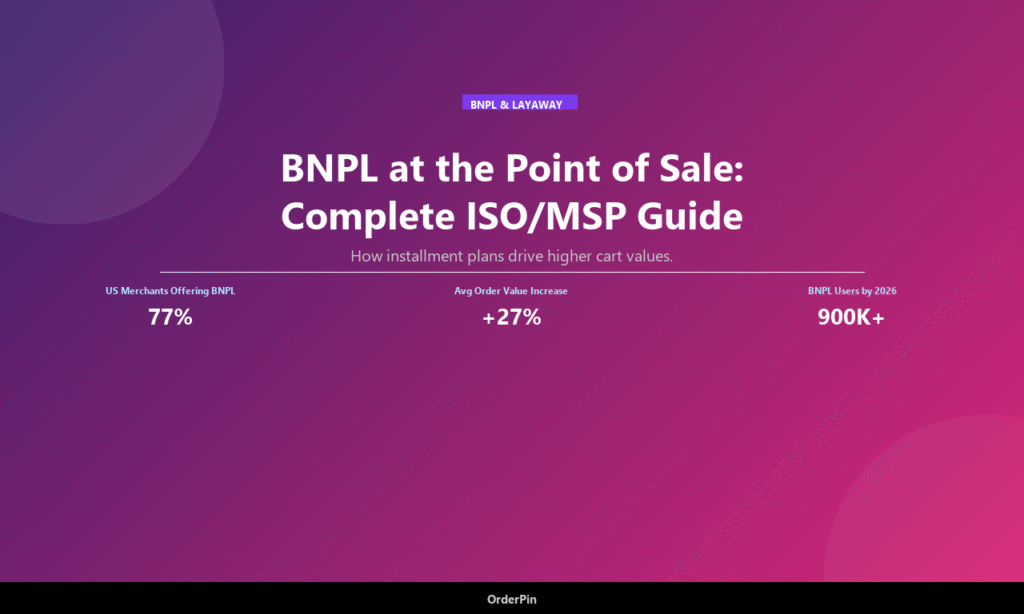
- Key Takeaway 1: BNPL (Buy Now, Pay Later) adoption among U.S. merchants reached 77% in 2025, driven by a 27% average increase in average order value (AOV) for participating merchants.
- Key Takeaway 2: ISOs earn transaction-based residuals on BNPL volume and can differentiate their merchant offerings by bundling BNPL with standard card processing — often as a single POS integration.
- Key Takeaway 3: Not all BNPL programs are equal: merchant fees range from 2–6% per transaction, and ISO residuals vary widely. Choose white-label BNPL providers that share residuals with ISO partners.
What Is BNPL at the Point of Sale?
BNPL (Buy Now, Pay Later) at the point of sale is a payment method that allows customers to split purchases into installment payments — typically four interest-free payments every two weeks, or longer-term financing plans for larger purchases — without traditional credit card interest. At the POS level, BNPL appears as a selectable payment option alongside debit and credit cards, and it is integrated directly into the merchant’s checkout flow.
For Independent Sales Organizations (ISOs) and Merchant Service Providers (MSPs), BNPL represents both a merchant retention tool and a revenue opportunity. Merchants who offer BNPL see higher conversion rates, larger basket sizes, and reduced cart abandonment — benefits that translate directly into higher processing volume for the ISO’s book of business.
Last updated: May 2026
How BNPL POS Integration Works
From the merchant’s POS perspective, BNPL integration typically follows one of two models:
- Embedded BNPL (SoftPOS): The BNPL option appears as a payment method within the POS software. The customer selects BNPL, completes a soft credit check via the BNPL provider’s app or QR code, and the merchant receives full payment upfront while the BNPL provider manages the installment collection from the customer. The merchant pays a flat fee (typically 2–6% per transaction) but receives the full sale amount immediately.
- BNPL as a Card Network: Some BNPL providers (notably Affirm and Afterpay) can function as virtual card networks, where the BNPL plan is processed as a card transaction. This model integrates more easily with existing card POS terminals but typically carries higher merchant fees.
In both cases, the merchant receives money upfront and the BNPL provider assumes the credit risk and manages collections. This is fundamentally different from traditional installment credit, where the merchant receives payments over time.
Why Merchants Want BNPL: The Business Case
BNPL adoption among merchants is accelerating because the data consistently shows positive outcomes:
- 27% average AOV increase: Merchants offering BNPL consistently see customers spend more per transaction. Customers are willing to commit to larger purchases when they can spread payments over time.
- 30% reduction in cart abandonment: Price is the #1 reason for online cart abandonment. BNPL’s split-payment option reduces sticker shock, particularly for purchases between USD 50 and USD 500.
- Higher conversion rates: Studies show BNPL options increase checkout conversion rates by 20–35% compared to card-only checkout, particularly for first-time customers.
- No credit risk for merchants: The BNPL provider assumes all credit risk. If a customer defaults, the merchant has already been paid in full.
- Customer acquisition: BNPL users tend to be younger, tech-savvy consumers (18–40 demographic) who are more likely to become repeat customers.
BNPL Providers: A Quick Comparison
| Provider | Merchant Fee | Pay-in-Four | Monthly Financing | ISO Partnership |
|---|---|---|---|---|
| Affirm | 3–5.99% | Yes | Yes (0–30% APR) | Yes |
| Afterpay (Block) | 3–6% | Yes | Limited | Limited |
| Klarna | 3.29–5.99% | Yes | Yes | Partner Program |
| PayPal Pay Later | 2.09–3.49% | Yes | Yes (Pay in 6/12) | Yes (PayPal) |
| Sezzle | 5.5% + USD 0.30 | Yes | No | Yes (ISO-friendly) |
| Zip (QuadPay) | 4.95% + USD 0.50 | Yes | No | Partner Program |
Industries Where BNPL Performs Best
BNPL is not equally effective across all merchant categories. Data from 2025 BNPL adoption studies reveals which industries see the strongest returns:
- Electronics and consumer tech: High-ticket purchases (USD 100–1,000+) see the most dramatic AOV increases. A USD 600 TV purchase that a customer might hesitate on becomes an easy decision when split into four USD 150 payments.
- Furniture and home goods: The furniture industry has some of the highest cart abandonment rates in retail. BNPL transforms a USD 2,000 sofa purchase — which would require financing through a traditional lender — into a manageable four-payment plan.
- Health and wellness: Gym equipment, supplements, and wellness services see strong BNPL adoption among the 25–40 demographic that prefers not to carry credit card balances.
- Restaurants (group dining): Large party bills at restaurants are increasingly being split using BNPL apps, improving tip amounts and reducing payment friction.
- Retail fashion and apparel: BNPL adoption in fashion retail has increased average order values by 30–40% as customers are more willing to complete larger basket purchases.
The ISO Revenue Opportunity in BNPL
BNPL represents a meaningful revenue stream for ISOs beyond traditional card processing residuals:
- Transaction residuals: ISOs typically earn 0.5–2.0% residual on BNPL transaction volume, depending on the provider and volume tier.
- Setup fees: Some ISOs charge merchants a one-time integration/setup fee for BNPL POS activation, typically USD 25–200.
- Volume bonuses: Many BNPL provider partner programs offer volume-based bonuses that reward ISOs who drive significant BNPL transaction volume.
- Merchant retention: Merchants who offer BNPL are significantly stickier — the switching cost of reconfiguring BNPL integration adds friction to switching POS providers.
Frequently Asked Questions
How does BNPL affect credit card processing volume for ISOs?
BNPL can slightly reduce card processing volume as customers shift some purchases from credit cards to BNPL installment plans. However, the net effect for most ISOs is positive: merchants who offer BNPL typically see a 15–20% net increase in total payment volume as AOV increases and cart abandonment decreases. ISOs should monitor their merchant mix to ensure BNPL volume compensates for any card volume shifts.
Are BNPL transactions subject to the same PCI DSS requirements as card transactions?
Partially. When BNPL is processed through an embedded integration where the merchant never handles card data, the merchant’s PCI DSS scope is reduced because no cardholder data touches their systems. However, if the BNPL is processed via a virtual card (BNPL-as-card-network model), the merchant’s standard card processing PCI requirements still apply. OrderPin’s BNPL integration is designed to keep merchant PCI scope minimal.
What happens if a customer defaults on a BNPL plan?
The BNPL provider absorbs the default — not the merchant. The merchant has already been paid in full at the time of the transaction. The BNPL provider pursues collections from the customer, which may include late fees, negative credit reporting, and debt collection. Some BNPL providers pass through a portion of default costs to merchants in higher fees, but this is typically only for merchants in high-risk categories.
Which BNPL provider should ISOs prioritize for their merchant book?
For most ISOs serving SMB merchants, PayPal Pay Later offers the best combination of low merchant fees (2.09–3.49%), broad consumer awareness (PayPal has 430+ million active accounts), and ISO-friendly residual sharing. Affirm is preferred for larger-ticket merchants (furniture, electronics) where longer-term financing options matter. Sezzle is often the best fit for ISOs targeting younger demographics and fashion/beauty merchants.
Can merchants offer both BNPL and traditional card processing through the same POS?
Yes — and this is actually the standard model. Merchants offer BNPL as an additional payment option alongside debit, credit, and cash. The customer chooses at checkout. A white-label POS platform like OrderPin integrates multiple BNPL providers alongside standard card processing, giving merchants a single POS screen that handles all payment types.
Conclusion
BNPL at the POS is not a trend that ISOs can afford to sit out. With 77% of U.S. merchants now offering some form of buy now, pay later, and proven data showing 27% AOV increases and 30% reductions in cart abandonment, BNPL has become a mainstream payment category that drives real merchant value.
For ISOs, the opportunity is clear: bundle BNPL with your existing card processing offering, earn residuals on a new transaction category, and differentiate your merchant value proposition in a competitive market. The ISOs who act now — before BNPL becomes table stakes — will capture the early-mover advantage in residuals and merchant loyalty.
Why ISO Partners Choose OrderPin
About OrderPin
OrderPin is a white-label POS platform built for ISO and MSP partners. We offer full data ownership, multi-BNPL integration, BNPL residual sharing, and seamless API integrations to help you build a recurring revenue business under your own brand.
Learn more about OrderPin’s white-label solution