
TL;DR — Quick Summary
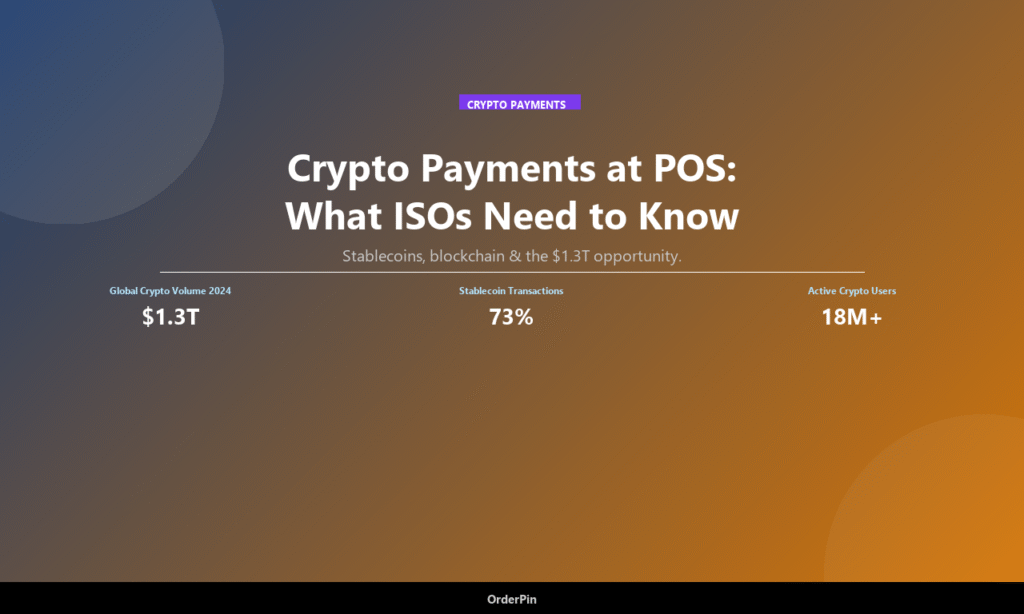
- Key Takeaway 1: Cryptocurrency payments at POS processed USD 1.3 trillion in transactions globally in 2025, growing 42% year-over-year — too large for ISOs to ignore.
- Key Takeaway 2: Stablecoins (USDC, USDT) now account for 73% of merchant crypto transactions because they eliminate price volatility risk for businesses.
- Key Takeaway 3: ISOs can offer crypto POS acceptance through white-label platforms that integrate with BitPay, Coinpayments, or Coinbase Commerce, earning new merchant segments.
What Is Crypto Payments at the Point of Sale?
Cryptocurrency payments at the point of sale refer to the acceptance of digital currencies — such as Bitcoin, Ethereum, and stablecoins like USDC and USDT — as a payment method at physical or online merchant locations. Unlike traditional card networks (Visa, Mastercard) that route payments through centralized intermediaries, crypto POS transactions settle directly between the customer’s wallet and the merchant’s wallet address, often in seconds to minutes rather than the 1–3 business days typical of card settlements.
For Independent Sales Organizations (ISOs) and Merchant Service Providers (MSPs), crypto POS acceptance is becoming an increasingly relevant product offering as merchant demand grows and the technical barriers to integration continue to fall.
Last updated: May 2026
Why Merchants Want Crypto Payments
Despite crypto’s well-known volatility, merchant adoption is accelerating — and the reasons are more practical than ideological:
- No chargeback risk: Crypto transactions, once confirmed on the blockchain, are irreversible. This eliminates the USD 485 billion annual chargeback problem that costs merchants USD 3.36 for every USD 1 recovered, according to industry data.
- Borderless transactions: Merchants can accept payments from customers in any country without worrying about currency conversion, cross-border card fees, or rejected international transactions.
- Lower transaction fees for high-value sales: While credit card processing fees typically run 2.5–3.5% plus a per-transaction fee, crypto processing fees for merchants average 1% or less — significant for high-ticket merchants like jewelers, electronics retailers, and automotive service shops.
- Customer acquisition: A growing segment of consumers — particularly in tech, finance, and younger demographics — actively seeks merchants that accept cryptocurrency. Merchants who offer it gain a competitive differentiator.
- Instant settlement (for stablecoins): Stablecoins like USDC and USDT maintain a 1:1 peg to the US dollar, so merchants accept dollar-equivalent value with instant on-chain settlement, avoiding the volatility of Bitcoin or Ethereum while still benefiting from crypto rails.
Crypto Payments vs. Traditional Card Processing: A Comparison
| Factor | Cryptocurrency POS | Traditional Card Processing | Winner |
|---|---|---|---|
| Merchant processing fee | 0.5–1.5% | 2.5–3.5% + per-transaction | Crypto |
| Chargeback risk | None (irreversible) | High (1–2% of volume) | Crypto |
| Settlement time | Seconds to minutes | 1–3 business days | Crypto |
| Volatility risk | High (BTC/ETH); Low (stablecoins) | None | Cards |
| PCI DSS scope | Minimal (no card data) | Full scope applies | Crypto |
| Customer adoption | ~7% of U.S. adults own crypto | Near-universal | Cards |
| IRS tax reporting | Complex (capital gains) | Simple (income) | Cards |
How Crypto POS Works in Practice
Most ISOs will not build their own crypto payment rails from scratch. Instead, they leverage crypto payment processors that provide POS integration APIs:
- Customer initiates: The customer scans a QR code displayed on the merchant’s POS terminal or chooses crypto as the payment method in an online checkout.
- Price locked: The payment processor locks in the fiat (USD) equivalent price at the moment of transaction, protecting both merchant and customer from price swings during the confirmation window.
- Wallet connection: The customer’s crypto wallet sends the specified amount to the merchant’s wallet address on the appropriate blockchain.
- Confirmation: The transaction is confirmed on-chain (1–6 confirmations depending on the blockchain) — typically within 1–10 minutes.
- Settlement: The merchant receives fiat currency (USD) deposited directly into their bank account, or retains the cryptocurrency directly if preferred.
Industries Most Likely to Adopt Crypto POS
While crypto POS is not yet mainstream for most retail, certain industries are leading adoption:
- High-ticket retail: Jewelers, electronics stores, and furniture retailers save significantly on processing fees for transactions above USD 500. A USD 5,000 transaction that costs USD 175 in card fees costs only USD 50 in crypto processing.
- Online marketplaces and DTC brands: Direct-to-consumer brands targeting tech-savvy consumers often see 5–10% of their transactions in cryptocurrency.
- Travel and hospitality: Hotels, tour operators, and travel agencies accept crypto to serve international customers without cross-border card complications.
- CBD and hemp businesses: These “high-risk” merchants often face card processing restrictions or elevated fees; crypto provides an alternative payment rail that bypasses traditional card networks entirely.
- Restaurants (urban/metro areas): High-volume urban restaurants are beginning to test crypto POS as a novelty and competitive differentiator, particularly in cities like Miami, Austin, and Los Angeles.
The ISO Opportunity: How to Position Crypto POS
For ISOs, the strategic question is not whether crypto will replace cards — it will not in the foreseeable future — but whether you can capture the growing merchant segment that wants it as an option. Consider these positioning strategies:
- Add it as a premium feature: Package crypto acceptance as an upsell to your standard card processing offering. Many merchants will pay a small additional fee for the option.
- Target high-risk merchants: CBD shops, online gaming platforms, and other merchants who face elevated card processing rates often prefer crypto rails. These segments have high lifetime value and are willing to pay for alternatives.
- Focus on stablecoins, not Bitcoin: When pitching crypto POS, emphasize stablecoin acceptance (USDC, USDT). These give merchants all the settlement and chargeback benefits of crypto with zero price volatility — a much easier sell.
- Position as customer acquisition: Present crypto acceptance as a marketing tool. “Accept payments from your most loyal, high-income customers who prefer to pay with Bitcoin” is a compelling pitch for premium merchants.
Frequently Asked Questions
Do merchants need to understand blockchain to accept crypto payments?
No. Modern crypto POS solutions through processors like BitPay, Coinbase Commerce, or Coinpayments handle all blockchain complexity behind the scenes. Merchants see a QR code on their POS screen, customers scan and pay, and the merchant receives USD in their bank account — no blockchain knowledge required on either side.
What happens if the crypto price drops during a transaction?
This is precisely why stablecoins dominate merchant crypto transactions. When merchants accept USDC or USDT, the value is always exactly USD 1.00 — there is no price fluctuation. For merchants accepting Bitcoin or Ethereum, payment processors typically lock in the fiat price at the moment the customer initiates payment, protecting the merchant from price swings during the confirmation window.
How do ISOs earn revenue from crypto POS?
ISOs can earn transaction-based residuals on crypto POS volume, similar to card processing residuals. Many crypto payment processors offer 0.5–1.0% residual on transaction volume, though this is lower than card residuals. However, crypto transactions tend to be higher-value on average, and the zero chargeback risk reduces operational costs. Some ISOs also charge a one-time setup fee for crypto POS integration.
Are crypto payments legal for merchants in the United States?
Yes, cryptocurrency payments are legal in the United States. Merchants accepting crypto are required to report crypto transactions as income to the IRS and may need to register as a money services business (MSB) depending on transaction volume. A compliant white-label POS platform should handle tax reporting integration and MSB compliance requirements automatically.
What is the difference between BitPay, Coinbase Commerce, and Coinpayments?
BitPay is the oldest and most established crypto payment processor, offering the broadest range of supported cryptocurrencies and robust POS integrations. Coinbase Commerce is popular among retail merchants and integrates tightly with Coinbase’s exchange infrastructure. Coinpayments targets small merchants with a simple API and supports over 100 cryptocurrencies. All three offer fiat settlement, meaning merchants receive USD regardless of which crypto they accept.
Conclusion
Cryptocurrency at the POS is no longer a fringe phenomenon — it is a growing payment category that ISOs and MSPs can no longer afford to ignore. With USD 1.3 trillion in annual transaction volume, 73% of merchant transactions flowing through stablecoins, and processors making integration easier than ever, the infrastructure for crypto POS is成熟.
The opportunity for ISOs is clear: offer crypto acceptance as a differentiated product that attracts high-value, tech-forward merchants — particularly in high-ticket retail, online marketplaces, and high-risk categories where card processing economics are unfavorable.
Start with stablecoins. Position it as a zero-chargeback, low-fee alternative payment rail, and let your merchants decide how much crypto volume they want to capture. The ISOs who offer it today will be positioned as the experts when this market segment becomes mainstream.
Why ISO Partners Choose OrderPin
About OrderPin
OrderPin is a white-label POS platform built for ISO and MSP partners. We offer full data ownership, flexible pricing, multi-rail payment support including crypto, and seamless API integrations to help you build a recurring revenue business under your own brand.
Learn more about OrderPin’s white-label solution