
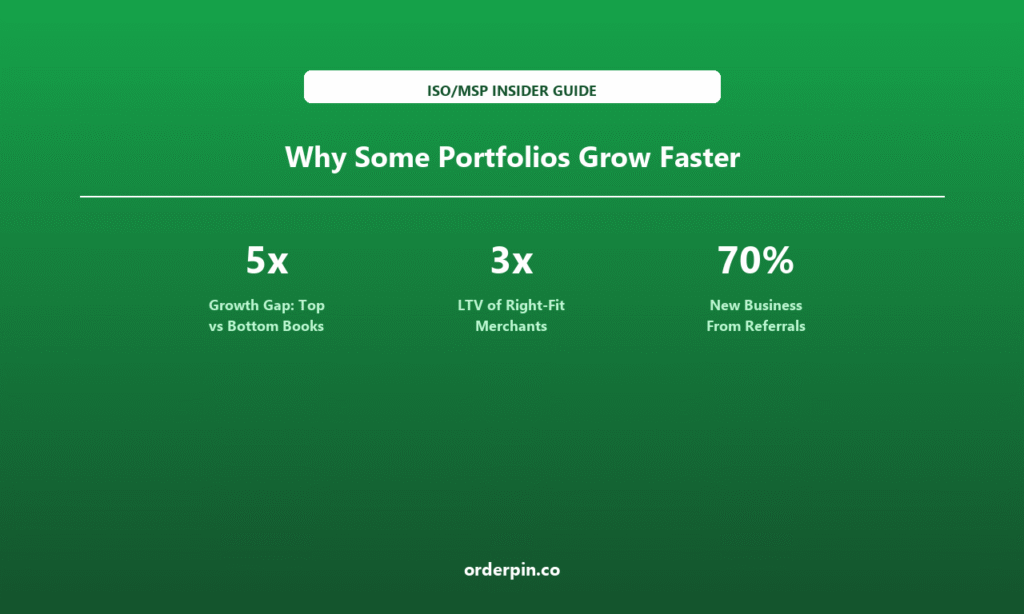
TL;DR — Quick Summary
- Portfolio growth differences are not explained by sales effort: Two ISOs with the same number of reps and the same market can see a multiple-fold difference in growth. The gap comes from what they sell and to whom: the mix of industries in the book, the quality of the referrals feeding it, and the discipline of the merchant profile they target. Sales effort converts; portfolio design compounds.
- Referral quality and merchant-profile selection matter more than coverage: The fastest-growing portfolios are built on referrals from merchants who fit a deliberate profile — right-sized, right-industry, right-technology-appetite. A referred right-fit merchant is worth several times a cold-signed wrong-fit merchant: higher lifetime value, lower churn, more referrals. Growth is not about signing more merchants; it is about signing better ones through better channels.
- Strategic focus beats broad coverage: ISOs that chase every vertical and every deal size grow slowly because their sales motion, service model, and software stack fit nothing well. ISOs that focus — on an industry, a merchant profile, a geography — build density, reputation, and referrals inside that niche, and the focus compounds into a growth engine broad ISOs cannot match.
Bottom Portfolio Books
Right-Fit Merchants
Referrals in Top Books
Why the Growth Gap Exists — and What Causes It
Ask an ISO owner why a competitor with a similar portfolio is growing faster, and the usual answer is that they sell harder, or have better reps, or got lucky. Look closer and a different pattern appears: the faster-growing portfolio is structurally different. It is concentrated in industries with healthy payment economics, fed by referrals rather than cold outreach, and signed around a deliberate merchant profile rather than any deal that moved.
Portfolio growth is not a function of sales velocity alone. It is a function of portfolio design: the mix of industries you serve, the quality of the channel that brings merchants to you, the fit between the merchant and what you sell, and the focus that lets your entire organization — sales, service, software — get good at one thing. Design the portfolio well and growth compounds; design it poorly and every new merchant adds cost instead of value.
This article breaks down the four drivers of the growth gap — industry mix, referral quality, merchant-profile selection, and strategic focus — and explains how an ISO can rebuild its portfolio around them. The goal is not more merchants. It is a book that grows itself.
Well and Poorly Designed Books
Right-Fit Merchant
From Referrals in Fast Books
Broad, Shallow Coverage
1. Industry Mix: The Book You Sign Determines the Curve
Industries have different payment economics: A quick-service restaurant processes daily and needs a POS that runs its kitchen; a seasonal landscaper processes unevenly and needs little. The first is worth multiples of the second in processing volume, software attach, and retention. Portfolios concentrated in high-frequency, software-hungry verticals grow faster per merchant than books built on low-engagement industries — regardless of how hard the reps work.
Mix drives churn, not just revenue: The industry mix also determines how sticky the book is. Merchants whose operations run on software — restaurants, retail, health and beauty — have high switching costs and low churn. Merchants who only swipe cards see payments as a commodity and churn on price. Two portfolios with identical volume can have completely different trajectories simply because of what they are made of.
2. Referral Quality: The Best Books Grow on Referrals
Not all leads are equal — referred leads are worth multiples: A merchant who arrives through a referral from an existing, similar merchant arrives pre-sold, pre-qualified, and pre-educated. They convert faster, churn less, and resemble the merchants who referred them. The top-growth portfolios in the industry are referral-fed: in the fastest books, referrals account for the majority of new business, while slower books depend on cold outreach that converts poorly and churns fast.
Referral quality compounds into a growth engine: Referrals are not random; they cluster. Serve a restaurant owner well and they introduce you to the restaurateurs’ group, the supplier, the neighboring shop. A referral engine — systematically asking happy merchants for introductions — produces a self-reinforcing stream of right-fit prospects. The ISOs that grow fastest did not have better luck; they built the process that makes referrals the majority of their pipeline.
3. Merchant-Profile Selection: Right-Fit Beats More
Every merchant costs the same to serve — but returns differently: Onboarding, support, and management cost roughly the same per merchant whether they process $5,000 or $50,000 a month. The fastest-growing ISOs learned to be selective: they defined the merchant profile that maximizes lifetime value — right size, right industry, right appetite for software — and trained their reps to walk away from deals that do not fit. Signing a wrong-fit merchant is not growth; it is a liability with a logo.
Profile discipline changes the whole organization: When an ISO commits to a merchant profile, every function improves: sales pitches get sharper, onboarding gets templated, support gets relevant, and the software stack gets tailored. Reps stop wasting weeks on deals that will not stick and start compounding the ones that will. The discipline that looks like turning down revenue is actually the highest-yield growth decision an ISO can make.
4. Strategic Focus vs. Broad Coverage
Broad ISOs are average everywhere and best nowhere: An ISO that sells to every industry with a generic pitch competes on price everywhere and wins nowhere. Their merchants churn, their referrals are diffuse, and their reputation never accumulates in any one community. Broad coverage feels like optionality but delivers the worst of both worlds: no density, no word-of-mouth flywheel, and no operational specialization.
Focus creates density, and density creates growth: When an ISO owns a niche — a vertical, a merchant size, a neighborhood — every merchant becomes a referral node, every win builds reputation, and the sales motion becomes repeatable. The focused ISO signs fewer total merchants but keeps more of them, earns more per merchant, and receives more referrals. That is why focused portfolios grow several times faster than broad ones of the same size.
5. Technology Adoption: The Accelerator Behind All Four Drivers
Software is what makes a portfolio designable: Industry mix, referral quality, profile selection, and focus are all easier to execute when the ISO owns the merchant software. A white-label platform lets an ISO tailor the product to its chosen vertical, track referral sources, measure merchant health, and build the switching cost that keeps right-fit merchants in the book. Technology is the lever that turns portfolio strategy from an intention into an operating system.
The compounding gap widens every year: Portfolio design advantages do not stay flat — they compound. The focused, referral-fed, right-fit book grows, which funds more focus and more referrals; the diffuse book churns, which forces more cold acquisition, which costs more. The gap between the two is not a 10% difference in sales productivity. Over a decade it is the difference between owning the market and renting it deal by deal.
Slow-Growth vs Fast-Growth Portfolio Design
| Dimension | Slow-Growth Book | Fast-Growth Book |
|---|---|---|
| Industry Mix | Anything that moves | High-frequency verticals |
| Lead Source | Cold outreach | Referral engine |
| Merchant Selection | Sign every deal | Deliberate right-fit profile |
| Market Posture | Broad and shallow | Focused and dense |
| Software Role | Vendor’s platform | Own white-label platform |
| Growth Engine | More reps, more dials | Compounding referrals + retention |
How OrderPin Lets You Design a Portfolio That Compounds
OrderPin is a white-label POS platform that gives an ISO the levers behind fast portfolio growth: tailor software to the verticals you choose, track where every merchant came from, and build the switching cost that keeps right-fit merchants in your book. It is the technology layer that turns portfolio design from an intention into an operating system.
- Tailor the platform to your focus: Because OrderPin runs under your brand, you can shape the product experience for the specific vertical and merchant profile you have chosen to win — instead of reselling a generic vendor product to everyone.
- Know your referral sources: OrderPin gives you portfolio data, so you can see which merchants came from referrals, which profiles perform, and where your growth actually comes from — then feed the channels that work.
- Make right-fit merchants sticky: When your merchants run their business on your platform, switching costs rise and churn falls — the retention engine that separates compounding books from churning ones.
- Compete on software, not price: A white-label POS moves the conversation from basis points to the value of the platform, so you stop renting merchants on price and start owning them with a product built for your chosen niche.
Frequently Asked Questions
Why do two similar ISOs grow at such different rates?
Because growth is driven by portfolio design, not just sales effort. The faster book is concentrated in industries with healthy payment economics, fed by referrals, signed around a deliberate merchant profile, and focused on a niche it can own. Sales effort converts leads; portfolio design determines how many leads exist, how well they convert, and how long they stay.
How important is industry mix to portfolio growth?
It is one of the largest drivers. Merchants in high-frequency, software-hungry verticals — restaurants, retail, health and beauty — generate more volume, attach more software, and churn less than merchants who only swipe cards. A portfolio’s industry mix determines both its revenue trajectory and its stickiness, independent of how hard the sales team works.
Why are referred merchants worth more than cold leads?
Referred merchants arrive pre-sold and pre-qualified — they trust the merchant who sent them, convert faster, resemble the book’s best merchants, and churn less. A referral engine also compounds: happy merchants introduce peers, creating a self-reinforcing stream of right-fit prospects. In the fastest-growing books, referrals are the majority of new business.
Should an ISO turn down merchants that do not fit its profile?
Yes — that discipline is a growth decision, not a revenue sacrifice. Every merchant costs roughly the same to onboard and support, but right-fit merchants return multiples more in volume, software attach, and retention. Signing wrong-fit merchants dilutes focus, raises churn, and consumes the service capacity that should go to the merchants who compound the book.
What is the fastest way to start improving portfolio growth?
Pick a focus and make referrals a system. Choose the vertical and merchant profile you can win, tailor your pitch and service to it, and build a process that systematically asks happy merchants for introductions. Then put software under it so the platform, the data, and the switching cost work for you — that combination is how books start compounding.
Does owning software really change portfolio growth?
Yes — it is the accelerator behind every other driver. A white-label platform lets you tailor the product to your chosen vertical, track referral sources and merchant health, and build the switching cost that keeps right-fit merchants. Without software ownership, portfolio strategy is an intention; with it, portfolio design becomes an operating system that compounds every year.
Some merchant portfolios grow several times faster than others of the same size — and the gap is not explained by sales effort. It is explained by design: an industry mix of high-frequency, software-hungry merchants; a referral engine that makes referrals the majority of new business; a deliberate merchant-profile discipline that signs right-fit merchants and walks away from the rest; and a strategic focus that builds density, reputation, and compounding referrals inside a niche the ISO can own. Each driver is a choice, not a circumstance. OrderPin is a white-label POS platform that lets an ISO execute all four — tailoring software to its focus, tracking referral sources, and building the switching cost that keeps right-fit merchants — so the portfolio stops growing deal by deal and starts compounding as a designed asset.
About OrderPin
OrderPin is a white-label POS platform built for ISO and MSP partners. We offer full data ownership, flexible pricing, and seamless API integrations to help you build a recurring revenue business under your own brand. Learn more about OrderPin’s white-label solution