
TL;DR — Quick Summary
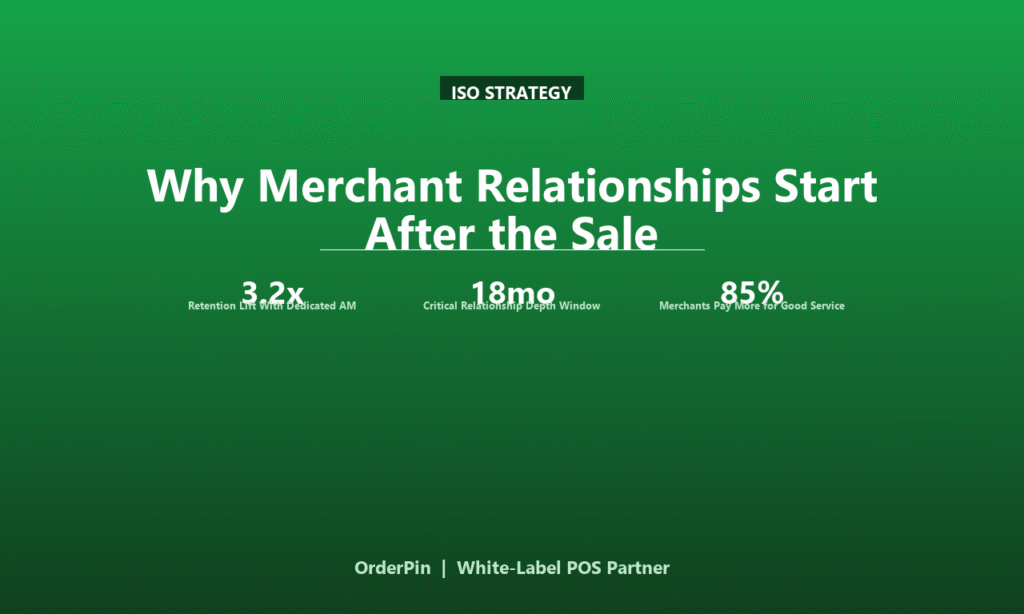
- The sale is the starting line, not the finish: Most ISOs spend 90% of effort acquiring merchants and 10% keeping them — yet post-sale engagement drives the retention and expansion that actually builds enterprise value.
- Relationship depth follows a window: The first 18 months after onboarding are when trust is built or lost; merchants who adopt the full platform in that window retain at 3.2x the rate of those who don’t.
- Service is a pricing weapon: 85% of merchants say they will pay more for a provider that delivers real operational value — so post-sale engagement protects margin, not just retention.
Dedicated Account Mgmt
Building Window
For Good Service
What Is Post-Sale Merchant Engagement — and Why Does It Matter Now?
In most ISOs, the relationship with a merchant is treated as closed the moment the contract is signed. The sales team celebrates, the merchant is handed off to support, and the ISO’s attention moves to the next acquisition. That handoff is where most of the value is quietly lost.
The merchants that stay for a decade, expand their locations, and refer their peers are not the ones who were sold the hardest — they are the ones who were served the best after the sale. Post-sale engagement is the structured practice of building that relationship: onboarding that drives real adoption, check-ins that catch problems early, and value delivery that makes the ISO indispensable to the merchant’s daily operation.
In a market where processing is commoditized and rates are transparent, the relationship after the sale is the last durable moat an ISO has. This is the framework for building it deliberately.
With Dedicated AM
Depth Window
For Good Service
Retain vs Acquire
1. The Sale Is the Starting Line, Not the Finish
ISOs are built to acquire. Comp plans reward new logos, not retained ones. Marketing budgets target prospects, not existing merchants. The entire organizational muscle is pointed at the top of the funnel — and then the merchant is expected to simply stay.
But a merchant who signed a contract has made a decision, not a commitment. The commitment is built in the months that follow — through how quickly they get live, how well the platform fits their operation, and whether anyone from the ISO shows up after the ink dries. The ISOs with the best retention are not the ones with the smoothest pitch; they are the ones with the strongest post-sale follow-through.
The effort imbalance is the root cause:
Acquisition gets the budget: Most ISOs invest the vast majority of time and money in landing merchants, then treat retention as something that happens on its own.
Retention builds the value: The merchants acquired five years ago — expanded, referred, and deeply embedded — are worth far more than this quarter’s new logos. Post-sale engagement is what converts a signed contract into a decade-long asset.
2. The 18-Month Window That Decides Everything
Research on B2B software and service relationships consistently points to the same pattern: the first 18 months after onboarding are the period in which a merchant decides, consciously or not, whether the relationship is a partnership or a vendor relationship they will eventually replace.
Onboarding sets the trajectory: Merchants who get live quickly and adopt the core features in the first quarter build habits around the platform. Slow or partial onboarding leaves them ghost users who churn at the first better offer.
Adoption drives retention: Merchants who adopt the full platform — not just payments, but the operational tools — in that window retain at roughly 3.2x the rate of those who use a single feature.
Trust is earned, not assumed: Every problem solved in the first year is a deposit in the relationship. Every silence is a withdrawal. By month 18, the balance is set.
Expansion starts early: The merchants who later add locations and services are usually the ones whose first-year experience proved the ISO was a partner, not a processor.
Acquisition-Led vs. Relationship-Led ISO
| Factor | Acquisition-Led ISO | Relationship-Led ISO | Winner |
|---|---|---|---|
| Retention | Churn-prone | Sticky, 3.2x lift | Relationship |
| Expansion Revenue | Limited | Strong, recurring | Relationship |
| Margin Defense | Rate-compressed | Value-protected | Relationship |
| Referral Growth | Weak | Active | Relationship |
| Enterprise Value | Volume-dependent | Relationship-dependent | Relationship |
3. Why Service Protects Margin, Not Just Retention
The conventional view is that good service keeps merchants from leaving. That is true — but it understates the financial impact. Strong post-sale relationships also defend margin, which is the harder number to protect in a commoditized market.
When a merchant sees the ISO as a partner who improves their operation — faster service, better reporting, fewer headaches — price stops being the deciding factor. Surveys of small-business payment buyers consistently find that a large majority, around 85%, will pay more for a provider that delivers real operational value. That means service is not a cost center; it is a pricing weapon.
An ISO that competes purely on rate has no margin to give and no loyalty to bank. An ISO that competes on relationship depth can hold rate, expand share of wallet, and absorb competitive pressure that destroys its rate-led peers. The relationship after the sale is what separates the two.
Across B2B service sectors, the consistent finding is that customers who rate post-sale support highly are both more likely to renew and more willing to accept price increases — making service quality a direct driver of both retention and margin.
How OrderPin Helps ISOs Build Post-Sale Relationships
OrderPin is a restaurant POS software ISV that helps independent sales organizations turn a signed contract into a long-term relationship. Because the platform is operational — not just a payment pipe — merchants who adopt it build daily habits around the ISO’s brand. With white-label POS capabilities, full data ownership, and API-first integrations, OrderPin gives ISOs the tools to deliver ongoing value that keeps merchants engaged long after onboarding.
- Operational stickiness: Merchants use the platform every day for orders, reporting, and operations — not just when they process a card.
- White-label program: The relationship is with the ISO’s brand, so post-sale value accrues to the ISO, not a third party.
- Full data ownership: ISOs see adoption and usage signals that flag at-risk merchants before they churn.
- API-first architecture: Integrations with the merchant’s other tools deepen dependence and expand the relationship over time.
4. Building a Post-Sale Engagement Engine
Post-sale engagement is not a feeling — it is a system. The ISOs that retain and expand merchants run a deliberate engagement engine with the same discipline their sales team applies to prospects.
Own the onboarding: A dedicated onboarding motion — not a self-serve link — gets merchants live fast and adoption high in the critical first quarter.
Run a technology-adoption program: Proactively drive merchants to adopt the next feature every quarter. Each adopted feature is a new reason not to leave.
Assign account ownership: Merchants with a named contact retain at 3.2x the rate of those in a faceless queue. Ownership is the single highest-leverage change.
Watch the signals: Log in frequency, feature usage, and support sentiment predict churn months early — when there is still time to act.
5. From Transactions to Trust
The end state of good post-sale engagement is a relationship that no competitor can disrupt with a cheaper rate. The merchant does not think of the ISO as a vendor who processes cards — they think of it as the partner who knows their business.
The shift happens in three stages:
First, the ISO becomes reliable — problems get solved, the platform just works. Second, it becomes valuable — the merchant’s operation is measurably better because of it. Third, it becomes trusted — the merchant asks the ISO for advice on hiring, expansion, and financing, not just payments. By the time an ISO reaches the third stage with a merchant, that merchant is effectively uncompetitive to any rate-led rival.
That is the relationship worth building. It starts the day after the sale — and it is the asset that outlives every individual transaction.
Frequently Asked Questions
Why do merchant relationships matter more after the sale than before?
Before the sale, the relationship is about persuasion; after the sale, it is about value. A merchant who signed a contract has made a decision, not a commitment. The commitment — and the retention, expansion, and referrals that build enterprise value — is earned in the months that follow through onboarding, adoption, and ongoing service. In a commoditized market, the post-sale relationship is the last durable moat.
What is the 18-month critical window?
It is the period after onboarding in which a merchant decides, consciously or not, whether the ISO is a long-term partner or a replaceable vendor. Habits form in the first quarter, adoption of the full platform in the first year drives retention, and trust is largely set by month 18. Merchants who adopt the full platform in this window retain at roughly 3.2x the rate of those who use a single feature — which is why engagement effort should be concentrated early.
How does better service actually protect margin?
When a merchant views the ISO as a partner who improves their operation, price stops being the deciding factor. A large majority of small-business payment buyers — around 85% — say they will pay more for a provider that delivers real operational value. That means strong post-sale service defends rate, expands share of wallet, and absorbs competitive pressure that destroys rate-led competitors who have no loyalty to bank.
What does a post-sale engagement program look like?
It is a system, not a sentiment. Core elements: a dedicated onboarding motion that gets merchants live fast, a technology-adoption program that drives the next feature every quarter, a named account owner for each merchant, and usage signals that flag at-risk accounts early. Merchants with a named contact retain at about 3.2x the rate of those in a faceless support queue — making account ownership the single highest-leverage change an ISO can make.
Can software make merchants stickier after onboarding?
Yes — software is the mechanism for stickiness. A platform that is operational, not just a payment pipe, becomes part of the merchant’s daily routine, so the relationship deepens with every login. White-label branding means that value accrues to the ISO’s brand, full data ownership lets the ISO see adoption signals and act before churn, and API integrations with the merchant’s other tools make the platform progressively harder to replace over time.
The most valuable merchant relationships do not end at the signature — they begin there. ISOs that treat the sale as the finish line hand their own future to churn; the ones that treat it as the starting line build retention, margin, and enterprise value that competitors cannot disrupt with a cheaper rate. The formula is unglamorous but decisive: own the onboarding, drive adoption in the first 18 months, assign account ownership, and deliver operational value every quarter. OrderPin is a restaurant POS software ISV built to make that engagement engine real — an operational, white-label platform that merchants use every day, so the relationship after the sale becomes the ISO’s most durable asset.
About OrderPin
OrderPin is a white-label POS platform built for ISO and MSP partners. We offer full data ownership, flexible pricing, and seamless API integrations to help you build a recurring revenue business under your own brand. Learn more about OrderPin’s white-label solution