
TL;DR — Quick Summary
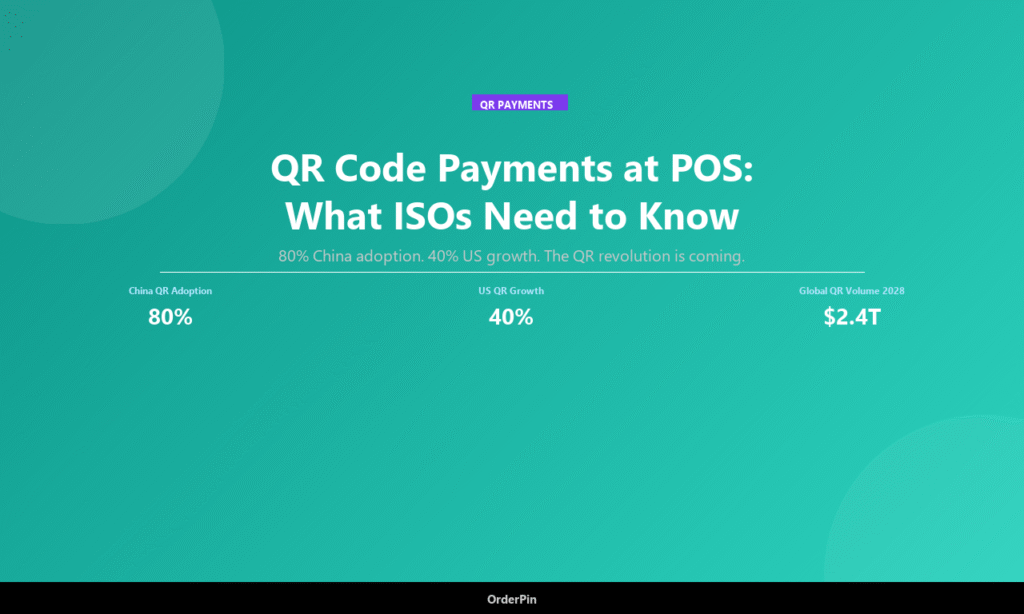
- Key Takeaway 1: QR code payments have achieved 80% merchant adoption in China and are now accelerating in the US, driven by consumer preference for contactless and the rise of merchant-side QR standards from Visa, Mastercard, and PayPal.
- Key Takeaway 2: For ISOs, QR code payments represent a hardware-free acceptance method that works on any smartphone POS — eliminating the card reader cost barrier for price-sensitive merchants.
- Key Takeaway 3: The key to winning with QR payments is supporting both the Alipay/WeChat Pay ecosystem for international tourists and domestic QR standards for US merchant growth.
QR Code Payments: From Chinese Streets to American Main Street
In 2011, Tencent launched WeChat Pay in China with a simple premise: instead of carrying cash or cards, customers would scan a QR code displayed by the merchant to pay. Within five years, QR payments had replaced cash for hundreds of millions of Chinese consumers. Today, 80% of merchants in China accept QR code payments, and the ecosystem processes more than $40 trillion in transactions annually.
In the United States, QR code payments took longer to catch on — largely because the entrenched card network infrastructure (Visa payWave, Mastercard PayPass) offered a similar contactless experience through NFC without requiring customers to open an app. But a confluence of factors is now accelerating QR adoption in the US:
- Consumer preference for mobile: Younger consumers increasingly prefer to pay through their phone’s camera rather than pulling out a card
- International tourism: The US receives 75 million international visitors annually, many of whom come from markets where QR payments are the default — especially Chinese tourists who expect Alipay and WeChat Pay acceptance
- Cost advantages: QR code payments avoid the hardware and per-transaction costs of card terminals, appealing to price-sensitive small merchants
- Card network standardization: Visa, Mastercard, and EMVCo have published QR code payment standards (MFA-QR, https://merchantsquare.mastercard.com/) that enable interoperable QR codes across any participating payment app
How QR Code Payments Work
QR code payments at POS operate on two distinct models:
Merchant-Displayed QR (Static or Dynamic)
The merchant generates a QR code — either static (always showing the same merchant ID and amount) or dynamic (generated fresh for each transaction with the specific amount). The customer scans it with their payment app:
- Merchant displays QR code on a screen, receipt, or printed signage
- Customer opens their payment app (Alipay, WeChat Pay, PayPal, Venmo, Cash App, or any bank app) and selects scan
- Customer scans the QR code with their phone camera
- Payment app reads the encoded merchant details and initiates the transfer
- Authorization and settlement occur through the payment network — same as any card transaction
Customer-Scanned QR (Pay with App)
Alternatively, the merchant’s POS generates a QR code that the customer’s phone scans directly, effectively acting as a contactless card tap. This is the model used by Apple Pay and Google Pay QR modes, where the phone generates a one-time token read by the merchant’s POS camera.
The International Tourist Opportunity
For US merchants in tourism-dependent industries — hotels, restaurants, retail stores, and attractions near major international airports — accepting QR payments from Chinese payment apps is no longer optional. China is the largest source of international tourists to the US, with 2.5 million visitors in 2024. These travelers carry virtually no cash and cannot use their Chinese debit cards at US ATMs without steep fees.
Their default payment methods are:
- WeChat Pay: China’s dominant social and payments super-app, used by 1.3 billion active users
- Alipay: Alibaba’s payment platform, used by 900 million active users
- UnionPay: China’s domestic card network, accepted at many US terminals but not universally
ISOs who can enable WeChat Pay and Alipay acceptance through their payment platform give their merchant clients a significant competitive advantage in serving international customers. In cities like New York, Los Angeles, San Francisco, and Honolulu, merchants near major attractions that accept WeChat Pay and Alipay report 15-25% increases in international customer spending.
QR Payments vs. NFC: A Fair Comparison
ISOs sometimes wonder whether QR code payments compete with NFC contactless (Apple Pay, Google Pay, tap-to-pay card payments). The answer is: they complement each other more than they compete.
QR code advantages:
- Works with any smartphone camera — no NFC hardware required on either device
- Enables real-time display of transaction amount, merchant name, and currency conversion
- Supports peer-to-peer and cross-border payments without card network integration
- Lower merchant processing costs in many international markets
- Easy to print on receipts, business cards, and invoices for remote payments
NFC tap-to-pay advantages:
- Faster transaction time (under 3 seconds vs. 10-15 seconds for QR scan)
- Works without an internet connection on the customer’s device (HCE-based tokens)
- No customer app required — any contactless card or phone wallet works
- More secure (tokenization happens at the NFC hardware level)
- Batteries not required (NFC works even if the customer’s phone is out of battery in some markets)
How ISOs Should Position QR Payment Solutions
For US ISOs targeting small and medium merchants in 2026, the strategic approach is:
- Lead with NFC tap-to-pay as the primary contactless acceptance method — it is faster, more familiar to US consumers, and supported by all modern smartphones and payment terminals.
- Add QR capability as a complementary feature — especially for merchants in tourism corridors, airports, international business districts, or restaurants serving a diverse customer base.
- Enable WeChat Pay and Alipay through a payment aggregator that supports these wallets natively — this is a differentiator that most standard card terminals do not offer.
- Position QR as a marketing and loyalty tool — QR codes can link to merchant landing pages, digital loyalty programs, or social media profiles, adding value beyond payment.
Last updated: May 2026
QR Payments in 2026: The Outlook
The global QR payment market is projected to reach $2.4 trillion in transaction volume by 2028, growing at a compound annual rate of approximately 25%. In the US specifically, QR payment adoption among small businesses has grown 40% over the past two years — driven by the factors outlined above and the maturation of QR payment standards that enable interoperability across different payment apps.
For ISOs, the key insight is this: QR code payments are not replacing card terminals or NFC. They are expanding the universe of acceptable payment methods to include consumers who were previously cash-only or excluded from the card network ecosystem. Every merchant who adds QR payment acceptance to their POS setup is opening their doors to a customer segment that could not pay them before.
The merchants who embrace QR payments now will be positioned to serve the next wave of mobile-first consumers — both domestic and international — before the market becomes saturated with competing solutions. For ISOs who act early, this is a rare opportunity to introduce a genuinely new acceptance category to merchants who thought they had already seen everything payments had to offer.