
TL;DR — Quick Summary
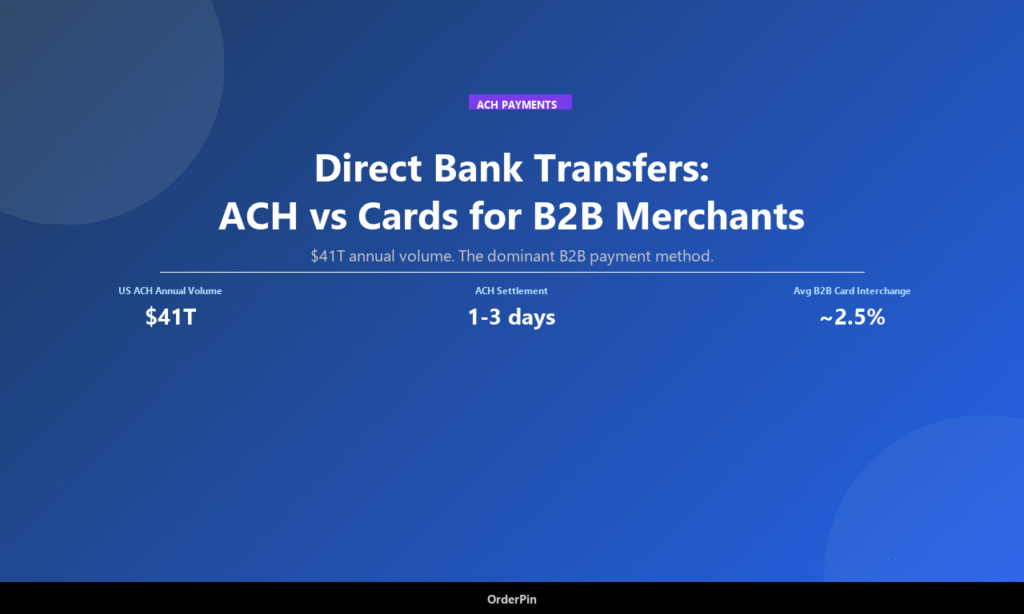
- Key Takeaway 1: ACH processes $41 trillion annually in the US — making it the dominant B2B payment method — but card networks still capture the majority of B2B transactions due to card rewards and chargeback protection.
- Key Takeaway 2: Same-day ACH and RTP (Real-Time Payments) have dramatically narrowed the speed gap between ACH and cards, making bank transfers viable for time-sensitive B2B payments.
- Key Takeaway 3: ISOs who offer both ACH and card processing for B2B merchants can reduce processing costs by up to 1.5% on large-ticket transactions while maintaining payment security and merchant cash flow.
The $41 Trillion Question: Why B2B Payments Are Different
When most people think of payment processing, they picture a consumer buying a coffee or ordering online — a small, card-present transaction that completes in seconds. But the B2B payments landscape tells a very different story: invoices average $1,000 to $50,000, payment terms run 30 to 90 days, and the method of choice is increasingly direct bank transfer via ACH.
The ACH (Automated Clearing House) network processes approximately $41 trillion annually in the United States, dwarfing the consumer card market. For Independent Sales Organizations (ISOs) and Merchant Service Providers (MSPs), understanding the ACH vs. card debate for B2B merchants is essential — because the wrong recommendation can cost your merchant thousands in unnecessary processing fees, while the right one can become a powerful retention and upsell tool.
What Is ACH and How Does It Work?
ACH is an electronic network for financial transactions in the United States. It processes batch payments between bank accounts — direct deposits, payroll, utility payments, and B2B invoices. Unlike the card networks (Visa, Mastercard), ACH is run by two private operators: The Clearing House (TCH) and Nacha.
When a B2B merchant accepts ACH payment:
- Authorization: The customer provides their bank routing and account number (or bank login via Plaid-style verification)
- Initiation: The merchant’s bank sends the ACH entry to the customer’s bank through the ACH network
- Settlement: Funds move from the customer’s bank account to the merchant’s bank account — typically within 1-3 business days for standard ACH
- Same-day ACH: An accelerated option processes transactions the same business day for an additional fee, available since 2017 and significantly expanded in 2021
ACH transaction fees are dramatically lower than card processing fees. Nacha rules allow Originators to charge a fixed fee of up to $5.50 per ACH transaction, though most small-business ACH providers charge between $0.20 and $1.00 per transaction — compared to 2-3% for a typical business credit card.
ACH vs. Cards: A Direct Comparison for B2B Merchants
Processing Costs
ACH wins decisively on cost. A $10,000 B2B invoice paid by ACH might cost $0.50 to $1.00 in processing fees. The same invoice paid by a rewards credit card could cost the merchant $200-$300 in interchange fees (2-3% of $10,000). For high-volume B2B merchants processing hundreds of thousands of dollars monthly, this difference translates directly to the bottom line.
Speed
Cards win on speed. Card payments authorize and settle within seconds. Standard ACH takes 1-3 business days, though same-day ACH has narrowed this gap significantly. For merchants who need immediate cash flow confirmation — such as landlords collecting rent or logistics companies collecting COD — cards still hold an advantage.
Security and Fraud Protection
ACH transactions in the US are governed by NACHA rules that require merchants to obtain explicit authorization from customers. However, ACH does not offer the same chargeback protections as credit cards. If a customer disputes an ACH payment, reversing it requires the customer’s bank to initiate a return — a process that is more cumbersome than a card chargeback from the merchant’s perspective.
For this reason, B2B merchants who deliver services on terms (i.e., before payment) often prefer card acceptance because chargebacks provide a form of payment protection. Merchants who receive payment before delivery (retail, e-commerce) face lower fraud risk with ACH.
Customer Payment Experience
Business buyers increasingly expect multiple payment options. A corporate accounts payable department may prefer to pay via ACH because it aligns with their internal payment approval workflows and avoids credit card rewards “leakage” (rewards dollars they could otherwise earn). Individual B2B buyers may prefer credit cards for the same reason — earning cash back or travel rewards on business purchases.
Record Keeping and Reconciliation
ACH payments include standardized company entry descriptions (CED) that make bank statement reconciliation straightforward. Card payments generate merchant codes and transaction IDs that integrate with most accounting software. Both methods offer excellent digital record-keeping compared to paper checks, which still represent a significant portion of small business B2B payments.
When B2B Merchants Should Switch to ACH
ISOs should counsel B2B merchants to prioritize ACH when:
- Average transaction size exceeds $1,000: The cost savings from ACH interchange (effectively zero) vs. card interchange (2-3%) become substantial at this threshold.
- Payment terms are 30+ days: Same-day ACH makes bank transfers competitive with card settlement speed while maintaining low processing costs.
- The merchant delivers before receiving payment: For service businesses billing after work is completed, offering ACH reduces card processing costs without significant fraud risk.
- Customer base is primarily other businesses: B2B customers are more likely to have established ACH payment infrastructure and prefer direct bank transfers.
When Cards Still Make Sense for B2B
Cards remain the right choice when:
- Speed of funds is critical: E-commerce, retail, and any business where the product or service exchanges hands immediately benefits from card settlement speed.
- Chargeback protection is needed: Merchants delivering on credit terms should weigh the cost of card fees against the value of chargeback rights.
- Customer payment experience matters: Corporate buyers often prefer cards for convenience and rewards; removing this option may slow payment cycles.
- International transactions: ACH only works for US domestic bank transfers; international B2B payments require card networks, wire transfers, or specialized cross-border payment platforms.
How ISOs Should Position ACH vs. Cards for B2B Clients
The ISO’s job is not to choose one or the other — it is to build a hybrid offering that serves the merchant’s specific payment needs. The best B2B processing packages include:
- ACH acceptance as a standard feature: Zero per-transaction cost, integrated into the same merchant dashboard as card processing.
- Same-day ACH for time-sensitive payments: Offered as a premium tier for merchants who need faster settlement.
- Virtual card support: Some B2B payment platforms issue virtual card numbers for invoice payments, generating card interchange revenue for the ISO while giving buyers a card-based payment method.
- Integrated invoicing: A pay-by-link or invoice payment feature that lets B2B merchants send ACH-compatible payment requests alongside card options.
Last updated: May 2026
The Bottom Line
ACH processes $41 trillion annually in the US because it is the most cost-effective way to move money between businesses. For high-ticket B2B merchants, accepting ACH is not optional — it is a competitive necessity. ISOs who can explain the cost savings clearly (a $50,000 invoice costs $50 via ACH vs. $1,000 via card at 2%) and make onboarding frictionless will win and retain these valuable merchant accounts.
The best B2B ISO strategy in 2026 is not ACH vs. cards — it is offering both with intelligent routing that automatically selects the lowest-cost method for each transaction. Merchants win with lower fees. ISOs win with a complete, sticky product offering that reduces churn and drives long-term residuals.