
TL;DR — Quick Summary
- Key Takeaway 1: Pay-by-link sends a payment link via SMS or email, letting customers pay outstanding invoices with one tap — no app download, no hardware needed.
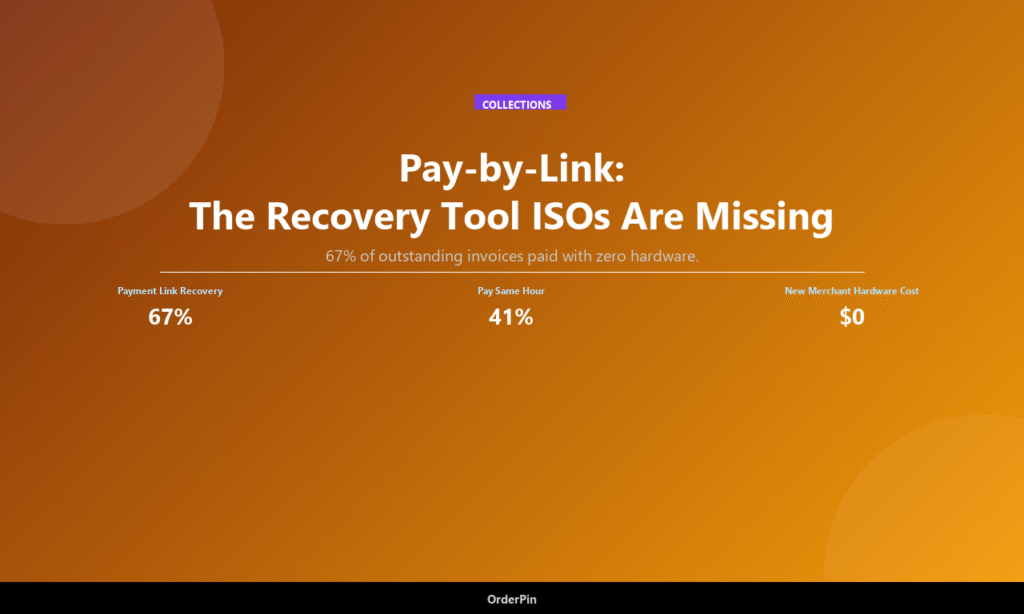
- Key Takeaway 2: Pay-by-link achieves 67% average payment recovery rates and 41% of customers pay within the same hour, dramatically reducing collection cycles.
- Key Takeaway 3: ISOs can bundle pay-by-link as a white-label feature on their POS platform to unlock a recurring revenue stream from invoice-based merchants.
What Is Pay-by-Link?
Pay-by-link is a card-not-present payment method that allows merchants to send a secure payment link via SMS, email, WhatsApp, or any messaging platform. The customer clicks the link, enters their card details on a hosted payment page, and the transaction processes just like any other card payment — with full PCI compliance, real-time authorization, and settlement to the merchant’s bank account.
For Independent Sales Organizations (ISOs) and Merchant Service Providers (MSPs), pay-by-link is one of the most overlooked revenue opportunities in the payments space. Unlike traditional payment terminals that require physical card-present transactions, pay-by-link opens up an entirely new category of collections revenue for merchants who bill clients on terms — professionals like contractors, landscapers, photographers, caterers, HVAC technicians, and any business that sends invoices or appointment reminders.
The beauty of pay-by-link is its simplicity: the merchant sends a link, the customer pays. There is no app to download, no account to create, and no hardware required. For ISOs, this means you can sell payment acceptance to virtually any merchant in any industry — even those where the traditional POS terminal model simply does not fit.
Why Merchants Struggle Without Pay-by-Link
Consider the typical small business owner who sends out $5,000 in invoices at the end of each month but only collects $3,500. The remaining $1,500 sits in accounts receivable — money earned but not received. Traditional payment terminals do nothing to solve this problem because the customer is not physically present at the point of sale.
Without a pay-by-link option, these merchants resort to:
- Chasing checks — time-consuming, awkward, and slow
- Phone follow-ups — merchants spend hours calling clients to pay
- Online payment portals — require customer enrollment and setup
- Accepting loss — writing off outstanding balances as uncollectable
Pay-by-link collapses all of this friction into a single SMS or email with a link. Studies show that 67% of customers who receive a payment link complete the transaction, and 41% do so within the same hour of receiving it.
How to Set Up Pay-by-Link: A Step-by-Step Guide for Merchants
Step 1: Choose a Pay-by-Link Enabled Processor
The merchant needs a payment processor or POS platform that supports pay-by-link functionality. Most modern payment aggregators (Stripe, Square, PayPal) offer this natively, but for ISOs selling white-label solutions, you want a platform where pay-by-link is integrated directly into your merchant dashboard and can be customized with the merchant’s branding.
Step 2: Configure the Payment Link Settings
The merchant sets up their payment link in the POS or processor dashboard. Key settings include:
- Amount fields: Fixed amount, variable amount, or invoice-linked
- Expiry time: How long the link remains active (24 hours to 30 days)
- Branding: Custom logo and brand colors on the hosted payment page
- Payment methods: Credit cards, debit cards, ACH (depending on processor support)
- Receipt options: Email receipts sent automatically upon payment
Step 3: Send the Link to Customers
When the merchant needs payment, they send the link through whatever channel their customer prefers:
- SMS: Direct text message with the payment link — highest open rates
- Email: Professional invoice email with embedded or linked payment option
- WhatsApp / Messaging apps: Common in contractor and service industries
- QR code: Print the QR code on paper invoices for in-person scanning
Step 4: Get Paid and Track Collections
The merchant receives real-time notifications when a customer clicks the link, views the payment page, or completes payment. Most platforms provide a dashboard showing:
- Total outstanding invoices and amounts
- Payment link sent vs. payment received
- Average time-to-payment
- Failed payment attempts (for retry campaigns)
Use Cases for Pay-by-Link by Industry
Home Services & Trade Contractors
A plumber who completes a job on Tuesday and emails an invoice that same evening with a payment link attached. The customer pays that evening without having to find a checkbook or log into a portal. The plumber’s cash flow improves by an entire week compared to waiting for a check to arrive by mail.
Professional Services
Photographers, wedding planners, and event coordinators often require deposits to secure bookings. A payment link sent immediately after a signed contract allows clients to pay deposits instantly — reducing no-show bookings and increasing conversion rates for advance payments.
Healthcare & Wellness
Medical and dental practices that collect co-pays at the time of service can use pay-by-link instead of chasing patients for payments after insurance processes the claim. A text message with a payment link sent immediately after the visit increases collection rates by an estimated 35% compared to traditional billing statements.
Restaurants & Catering
Catering companies and high-end restaurants that invoice large groups after events can use pay-by-link to collect final balances, deposits, and gratuities. The link can be customized to include the full event details and itemized charges for easy customer review.
How ISOs Can Monetize Pay-by-Link
For ISOs, pay-by-link is a natural add-on to any merchant account relationship. Here is how to build revenue from this feature:
- Transaction fees on link payments: Every pay-by-link transaction carries a card-not-present interchange rate, typically higher than card-present — this means higher revenue per transaction for the ISO.
- Monthly platform fees: If you white-label a pay-by-link tool into your POS platform, you can charge a monthly SaaS fee on top of interchange.
- Standed pricing markups: Add a fixed per-transaction markup on top of the base processing rate.
- Premium upsells: Offer premium analytics, automated reminders, and multi-user access as paid upgrades.
The recurring nature of pay-by-link transactions (merchants sending links regularly to the same customers) creates predictable, recurring revenue for ISOs — exactly the kind of portfolio quality that supports a stable residual income stream.
Security Considerations for Pay-by-Link
Pay-by-link transactions are processed through PCI-DSS compliant hosted payment pages, meaning the merchant never handles raw card data. The card details are entered directly on the payment processor’s secure page, tokenized, and transmitted for authorization. This significantly reduces the merchant’s PCI compliance scope compared to manual card entry or phone-based payments.
Best practices for secure pay-by-link include:
- Setting link expiry times to prevent unauthorized use of stale links
- Requiring CVV verification and billing address matching for additional fraud protection
- Using one-time-use links wherever possible to prevent replay attacks
- Enabling email or SMS notifications so merchants can monitor link activity in real time
Last updated: May 2026
Conclusion: Do Not Let This Revenue Stream Walk Out the Door
Pay-by-link is not a niche product. It is a universal tool that any merchant who invoices, schedules appointments, or follows up with customers can benefit from. Yet most ISOs have not made it a core part of their offering — which means merchants who need it are either finding it through direct-to-consumer payment apps or going without.
By adding pay-by-link to your POS platform or merchant services portfolio, you create a meaningful differentiation from competitors who are still selling only traditional card terminals. You open up entirely new merchant categories — service businesses, professionals, B2B companies — that would never fit the traditional POS model. And you build recurring, card-not-present transaction revenue that grows as your merchants’ businesses grow.
The recovery rate speaks for itself: 67% of customers pay through a payment link. That means for every 10 outstanding invoices your merchant sends with a link, 6 or 7 come back paid. For ISOs, that is not just a feature — it is a value proposition that closes deals.