
TL;DR — Quick Summary
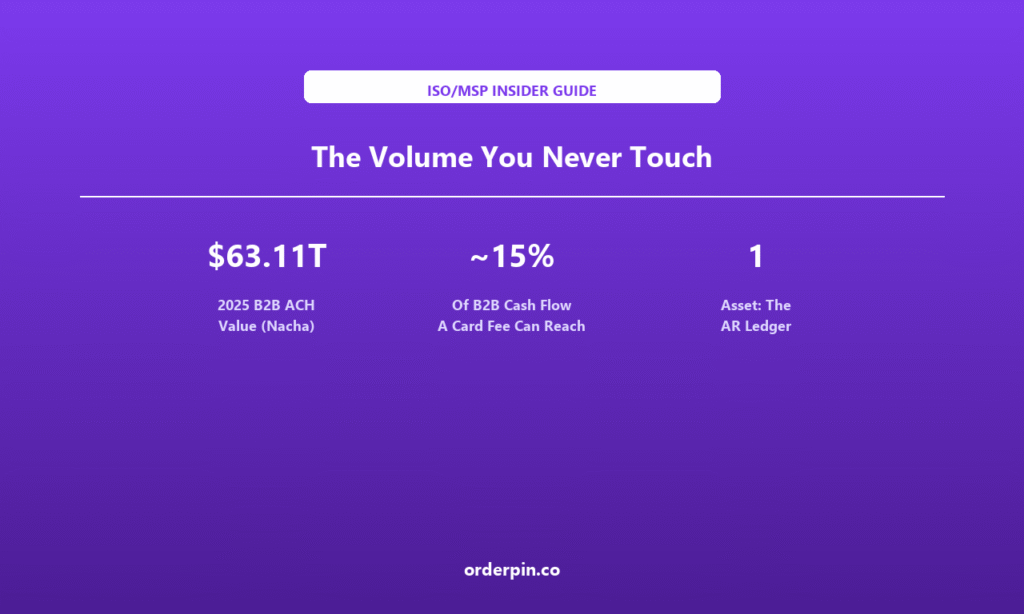
- You boarded the merchant, not their cash flow. In 2025 the ACH Network moved 8.08 billion B2B payments worth $63.11 trillion (Nacha), an average of roughly $7,810 each. A 2.7% card fee on that invoice is $211, so a merchant will never put it on a card — which is exactly why this volume never shows up on your residual statement.
- The money is on the workflow, not the rail. A fixed-fee rail (1,000 regular ACH originations cost $3.50 in base fees under the 2027 FedACH schedule) makes large invoices viable; a percentage fee does not. So the billable line is a per-merchant AR module plus a per-invoice reconciliation fee — recurring software, not basis points.
- It deepens the relationship more than any loyalty programme. An ageing report is opened every morning by the person who controls the account; points are checked occasionally. Put invoice presentment, cash application and ageing on the ledger before the 1 January 2027 check-price rise gives your competitor the opening.
(Nacha, 8.08B payments)
receipts your card residual can reach
rise 5.4% on average
The Volume You Never Touch
You already won the merchant. They run your terminal, your statement reaches their bookkeeper every month, and your residual is a line in their budget. What you almost certainly do not see is the majority of their cash flow: the invoices they send, the terms they extend, the receivables they age, and the payments that arrive days or weeks later by ACH. For a B2B merchant, the card counter is the small end of the business.
This is not a market-size argument and it is not a rail comparison. Both have been made on this blog. It is an accounting observation about one merchant you already serve: if 45% of their sales are on credit and the average B2B ACH payment is about $7,810, then the part of their cash flow that a percentage-based card fee can reach is structurally tiny. A 2.7% fee on that invoice is $211, no buyer will accept it, and no seller will absorb it. So the money travels on a fixed-fee rail — and your platform is not in the room when it does.
The opportunity is therefore not “go win B2B volume”. It is attach the invoice-to-cash workflow to the merchant you already own, charge for the work performed rather than the dollars routed, and in doing so put a daily-use system where a loyalty programme could never go. This briefing gives the data, the unit economics and a 30-day path — with dated primary sources at the bottom and every internal number labelled as modeled arithmetic.
1. One Merchant, Two Cash Flows
Take a single illustrative B2B merchant with $2.0 million in annual receipts. The split below is modeled — a structural estimate for showing the shape of the problem, not a surveyed figure. It uses the widely reported framing that roughly 45% of US B2B sales are made on credit (Atradius, via secondary compilations) and keeps the remainder as card-facing and immediate payment. What matters is not the exact percentages. It is that the ISO’s residual is attached to the narrow left-hand segment only.
Modeled split of $2.0M annual receipts. Scale is 0–100% in equal 25-point steps.
The arithmetic that decides the rail
Put one $7,810 B2B ACH payment — the 2025 average implied by Nacha’s two published totals — next to the two ways of paying for it.
2.7% × $7,810. Neither the buyer nor the seller absorbs this on a routine invoice. The fee grows with the ticket, which is exactly backwards for B2B.
$3.50 base item fees per 1,000 regular ACH originations under the 2027 FedACH schedule, before monthly charges. The cost does not grow with the invoice.
The conclusion is structural, not a preference: percentage pricing cannot reach large invoices, so the volume settles elsewhere. If your only product is a percentage of card volume, you have priced yourself out of 45% of this merchant’s receipts before the conversation starts.
2. What the Primary Sources Actually Say
Three facts are enough to justify the build, and all three are verifiable against an official, dated source. Note what is not here: there is no ISO-level attach benchmark, no AR market-size forecast, and no invented survey. Those do not exist in citable form, so they are not used as facts.
Nacha’s 28 January 2026 release reports 8.08 billion B2B ACH payments worth $63.11 trillion in 2025 — up 9.9% by count and 8.4% by value, and the ACH Network’s “most significant growth segment”. The whole network carried 35.19 billion payments worth $93.00 trillion. Divide one by the other and the average B2B ACH payment is roughly $7,810 — an arithmetic ratio, not a surveyed ticket size, but it is the right order of magnitude for an invoice.
On 12 November 2026 the Federal Reserve announced pricing effective 1 January 2027: an average 5.4% rise in check-service prices, FedReceipt Daily per-item from $0.0005 to $0.0015, earliest premium delivery from 4.8 to 5.8 cents, and standard rejected-item repair from 30 to 36 cents. Commercial checks sent to the Reserve Banks for collection had already fallen 8.7% year-on-year through August. Separately, Nacha will raise the Same Day ACH limit from $1 million to $10 million in September 2027, which makes large invoices eligible for the faster rail.
Under the FedACH schedule, 1,000 regular ACH originations carry $3.50 in base item fees before monthly charges or discounts; 1,000 Same Day ACH payments carry $56.50 and 1,000 FedNow transfers $45. Nacha reported close to 2.3 billion B2B ACH payments in Q3 2026 alone, up 9.7% year-on-year. A fixed per-item rail is precisely what a $7,810 invoice needs — and precisely what a percentage-based card fee does not.
Modeled structural estimates for ordering the opportunity, not measured benchmarks. Replace with your own portfolio split before using any figure in a plan.
| Vertical | Card-reachable | Invoiced / on terms | Typical invoice | ISO reach today |
|---|---|---|---|---|
| Wholesale / distribution | ~5% | ~95% | $8,000 | Very low |
| Construction / trades | ~15% | ~85% | $12,000 | Very low |
| Manufacturing / industrial | ~5% | ~95% | $15,000 | Very low |
| Professional services | ~20% | ~80% | $2,500 | Low |
| Healthcare / dental B2B | ~30% | ~70% | $1,200 | Low |
| Mixed retail + wholesale | ~60% | ~40% | $400 | Medium |
| Restaurant / QSR (reference) | ~95% | ~5% | $60 | High |
Reading the table: the verticals where an ISO’s current reach is lowest are the ones where invoiced volume is highest. That is the whole opportunity, and it needs no new merchant acquisition. Figures are modeled for relative ordering only; no survey or proprietary dataset was used.
It is not another $120 trillion market-size story. We made that argument in B2B Payments: The $120 Trillion Opportunity Your ISO Is Ignoring. This one is not about how large B2B is. It is about the same merchant you already boarded, and the share of that one merchant’s cash flow your statement never sees.
It is not a rail comparison. ACH vs Card Processing and Direct Bank Transfers already settle when a merchant should switch. The buyer’s choice of rail is not the ISO’s product decision. This briefing is about attaching the invoice-to-cash workflow that sits in front of whichever rail wins.
It is not a restatement of “there is untapped revenue in your portfolio”. That piece made the strategic case for mining the book. This one gives a single, specific line item — accounts receivable — with a unit-economics model and a 30-day attach path. If you want the general argument, read that; if you want the build, read on.
It is not an invitation to hold funds, lend, or become a money transmitter. We drew that boundary in Stablecoins and the GENIUS Act: exposure follows whoever holds the money at a given step. Invoice presentment, reconciliation and ageing reporting are data services. Custody, credit and settlement are not, and the two should stay in different boxes on your architecture diagram.
It is not an industry benchmark. There is no citable dataset for “ISO AR attach rate”, so we will not invent one. Every merchant-level figure below is a modeled structural estimate or illustrative arithmetic on stated inputs, labelled as such. The dated facts come from the primary sources listed at the bottom; the model is there to show the shape of the decision, not to predict a result.
3. Why Basis Points Break on a $7,810 Invoice
The instinct is to price a new volume line the way the existing book is priced: take the dollars routed, multiply by a small percentage, and book the residual. On B2B invoices that instinct produces a number that is large on a slide and close to zero in the bank. There are only three defensible positions.
| Position | What you do | Revenue effect | Compliance load |
|---|---|---|---|
| Keep charging basis points | Price the B2B relationship as a percentage of routed volume, as you do for card residual | Looks large on a spreadsheet ($270M × 0.35% = $945K) but is uncollectable: a 2.7% card fee on a $7,810 invoice is $211 and the merchant will not pay it | Low — but the revenue never lands |
| Attach the workflow | Bill a per-merchant AR module plus a per-invoice reconciliation fee; the rail is the merchant’s choice | Recurring software revenue on the book you already have, independent of ticket size | Bounded — data quality, reconciliation and support, not scheme rules |
| Own the ledger | Become the merchant’s system of record for receivables, ageing and cash application | Highest switching cost and the deepest data, slowest to land | High — accounting integrations, audit expectations, possible custody questions |
An illustrative model, not a forecast
Use the same book as the rest of this series: 5,000 merchants, $68 NMGM, $600 CAC (the margin benchmark), 85% software gross margin and the 30% attach baseline. Suppose 20% of the book is B2B or mixed (1,000 merchants) and 30% of those attach (300 merchants). Price the AR workflow at $49 per merchant per month plus $0.35 per reconciled invoice, at 40 invoices per merchant per month.
Now the comparison that matters. Those 300 merchants carry roughly $270 million of annual invoiced volume (300 × the modeled $900K). At 35 bps that looks like $945,000 — nearly four times the workflow fee. It is also uncollectable, because the merchant will not pay $211 to receive a $7,810 invoice. The bigger number is the wrong number. The billable unit is not dollars routed; it is invoices reconciled and merchants on the ledger.
On the other side of the ledger, the churn work put one point of annual attrition at about $71,000 (churn benchmarks). Holding 1.5 points is roughly $106,500 of margin not lost — and an ageing report in daily use is a far more plausible retention mechanism than a points balance. Every input above is an assumption; replace it with your own. The structural point survives: recurring fee ∝ invoices reconciled + merchants on ledger, not ∝ dollars routed.
4. Why It Deepens the Relationship More Than Any Loyalty Programme
A loyalty programme is a marketing layer sitting on top of the transaction. It is optional, occasionally used, and removable without breaking anything. An AR ledger is an operating system of record. The comparison is not about features; it is about what a competitor would have to unpick to replace you.
| Dimension | Loyalty programme | AR / invoice-to-cash |
|---|---|---|
| Who opens it | A consumer, occasionally | The controller, every morning |
| Data it holds | Visit frequency and points | Who owes the merchant, on what terms, and who pays late |
| Revenue line | Often bundled or free | Explicit per-merchant software fee, countable in attach |
| To switch away | Turn off a campaign | Re-migrate an open ledger, re-issue payment links, retrain the bookkeeper |
| Churn mechanism | Weak — easy to drop quietly | Strong — the merchant’s own customers are configured around it |
This is also why the retention-based compensation design and support tiering matter here: a daily-use AR module generates a different support profile from a terminal, and the account owner should be paid for keeping it, not just for signing it.
The person who signs is the person who uses it
Processing is bought by an owner once a year and noticed only when it breaks. An ageing report is opened by the controller before the first coffee. That shifts the relationship from a price conversation at renewal to a daily dependency — the same dynamic behind why confidence beats satisfaction. Confidence comes from a system that is correct every morning, not from a satisfaction survey.
The data is the defensible part
Invoice history tells you who a merchant’s customers are, how reliably they pay, and how the business survives a slow quarter. That is the same “who holds the record” question we asked about funds under the GENIUS Act and product data in agentic commerce. Hold the ledger and you have a software line, a diligence export and a switching cost. Leave it in a spreadsheet and you have none of the three.
The clock is commercial, not regulatory
Nothing here has a compliance deadline. What it has is a dated, quotable reason to start the conversation: the Fed’s check-service prices rise on 1 January 2027, and Nacha raises the Same Day ACH limit in September 2027. Both are inputs you can bring to a merchant who still reconciles paper. That is a commercial window, and unlike a statute it will simply be taken by whoever shows up first.
5. The 30-Day Attach Path
Five things to attach, in build order, each with a target, a named owner and an observable completion test. This is the Playbook half of the briefing: if a line below has no owner or no test, it is a wish rather than a step.
What This Playbook Delivers
In 30 days: one B2B segment of your existing book, a workflow-priced AR module, and 20 merchants reconciling on your ledger — with no new logo and no custody.
Invoice presentment
The merchant creates and sends an invoice from the same system that runs the counter. It carries a stable invoice ID, terms, due date and a payment link — not a PDF emailed from a personal account.
Payment acceptance on a fixed-fee rail
The link accepts ACH (and card for small tickets) without the ISO taking custody of funds. Settlement lands in the merchant’s account; the ISO records the event, not the money.
Automatic cash application
The incoming payment is matched to the open invoice without a human retyping a reference number. Unmatched items go to a queue with an owner, not into a month-end spreadsheet.
Ageing and the daily view
A controller opens the platform each morning to see what is current, 30, 60 and 90+ days past due. This is the daily-use moment that a loyalty programme never gets.
Put it on the bill as software
The AR module is a recurring per-merchant line plus a per-invoice reconciliation fee — never a basis-point charge. It counts toward attach only when it is actually billed.
The 30-day calendar, with owners
From the merchants you already board, flag the ones that invoice on terms. Do not go looking for new logos; the whole thesis is that the volume is already in your portfolio.
Fix a per-merchant monthly fee and a per-invoice reconciliation fee. Model it on 300 attached merchants and 40 invoices per month, then replace both with your own numbers.
Pick merchants with real invoice volume, not friendly ones. Measure auto-match rate, exceptions per 100 invoices and whether the controller actually opens the ageing view.
Add the AR line to the statement, put the revenue in the attach numerator, and report recurring gross profit share next to it so a rising percentage cannot hide flat dollars.
6. Three Ways This Fails — and the Decision Checklist
These are the three failure modes seen when a processing business tries to sell a workflow product. All three are avoidable at the design stage and expensive to unwind after a pilot.
The moment the AR line is expressed as a percentage of routed volume, you have rebuilt the ceiling you were trying to remove. $270M of invoice volume at 35 bps looks like $945K on a slide and collects almost nothing, because nobody pays $211 to receive $7,810. Charge for the workflow performed — invoices reconciled, merchants on the ledger — not for the dollars that pass through it.
If the invoice ID in presentment is not the ID the payment event carries, cash application degrades into manual matching and the controller quietly returns to a spreadsheet. Define one identifier across invoice, payment, reconciliation and ageing before a single integration is wired. The same discipline as the four data foundations, applied one ledger earlier.
A free pilot counts as an attached merchant in a careless numerator and as nothing in the bank. Only billed, active merchants count; report recurring gross profit share alongside attach. Otherwise a rising percentage masks flat dollars — the exact failure mode flagged in the attach-rate analysis.
The decision checklist
Three columns. The third matters as much as the first: most of the wasted effort here comes from work that should never have been started.
- Count what you never touch. For your 20 largest B2B-coded merchants, ask one question: what share of their receipts arrive as an invoice on terms? Most ISOs cannot answer it today, and the answer is usually the majority.
- Reprice one line. Take a single merchant and write two versions of next year’s statement: one with a volume-based fee, one with a per-merchant plus per-invoice fee. Put both in front of a controller and see which one survives contact with a $7,810 invoice.
- Draw the custody boundary. On one page, mark where money sits at each step of invoice-to-cash. If your platform ever holds a balance, stop and get advice before shipping — that is a different business with different obligations.
- Name the owner of reconciliation. Unmatched payments are not a rounding difference; they are the defect that sends the controller back to a spreadsheet. Give the queue an owner and a reason code.
- 1 January 2027. The Fed’s check-service price increase takes effect — a concrete, quotable reason to raise the topic with a merchant who still reconciles paper.
- September 2027. The Same Day ACH limit rises from $1 million to $10 million, making larger invoices eligible for the faster rail.
- Request-for-Payment support. Whether your acquirer exposes RFP messages, and whether accounting platforms open their AR data to ISO-grade integrations.
- Do not lead with market size. “$120 trillion” is a macro number; the merchant in front of you cares whether this month’s 40 invoices reconcile without retyping.
- Do not take custody to chase a spread. Holding the money changes your obligations. Keep presentment, reconciliation and reporting on your side of the line.
- Do not promise a DSO reduction you cannot attribute. Faster reconciliation is an input you control; a shorter collection cycle depends on the merchant’s customers. Commit to the input, as we set out in the onboarding SLA.
7. Exposure by Role
The exposure is uneven and it does not sit where the announcements suggest. The party with the most to lose is the one whose statement currently shows only a processing line, not the one operating the rail.
| Role | What creates the exposure | What it costs | Bites on |
|---|---|---|---|
| Wholesale / distribution merchant | 95% of receipts arrive as invoiced, on-terms payments; the ISO only ever priced the card counter | The entire receivable ledger lives in a spreadsheet or an accounting add-on the ISO does not sell | Already today |
| Construction / trades merchant | Progress billings, retainage and $12,000 invoices have no card path at all | No line on the statement, no daily use of the ISO’s system, no reason not to switch | 2027 renewals |
| Mixed retail + wholesale merchant | A card-present counter and an invoice book sit in the same business but on two different systems | The ISO is visible in one and absent in the other; the competitor who joins them wins the whole account | Q1 2027 |
| ISO / white-label platform | Has merchant-level processing data but no invoice, ageing or cash-application record | Attach stalls at a ceiling, and the merchant relationship stays one-dimensional | 2027 planning |
| Acquirer / processor | Fixed-fee ACH and Same Day ACH are available but never surfaced to ISO partners as a product | The volume migrates to a neobank or an accounting platform instead of through the ISO | Now |
Why the ISO, Not the Rail, Owns This
The merchant will choose their own rail, their own bank and their own accounting package. None of those parties has an incentive to make the ISO’s statement more useful. The party that already holds a merchant-level view across the book is the only one that can add an invoice-to-cash line to it. That is an argument about where the record sits, not about which vendor has the best B2B roadmap.
- One merchant-level record. The same per-merchant view that produces NMGM is where the “invoices on terms” flag belongs.
- Software revenue on the same ledger. The AR line only counts if it is billed — the attach-rate discipline applies unchanged.
- An export for diligence. When a buyer asks how deep the merchant relationship goes, a ledger export answers in an hour rather than a quarter — the same payoff as the product-data inventory in the last briefing.
Frequently Asked Questions
How large is the B2B volume an ISO is missing, in real numbers?
Nacha reports 8.08 billion B2B ACH payments worth $63.11 trillion in 2025, up 9.9% by count and 8.4% by value — the network’s fastest-growing significant segment. That is a national figure, not a per-ISO one. The relevant number for you is smaller and local: for your 20 largest B2B-coded merchants, what share of receipts arrive as an invoice on terms? Industry summaries put US B2B credit sales near 45%, but treat that as an order-of-magnitude framing, not an audited benchmark.
Why not just put these invoices on a card and earn the interchange?
Because of the arithmetic. The 2025 B2B ACH average implied by Nacha’s two published totals is roughly $7,810; a 2.7% card fee on that is about $211, while 1,000 regular ACH originations carry $3.50 in base item fees under the 2027 FedACH schedule. Neither side of a routine invoice will pay the percentage. The volume does not avoid cards by preference; it avoids them by cost structure.
Do I need to hold funds, lend, or become a money transmitter to do this?
Not for the workflow described here. Invoice presentment, payment-link acceptance, automatic cash application and ageing reporting are data services; settlement can land directly in the merchant’s account. The moment your platform holds a balance, extends credit or exchanges value, the analysis changes — that is the boundary drawn in the GENIUS Act briefing. Map where money sits at each step and get qualified advice before crossing it. This is not legal or compliance advice.
How should an AR module be priced?
As software, not as basis points: a per-merchant monthly fee plus a per-invoice reconciliation fee, independent of ticket size. In the illustrative model, 300 attached merchants at $49 per month plus $0.35 per reconciled invoice (40 per month) produce $226,800 a year of recurring revenue and $192,780 of gross profit at 85% margin. Pricing the same book at 35 bps on $270M looks like $945,000 and collects almost nothing. Every input is an assumption; replace it with your own.
Does this count toward software attach rate and valuation?
Yes, if it is billed. An AR module is recurring software, so it belongs in the attach numerator only when there is a software fee on the merchant’s statement — free pilots and enabled-but-unbilled merchants are excluded. Report recurring gross profit share alongside attach, exactly as in the attach analysis, so a higher percentage cannot mask flat dollars.
Is there a compliance deadline I should be working to?
No. There is no statute requiring an ISO to attach AR. The dated items are commercial: the Federal Reserve’s check-service prices rise 5.4% on average from 1 January 2027 (announced 12 November 2026), and Nacha raises the Same Day ACH limit from $1 million to $10 million in September 2027. Both give you a concrete reason to open the conversation. Treat them as a window, not a filing date.
You already won the merchant; you never touched most of their cash flow. In 2025 the ACH Network moved 8.08 billion B2B payments worth $63.11 trillion, and a percentage-based card fee cannot reach a $7,810 invoice without charging $211 for the privilege. The billable unit is therefore not dollars routed — it is invoices reconciled and merchants on the ledger. Price it as software, keep custody on the merchant’s side of the line, and put an ageing report in front of the controller every morning. That is a deeper relationship than any loyalty programme, and the 1 January 2027 check-price rise is as good a reason as any to start. OrderPin is an ISV focused on restaurant POS software.
Sources, Dates & What Would Change This
Primary sources — official and dated: Nacha, “Same Day ACH and Business-to-Business Payments Propel ACH Network Volume Growth in 2025”, 28 January 2026 (full-year 2025: 35.2 billion payments / $93 trillion; B2B ~8.1 billion, +~10%); Nacha, ACH Network Volume and Value Statistics (2025 B2B: 8.08 billion payments / $63.11 trillion, +9.9% count / +8.4% value; Same Day B2B 415.05 million / $2.31 trillion; Q3 2026 update linked from the same page); Federal Reserve Board, pricing announcement, 12 November 2026 and the 2027 fee schedule (check services +5.4% average from 1 January 2027; FedReceipt, premium delivery and rejected-item repair changes); FRBservices, 2027 FedACH and FedNow fee schedules (1,000 regular ACH originations $3.50 base item fees; Same Day ACH $56.50; FedNow $45).
Treated as secondary, not as binding figures: PYMNTS, “Fed Raises Check Fees as Businesses Keep Writing Them”, 13 November 2026, reporting PYMNTS Intelligence surveys (59% of businesses used checks for B2B in the preceding year, 57% used regular ACH, checks were 13% of payments on average in that sample; 54% of long-established SMBs’ vendor payments by check). Industry compilations of accounts-receivable statistics citing Federal Reserve Z.1 (US nonfinancial trade receivables ~$7.93 trillion, Q2 2026), the Credit Research Foundation (median DSO ~37.5 days, Q2 2026) and Atradius (about 45% of US B2B sales on credit) are secondary summaries. They are used here only for order-of-magnitude framing, not as audited figures. Verify against the publisher before quoting any of them.
Status as of 19 November 2026: The ACH Network is growing B2B volume at roughly 10% a year, checks face a dated price increase on 1 January 2027, and fixed per-item rails are already priced for large invoices. None of this requires a new regulation or a new protocol. There is still no citable benchmark for ISO-level AR attach rate, and we have not manufactured one.
What would change this analysis: The September 2027 Same Day ACH limit increase to $10 million; broad Request-for-Payment support from acquirers; a major accounting platform opening AR data to ISO-grade integrations; or a scheme rule that reclassifies invoice presentment or reconciliation as a regulated activity. If one lands, re-run the section 7 checklist rather than rewriting the strategy.
Not a forecast, not legal advice: The $7,810 average is an arithmetic ratio of two published 2025 totals, not a measured ticket size. The vertical split table, the 20%/30% attach assumptions, the $49 per-merchant and $0.35 per-invoice fees, and every resulting dollar figure in section 3 are modeled or illustrative arithmetic on stated inputs — replace them with your own. Custody, lending, money-transmission and accounting-integration questions depend on facts and on how your processor applies the rules; validate them with your acquirer and counsel.
Assumptions & How to Adapt
Nature of the content: this is an operating framework, not a data report. The targets below are recommended starting values derived from where the work characteristically accumulates, not measured benchmarks — no survey or proprietary dataset was used, and no figure should be quoted as an industry statistic.
How to adapt: run the starting values for one quarter, then replace them with your own measured P50 and set the target slightly ahead of it.
About OrderPin
OrderPin is a white-label POS platform built for ISO and MSP partners. We offer full data ownership, flexible pricing, and seamless API integrations to help you build a recurring revenue business under your own brand. Learn more about OrderPin’s white-label solution