
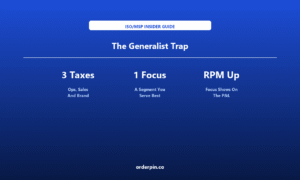

The Hidden Cost of Being “Everything to Everyone”
A generalist ISO pays a tax in three places: operational complexity (every vertical needs different support and integrations), sales inefficiency (a diluted pitch that resonates with no one), and brand confusion (merchants cannot say what the ISO is best at). This article quantifies the generalist tax and argues that market focus is a margin decision, not a marketing one.
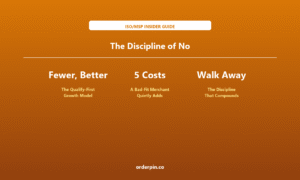
The Discipline of Saying No: Why Merchant Qualification Beats Merchant Volume
The ISOs that grow fastest are the ones that turn away the most merchants. Volume-first ISOs sign every logo, then absorb the support cost, churn, and concentration risk of bad-fit merchants. This article argues that merchant qualification – a defined ideal-merchant profile, a disqualification checklist, and the discipline to walk away – is the highest-leverage growth decision an ISO makes, and shows how to quantify the true cost of a bad-fit merchant.
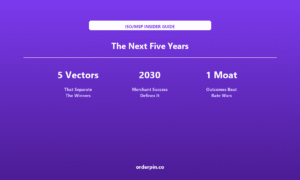
What Will Differentiate Merchant Service Providers Over the Next Five Years?
The differentiators of 2030 will not be rate or processing speed – they will be technology depth, service experience, industry specialization, partnerships, and above all merchant success. As the dumb-pipe trap and the specialization shift play out, the ISOs that win will be measured by merchant outcomes, not processing volume. This article synthesizes the five differentiation vectors into a forward framework and argues merchant success is the through-line that ties them together.
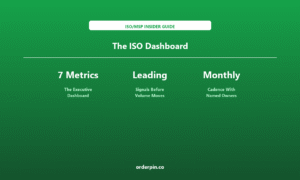
The ISO Executive Dashboard: 7 Metrics That Predict Portfolio Health
Most ISO executives track processing volume and call it analysis. Volume is a lagging indicator. The metrics that predict portfolio health are leading: merchant attrition rate, net new merchant acquisition, revenue per merchant, portfolio concentration, partner performance, support-driven churn, and software penetration. This article builds the monthly executive dashboard – what to measure, the benchmarks, and how to act on leading signals before they show up in volume.
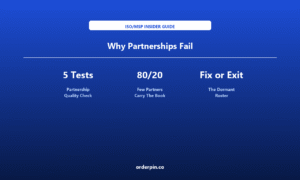
Why Some ISO Partnerships Generate Millions While Others Fail
Partnership quantity is easy; partnership quality is rare. The partnerships that print money share incentive alignment, real partner enablement, clear communication, strategic fit, and long-term commitment. The ones that fail treat partners as lead sources and starve them after signing. This article is a diagnostic of partnership quality for ISOs — what separates a million-dollar referral, ISA, or bank partnership from a dead one, and how to fix the broken ones.
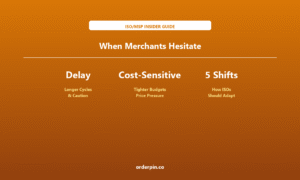
How Economic Uncertainty Changes Merchant Buying Behavior
When the economy turns uncertain, merchants delay decisions, scrutinize every dollar, and shift from growth spending to cost control. ISOs that keep selling the same way lose deals to hesitation. This article covers how economic uncertainty changes merchant buying behavior — longer cycles, cost sensitivity, and risk aversion — and how ISOs should adapt their sales strategy, messaging, and offer structure to win in a cautious market.
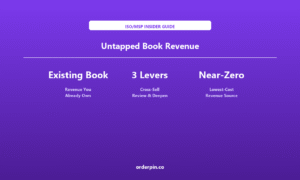
The Untapped Revenue Inside Your Existing Merchant Portfolio
Most ISOs chase the next logo while ignoring the revenue already sitting in their book. Cross-selling the platform depth merchants are not using, running periodic business reviews, and deepening the relationship surface far more low-cost revenue than net-new acquisition. This article covers how to find and monetize the untapped revenue inside an existing merchant portfolio, distinct from the customer-success motion in AC17 and the support-driven retention in AC46.

Why Merchant Service Companies Should Think Like Private Equity Firms
ISOs optimize for merchant count and volume, not for portfolio return. PE firms optimize for portfolio quality, unit economics, and long-term value creation. This article maps how ISOs can borrow PE discipline: portfolio optimization, per-merchant ROI, operational efficiency, and long-term value creation, distinguishing the operating approach from the exit-multiple angle covered in AC12.
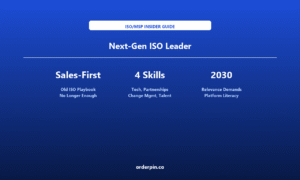
The Next Generation of ISO Leaders: The Skills That Will Matter Most
Running a successful ISO used to require sales hustle and processor relationships. The next generation needs technology literacy (evaluating platforms, APIs, AI tools), strategic partnership judgment, change management, and talent development, because the business is shifting from relationship-driven to platform-and-data-driven. This article maps the skill evolution every ISO leader should build now to stay relevant through 2030.