
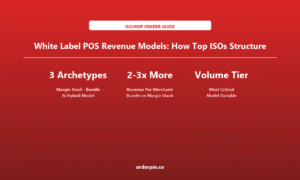

White Label POS Revenue Models: How Top ISOs Structure Their Business
The most profitable white label ISOs do not structure revenue the same way — and understanding the three dominant revenue archetypes is the first step to choosing the right model for your business. This article profiles the Margin Stack model (interchange markup plus SaaS add-ons), the Bundle model (platform fee plus transaction revenue share plus professional services), and the Hybrid model (referral-based volume for one segment, white label for strategic accounts). Includes benchmarks by merchant volume tier and a model selection flowchart based on ISO size, technical capacity, and merchant profile — so an ISO can make the revenue model decision with a framework, not a guess.
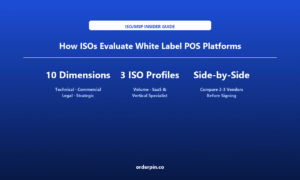
How ISOs Evaluate White Label POS Platforms: A 10-Dimension Scoring Framework
No weighted scoring matrix exists in the white label POS market that ISOs can use to compare vendors systematically before committing. This article provides one: 10 evaluation dimensions (API breadth, uptime reliability, pricing transparency, white label flexibility, AI feature depth, onboarding speed, support tier, exit terms, PCI DSS scope, and strategic roadmap) weighted by ISO use case — volume-focused, SaaS-focused, or vertical-specialist — with a printable scoring worksheet. ISOs use this framework to compare two to three vendors side by side and make the decision with data rather than a demo.
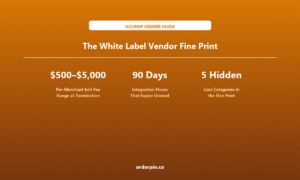
The White Label Vendor Fine Print: Integration, Exit & Data-Migration Fees They Don’t Lead With
The headline API pricing looks good. The fine print has the real numbers. This article reveals the hidden costs white label vendors typically do not disclose upfront: per-transaction fees that jump above volume thresholds, minimum transaction guarantees that bill you for volume you did not process, integration hours that expire in 90 days, exit fees ranging $500–$5,000 per merchant on termination, and data export formats that require vendor assistance to decode. It includes a ‘total cost of exit’ calculation worksheet so an ISO can model the true cost of leaving before committing to a platform.
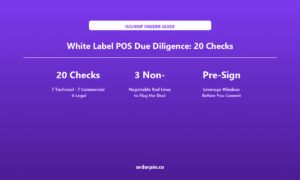
White Label POS Due Diligence: 20 Technical, Commercial & Legal Checks Before You Sign
Most ISOs sign white label POS agreements without a structured checklist — and discover the gaps only after they are locked in. This article provides 20 due diligence checks across three dimensions: Technical (API completeness, sandbox access, uptime SLA, data export portability, webhook reliability, mobile SDK, PCI-DSS posture), Commercial (MRR minimums, rate-card transparency, escalation clauses, exit fees, renegotiation windows, volume-tier pricing, hardware lock-in), and Legal (IP ownership, DPA, PCI liability allocation, indemnification, termination enforceability, non-compete scope). Use it as a pre-signature checklist before committing your merchant base to any platform.
AI Features in White Label POS: What to Evaluate in 2026
Every white label POS vendor claims AI capabilities. Not all AI is equal: rule-based automation dressed as AI, cloud API calls to third-party LLMs, and native model training on merchant data are fundamentally different technologies with fundamentally different costs, performance characteristics, and contract implications. This article gives ISOs a framework for evaluating white label POS AI capabilities in 2026 — what to test, what questions to ask, what contract language protects the ISO, and how to distinguish genuine AI from marketing AI.
White Label vs Build in 2026: The Real Cost Reality for ISOs
A year ago, the build vs white label decision for an ISO was a capital and engineering question. In 2026, AI code generation tools have shifted the calculus: building an MVP POS has become 60–70% cheaper and 2–3x faster than it was in 2024. This article re-runs the build vs white label decision with current tooling costs, realistic timelines, the hidden maintenance burden of self-built software, the strategic cost of not owning the merchant relationship, and what has actually changed in the last 18 months that every ISO considering a build decision should know.
The White Label POS Unit Economics Model: CAC, LTV & Margin vs Pure Processing
Most ISOs model their business in interchange spread. Few model it in white label. This article builds the complete unit economics model for a white label POS business: customer acquisition cost by channel, merchant lifetime value by vertical and volume tier, gross margin on SaaS revenue versus transaction fees alone, payback period, and the 5-year NPV comparison between a white label portfolio and a pure-processing book. Includes benchmarks by annual merchant volume ($50K–$500K+) and a framework you can adapt for your own numbers.
How to Migrate from Clover or Square to a White Label POS Platform
Migrating a Clover or Square merchant account to a white label POS platform is not just a software swap — it is a relationship decision. This playbook walks ISOs through every step: assessing readiness, exporting data from Clover and Square, structuring the migration conversation with merchants, managing the 90-day window, and minimizing churn during the transition. Includes a ready-to-use migration checklist and a sample conversion incentive structure.
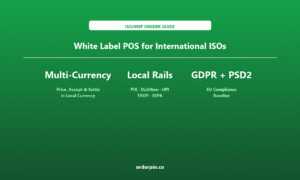
White Label POS for International ISOs: Multi-Currency, Cross-Border & Local Compliance
Most white label POS content is written for US ISOs — but the demand is global. This guide covers what changes when you take a white label POS across borders: multi-currency settlement, cross-border acquiring, local payment methods like PIX, DuitNow, UPI, and TROY, and the compliance reality of GDPR, PSD2, VAT, and data residency. It also shows how international ISOs structure white label agreements so the model travels instead of stalling in its first foreign market.